How to make a cup of coffee at home
Whatever method you use, good coffee comes down to four things: the amount of coffee, the grind, the water temperature and how long the water and coffee are in contact. The National Coffee Association (NCA) gives these starting points [2][3]:
- Drip or filter machine. 1 to 2 tablespoons of ground coffee for every 6 oz (about 180 ml) of water, a medium grind, and about 5 minutes of contact between coffee and water. Fill the reservoir, put the filter and coffee in the basket and let the machine run.
- French press (cafetière). 1 g of coffee to between 10 and 16 g of water, a coarse grind, and water at about 93°C, which is roughly what you get by letting a boiled kettle rest for 30 seconds. Stir after a minute, put the lid on, steep for about three more minutes, then press and pour straight away, because coffee left on the grounds keeps brewing and turns bitter.
- Pour-over. The same idea as a drip machine, but you pour the water over the grounds by hand. It takes more skill and usually makes one cup at a time, but you can adjust it to your taste [2].
The NCA’s general rule for grinding is that the longer coffee is in contact with water, the coarser the grind should be: fine for espresso, which brews in seconds, medium for drip and pour-over, coarse for French press and cold brew [2]. If your coffee tastes bitter, try a coarser grind. If it tastes flat or watery, go finer. Use fresh, cold water, filtered if your tap water tastes strongly, and grind the beans just before brewing if you can.
How to make espresso, the base of most café drinks
Espresso is a brewing method rather than a type of bean. Hot water is forced under high pressure through finely ground, tightly packed coffee, giving a small, concentrated shot of about 25 to 30 ml in around 25 to 30 seconds, with a layer of light brown foam called crema on top [4]. You need an espresso machine (or a stovetop moka pot for something close to it).
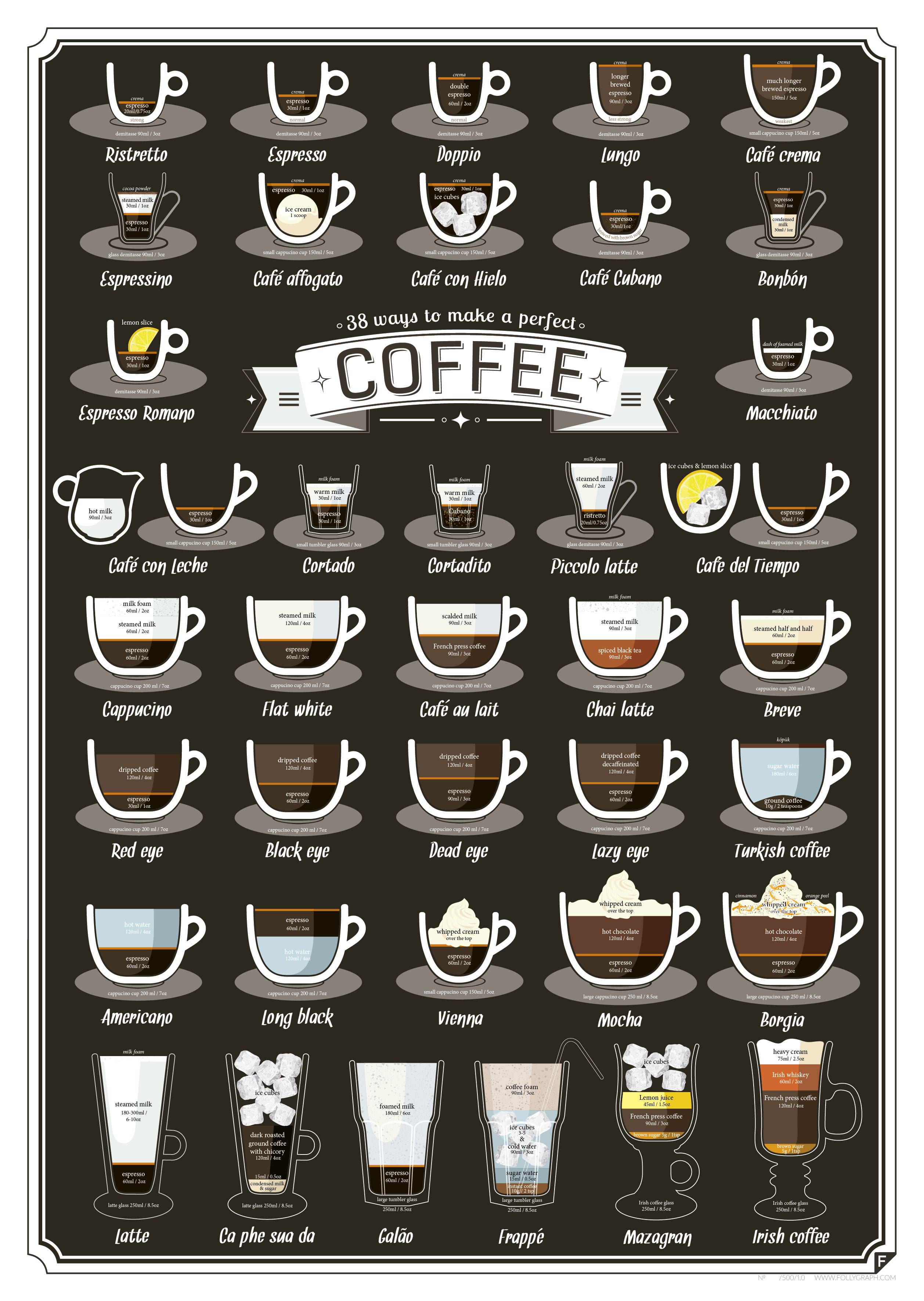
Changing only the amount of water gives you a family of drinks. Follygraph’s poster above uses 20 ml for a ristretto, 30 ml for a normal espresso, 60 ml for a doppio (a double), 90 ml for a lungo and 150 ml for a café crema, getting weaker as the water goes up [1]. Standard definitions agree on the order: a ristretto uses the same coffee with about half the water, and a lungo about twice the water [5][6]. The poster’s 90 ml lungo is on the long side; Wikipedia gives a typical lungo as 50 to 70 ml [6].
Small additions turn a shot into a different drink. A macchiato is espresso “stained” with a dash of foamed milk, an espresso Romano is served with a slice of lemon, an affogato is a shot poured over a scoop of ice cream, and a café Cubano is espresso brewed with brown sugar so it comes out sweet [1][13].
How to make a cappuccino, flat white and latte
Milk coffees mostly differ in how much milk goes in and how much of it is foam. These are the proportions on the poster, which match the usual café versions [1]:
| Drink | Espresso | Milk | Typical cup |
|---|---|---|---|
| Cortado | 30 ml | 30 ml warm milk, a little foam | Small glass, 90 ml |
| Piccolo latte | 20 ml ristretto | 60 ml steamed milk, foam | Glass demitasse, 90 ml |
| Cappuccino | 60 ml | 60 ml steamed milk, 60 ml foam | Cup, 200 ml |
| Flat white | 60 ml | 120 ml steamed milk, very little foam | Cup, 200 ml |
| Latte | 60 ml | 180 to 300 ml steamed milk, foam on top | Glass, 250 ml |
| Galão | 60 ml | 180 ml foamed milk | Tall glass, 250 ml |
A cappuccino is the smaller, foamier drink, roughly equal parts espresso, steamed milk and foam [7]. A latte is mostly steamed milk with a thin layer of foam and is traditionally served in a glass [8]. A flat white sits between them: a stronger coffee taste than a latte because it has more espresso for the amount of milk. Coffee roaster Anette Moldvaer describes it as a double espresso (about 50 ml) with roughly 130 ml of steamed milk [9]. A cortado is espresso cut with about the same amount of warm milk [10], and the Portuguese galão is about one quarter coffee to three quarters foamed milk [12].
To steam milk at home without a machine, heat it gently and froth it with a hand frother or by pumping it in a French press. For a breve, the poster swaps the milk for steamed half and half, which makes a richer drink [1].
Americano, long black and other black coffees
An americano and a long black use the same two ingredients in a different order. An americano adds hot water to espresso, while a long black pours a double espresso on top of hot water, which keeps more of the crema [11][14]. The poster’s americano is 60 ml of espresso to 120 ml of water, a 1 to 2 ratio [1]. Wikipedia gives a more dilute 1 to 3 or 1 to 4 [11], so add more water if you want something closer to filter coffee strength.
If you want more caffeine, add espresso to filter coffee. On the poster a red eye is 120 ml of drip coffee with one 30 ml shot, a black eye has two shots and a dead eye three. A lazy eye uses decaffeinated drip coffee with two shots [1].
Turkish coffee is different again: very finely ground coffee is boiled with water and sugar in a small pot called a cezve and served unfiltered, with the grounds settling in the cup [17]. The poster uses 10 g (2 teaspoons) of coffee to 180 ml of water [1].
Coffee with chocolate, cream or alcohol
- Mocha. A double espresso with 120 ml of hot chocolate, topped with whipped cream [1].
- Borgia. A mocha finished with whipped cream, cinnamon and orange peel [1].
- Vienna. A double espresso under a cap of whipped cream [1].
- Espressino. Equal parts espresso and steamed milk with cocoa powder, 30 ml each [1].
- Irish coffee. Hot coffee, Irish whiskey and sugar with a layer of cream floated on top [16]. The poster uses 120 ml of French press coffee, 60 ml of whiskey, a teaspoon of brown sugar and 75 ml of heavy cream [1].
Iced coffee and coffee from around the world
Several drinks on the poster are national specialities. Vietnamese iced coffee (cà phê sữa đá) is dark roast coffee dripped through a small metal phin filter onto sweetened condensed milk and poured over ice [15]. Spain’s bonbón is espresso layered over condensed milk, and café con hielo is a shot served with a glass of ice to pour it over [1].
The Greek frappé, created in Thessaloniki in 1957, is made with instant coffee shaken or blended with water, sugar and ice until it foams [18]. The poster’s version is 10 g of instant coffee, a little sugar water and 90 ml of cold water over 3 to 5 ice cubes [1]. A mazagran mixes French press coffee with lemon juice, brown sugar and ice [1].
For any iced coffee, brew it stronger than usual, because the ice dilutes it as it melts.
Questions about how to make coffee
What is the difference between espresso and coffee?
Espresso is a way of brewing coffee, not a different bean. Water is forced through finely ground coffee under high pressure, which gives a small, concentrated shot of about 25 to 30 ml with crema on top [4]. Drip, pour-over and French press coffee let water pass through or sit with coarser grounds for several minutes, giving a larger, milder cup.
How long should I brew my coffee?
The NCA suggests about 5 minutes of contact for drip coffee and about 4 minutes for a French press [2][3]. Espresso takes only around 25 to 30 seconds [4]. Brewing for much longer than these times tends to make coffee bitter.
How much coffee do I need for 2 cups?
Using the NCA’s ratio of 1 to 2 tablespoons per 6 oz of water, two 6 oz cups need 2 to 4 tablespoons of ground coffee [2]. Start in the middle and adjust to taste. If you weigh it, a ratio of about 1 g of coffee to 16 g of water is a common starting point for a French press [3].
What is the difference between a cappuccino and a latte?
A cappuccino is the smaller drink, with roughly equal parts espresso, steamed milk and thick foam. A latte has much more steamed milk and only a thin layer of foam, so it tastes milder [7][8].
Which coffee drink is the strongest?
For taste, a ristretto is the most concentrated, because it uses the same coffee as an espresso with about half the water [5]. For total caffeine, drinks that add espresso to filter coffee, such as the dead eye with three shots, carry the most of the drinks on the poster [1].
Sources
- Follygraph, 38 Ways To Make a Perfect Coffee, poster (product page).
- National Coffee Association, Drip coffee.
- National Coffee Association, French press coffee.
- Wikipedia, Espresso.
- Wikipedia, Ristretto.
- Wikipedia, Lungo.
- Wikipedia, Cappuccino.
- Wikipedia, Latte.
- Wikipedia, Flat white.
- Wikipedia, Cortado.
- Wikipedia, Caffè americano.
- Wikipedia, Galão.
- Wikipedia, Cuban espresso.
- Wikipedia, Long black.
- Wikipedia, Vietnamese iced coffee.
- Wikipedia, Irish coffee.
- Wikipedia, Turkish coffee.
- Wikipedia, Frappé coffee.
Last reviewed 2 November 2026