Cigar basics: what you need to know
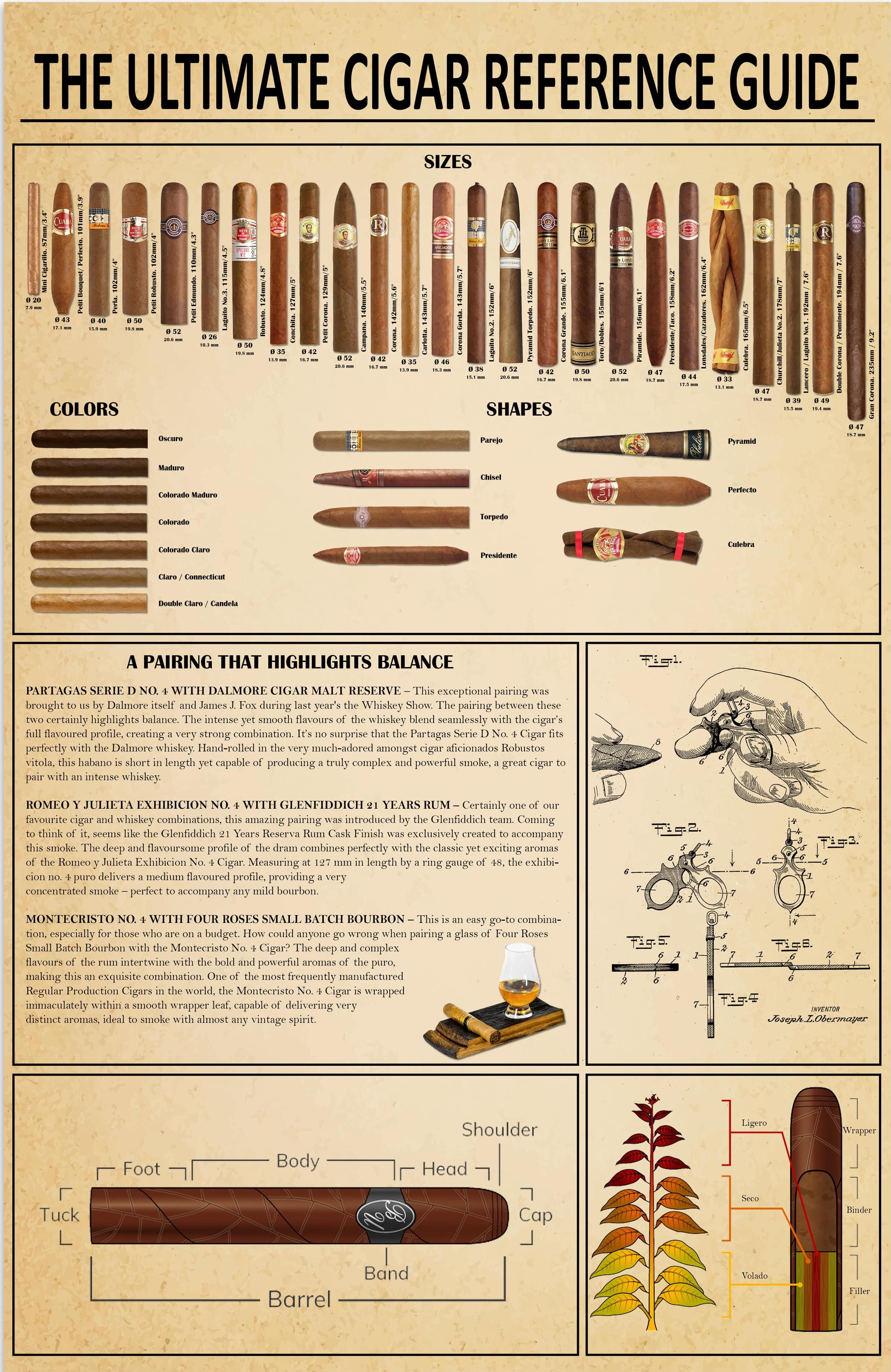
Cigars are described by four things: size (length and ring gauge), shape, wrapper colour and how they are built from different leaves. A cigar’s size name, or vitola, tells you roughly how long it will last; its ring gauge tells you how thick it is; the wrapper shade gives a clue to its flavour; and the blend of filler leaves sets its strength. The reference poster above brings all of these together on one page, from 25 common sizes to the parts of a cigar and the leaves of the tobacco plant.
Cigar sizes and ring gauge explained
Every cigar size has two measurements. Length is given in inches or millimetres. Ring gauge is the diameter, measured in 64ths of an inch, so a 64 ring gauge cigar is one inch across, and a 50 ring gauge cigar is 50/64 of an inch, about 19.8 mm (our arithmetic).
Some of the most common sizes, with the figures the poster gives:
| Size | Length | Ring gauge |
|---|---|---|
| Petit Corona | 129 mm (about 5 in) | 42 |
| Robusto | 124 mm (about 4.9 in) | 50 |
| Corona | 142 mm (5.6 in) | 42 |
| Toro | 155 mm (6.1 in) | 50 |
| Pyramid / Piramide | 152 to 156 mm (6 to 6.1 in) | 52 |
| Lonsdale | 162 mm (6.4 in) | 44 |
| Churchill | 178 mm (7 in) | 47 |
| Lancero | 192 mm (7.6 in) | 39 |
| Double Corona | 194 mm (7.6 in) | 49 |
Treat these as typical rather than fixed. Factories and brands vary their measurements, which is why you will see slightly different figures for the same size name. For example, Cigar Aficionado gives a true Cuban lancero as 7 1/2 inches by 38 ring gauge [1], a touch shorter and thinner than the poster.
Cigar shapes
Most cigars are parejos: straight-sided cylinders with a rounded head. Anything that is not straight-sided belongs to the figurado family [1]:
- Torpedo and pyramid: the head tapers to a point.
- Perfecto: tapered at both ends and often bulging in the middle. Perfectos were very popular in the early 1900s, and the Fuente family helped bring them back with its Hemingway line in 1983 [1].
- Presidente: tapered at both ends, like a large perfecto.
- Chisel: a flattened, wedge-shaped head.
- Culebra: three long, thin cigars braided together and tied with a ribbon.
Cigar wrapper colours
The wrapper is the outer leaf and the part you see. Its colour depends on the leaf and how it was cured and fermented; mulling, for instance, darkens and sweetens tobacco [1]. From darkest to lightest, the traditional shades are:
- Oscuro: the blackest wrapper, darker than maduro [1].
- Maduro: very dark brown.
- Colorado Maduro: dark reddish-brown.
- Colorado: reddish-brown. Cuban-seed wrappers with a reddish tint are also called rosado [1].
- Colorado Claro: medium tan-brown.
- Claro / Connecticut: light tan.
- Double Claro / Candela: pale green. Candela wrappers were so popular in the US in the mid-20th century that they were known as American Market Selection [1].
Parts of a cigar
- Head: the end you put in your mouth, closed with a small piece of leaf called the cap. This is the part you cut.
- Shoulder: where the head curves into the body. Cut above it, or the wrapper can unravel.
- Body or barrel: the main length of the cigar.
- Foot: the end you light. A tuck is a foot left uncut and rounded.
- Band: the paper ring that shows the brand.
The head is secured with a flavourless vegetable glue called gomma [1].
What is inside a cigar?
A premium cigar has three layers: the filler at the core, a binder leaf that holds the filler together, and the wrapper on the outside. The filler is usually a blend of leaves from different heights on the tobacco plant:
- Ligero from the top of the plant gets the most sun and is the strongest.
- Seco from the middle is medium in strength and adds aroma.
- Volado from the bottom gets the least sun, so it is mild, but it burns well and is used to help the cigar stay lit [1].
How the filler is rolled matters too. Simply stacking leaves like the pages of a book (booking) is quick but can spoil the draw; folding them in an S shape (accordion) or rolling each one into a tube (entubado) leaves more channels for smoke [1].
How to store cigars
Cigars need humidity. Cigar Aficionado recommends keeping them in a humidor at 65 to 70% relative humidity, checked with a digital hygrometer, which is far more accurate than an analogue one [1].
Are cigars safer than cigarettes?
No. The US National Cancer Institute says cigar smoke, like cigarette smoke, contains toxic and cancer-causing chemicals, and that cigar smoking causes cancer of the mouth, larynx, oesophagus and lung [2]. A large cigar can contain between 5 and 20 grams of tobacco, and some premium cigars hold as much as a whole pack of cigarettes [2]. Cigars are addictive even if you do not inhale, because nicotine is absorbed through the lining of the mouth [2]. The CDC says no tobacco product is safe [3].
Questions about cigars
What does ring gauge mean on a cigar?
Ring gauge is a cigar’s diameter in 64ths of an inch. A 50 ring gauge cigar is 50/64 of an inch across, about 19.8 mm.
What are the most common cigar sizes?
There is no official count, but the robusto, corona, toro and Churchill are among the best-known sizes. The poster gives the robusto as 124 mm by 50 ring gauge and the Churchill as 178 mm by 47.
What is the difference between maduro and Connecticut wrappers?
Maduro is a very dark brown wrapper, second only to oscuro in darkness [1]. Connecticut (claro) is a light tan wrapper near the pale end of the scale.
Which end of a cigar do you cut?
The head, the closed end. Cut through the cap, just above the shoulder where the head starts to curve.
What is a figurado cigar?
Any cigar that is not straight-sided, such as a torpedo, pyramid or perfecto [1].
Sources
- Cigar Aficionado, The ABCs of Cigars.
- US National Cancer Institute, Cigar Smoking and Cancer.
- US Centers for Disease Control and Prevention, Cigars.
Last reviewed 2 November 2026