Which European countries have the best English?
English proficiency in Europe is the best in the world among countries where English is not the native language. On the 2025 EF English Proficiency Index, the 12 highest scoring countries are all European, led by the Netherlands with 624, then Croatia, Austria, Germany and Norway. Only Turkey and Azerbaijan are rated low.
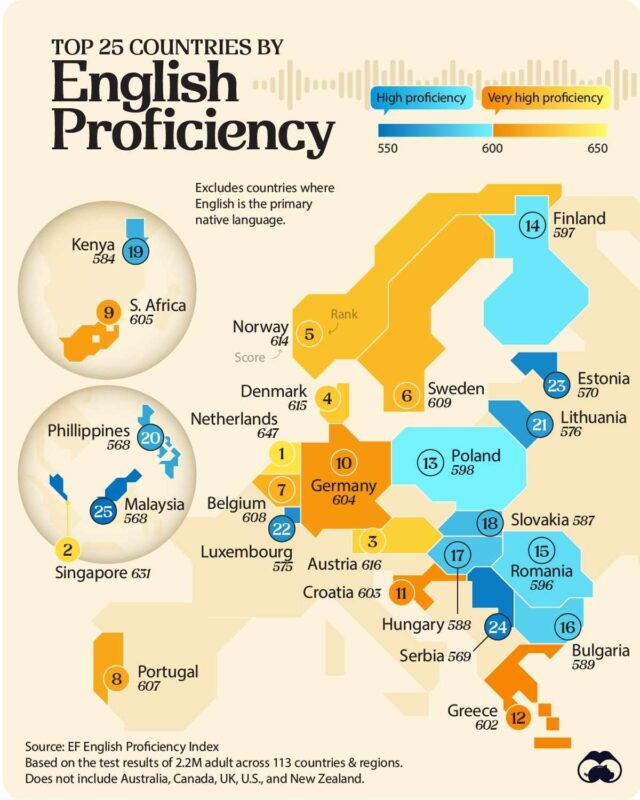
The index is published each year by EF Education First, the language school company, from the results of its free online English test [1]. It only ranks countries where English is not the main native language, so the UK and Ireland are left out. The map by EF Education First shows the 2024 edition, when the Netherlands scored 636 and Norway, Sweden, Croatia and Portugal made up the rest of the top five [2].
A new edition is due on 18 November 2026 [3]. Until then, the 2025 index below is the latest.
English proficiency in Europe by country
Northern and central Europe score highest, the big Romance-language countries and the former Soviet states sit in the middle, and Turkey and Azerbaijan come last. The table lists the 37 European countries in the 2025 index, with their world rank among 123 countries and regions and their 2024 score [1][2].
| Rank in Europe | Country | Score, 2025 | Band | World rank | Score, 2024 |
|---|---|---|---|---|---|
| 1 | Netherlands | 624 | Very high | 1 | 636 |
| 2 | Croatia | 617 | Very high | 2 | 607 |
| 3 | Austria | 616 | Very high | 3 | 600 |
| 4 | Germany | 615 | Very high | 4 | 598 |
| 5 | Norway | 613 | Very high | 5 | 610 |
| 6 | Portugal | 612 | Very high | 6 | 605 |
| 7 | Denmark | 611 | Very high | 7 | 603 |
| 8 | Sweden | 609 | Very high | 8 | 608 |
| 9 | Belgium | 608 | Very high | 9 | 592 |
| 10 | Slovakia | 606 | Very high | 10 | 584 |
| 11 | Romania | 605 | Very high | 11 | 593 |
| 12 | Finland | 603 | Very high | 12 | 590 |
| 13 | Poland | 600 | Very high | 15 | 588 |
| 14 | Latvia | 598 | High | 16 | Not ranked |
| 15 | North Macedonia | 595 | High | 17 | Not ranked |
| 16 | Bulgaria | 594 | High | 18 | 586 |
| 17 | Greece | 592 | High | 20 | 602 |
| 18 | Bosnia and Herzegovina | 591 | High | 21 | Not ranked |
| 19 | Hungary | 590 | High | 22 | 585 |
| 20 | Czechia | 582 | High | 23 | 567 |
| 21 | Serbia | 578 | High | 25 | 568 |
| 22 | Switzerland | 564 | High | 30 | 550 |
| 23 | Estonia | 561 | High | 31 | 578 |
| 24 | Lithuania | 543 | Moderate | 33 | 569 |
| 25 | Georgia | 541 | Moderate | 35 | 543 |
| 26 | Spain | 540 | Moderate | 36 | 538 |
| 27 | France | 539 | Moderate | 38 | 524 |
| 28 | Cyprus | 537 | Moderate | 40 | 558 |
| 29 | Belarus | 533 | Moderate | 41 | 539 |
| 30 | Albania | 532 | Moderate | 42 | 533 |
| 31 | Moldova | 531 | Moderate | 43 | 536 |
| 32 | Ukraine | 526 | Moderate | 45 | 535 |
| 33 | Russia | 521 | Moderate | 49 | 532 |
| 34 | Armenia | 515 | Moderate | 56 | 537 |
| 35 | Italy | 513 | Moderate | 59 | 528 |
| 36 | Turkey | 488 | Low | 71 | 497 |
| 37 | Azerbaijan | 454 | Low | 94 | 462 |
EF places each country in one of five bands. A score of 600 or more is very high, 550 to 599 high, 500 to 549 moderate, 450 to 499 low and under 450 very low [2]. No European country is in the very low band.
Countries with the highest English proficiency
The Netherlands topped both the 2024 and 2025 editions, with 636 and then 624 [1][2]. The rest of the very high band is a mix of the Nordic countries (Norway, Denmark, Sweden and Finland), German speakers (Austria and Germany), Belgium, Portugal, Croatia and three central and eastern European countries, Slovakia, Romania and Poland [1].
EF’s description of the very high band is being able to use nuanced language in social situations, read advanced texts with ease and negotiate a contract with a fluent English speaker [1]. In practice that means you can get by in English almost anywhere in these countries, especially with younger people and in cities.
Where English is less widely spoken
Spain (540), France (539) and Italy (513) are all in the moderate band, well below their smaller neighbours [1]. Italy is the lowest-ranked EU country in the index, 59th in the world [1]. EF’s description of moderate proficiency is being able to take part in meetings in your own field, understand song lyrics and write professional emails on familiar subjects [1]. In tourist areas you will usually find English speakers, but outside them it is less reliable.
Russia, Ukraine, Belarus, Moldova, Georgia and Armenia are also moderate, along with Albania and Cyprus [1]. Turkey (488, 71st in the world) and Azerbaijan (454, 94th) are the only European countries in the low band [1].
English-speaking countries in Europe
English is the main native language in only two European countries, the UK and Ireland, which together have more than 71 million people [4]. English is also an official language in Malta, alongside Maltese, and in Gibraltar, the Isle of Man, Jersey and Guernsey [4]. None of these is ranked in the EF index because it measures English as a foreign language.
Outside those places, most English in Europe is spoken as a second language. It is by far the most widely spoken foreign language in the EU, according to Eurostat [5]. If you want a country where you can live or travel in English without learning the local language, the Netherlands, the Nordic countries, Austria and Germany are the safest picks on the index.
How English proficiency in Europe has changed
EF says Europe’s average English level plateaued in 2025, while the EU improved slightly, with France, Germany and Poland gaining more than average [1]. Slovakia (up 22 points), Germany (up 17), Austria and Belgium (both up 16) and France (up 15) gained most against 2024 [1][2]. Lithuania fell 26 points, Armenia 22, Cyprus 21 and Italy 15 [1][2]. Latvia, North Macedonia and Bosnia and Herzegovina, which were not on the 2024 Europe list, are ranked in 2025, all in the high band, while Luxembourg is no longer listed [1][2].
Treat year-on-year changes with some care. The 2025 edition is the first to include speaking and writing results as well as reading and listening, so part of the movement could come from the new test rather than a real change [1]. EF also notes that European countries have some of the widest gaps in the world between their reading and listening skills and their speaking and writing [1].
The 2024 report found English proficiency in Europe had declined slightly, with a 13 point fall in the EU against 2 points for the whole European region [2].
How the EF English Proficiency Index works
The 2025 index is based on the results of 2.2 million adults who took the EF Standard English Test (EF SET) in 2024 [1]. Country scores are a three-year rolling average and the bands are linked to the Common European Framework of Reference for Languages, with all countries falling between levels A2 and C1 [1].
EF is open about the limits. The people who take the test choose to, and they are mostly working adults and young adults with internet access, so the results are not a representative sample of each country’s population [1]. The index is a useful guide to how countries compare, but not a precise measure of how many people in a country speak English.
Questions about English proficiency in Europe
Which European country speaks the best English?
The Netherlands, with a score of 624 on the 2025 EF English Proficiency Index, first in the world among countries where English is not the native language [1]. Croatia (617), Austria (616), Germany (615) and Norway (613) are next [1].
What are the English-speaking countries in Europe?
The UK and Ireland, where English is the main native language, and Malta, where it is an official language alongside Maltese [4]. Gibraltar, the Isle of Man, Jersey and Guernsey also use English officially [4].
Which European country has the lowest English proficiency?
Azerbaijan, with 454 in 2025, 94th in the world and in the low band. Turkey is the only other European country rated low, with 488 [1]. Among EU members, Italy is lowest at 513 [1].
Do people in Germany speak English?
Mostly yes. Germany is 4th in the world on the 2025 index with 615, in the very high band, up from 598 in 2024 [1][2].
Is English widely spoken in France, Spain and Italy?
Less than in northern Europe. All three are in the moderate band, with Spain at 540, France at 539 and Italy at 513 in 2025 [1].
What is the EF English Proficiency Index?
A yearly ranking of countries and regions by the English skills of adults who take EF’s free online test. The 2025 edition covers 123 countries and regions and 2.2 million test takers [1].
Sources
- EF Education First, EF English Proficiency Index 2025, report PDF (Europe rankings on page 20).
- EF Education First, EF English Proficiency Index 2024, report PDF. The original source of the infographic.
- EF Education First, EF EPI, notice of the 2026 edition release date.
- Wikipedia, English language in Europe.
- Eurostat, Foreign language skills statistics.
Last reviewed 13 November 2026