What are the main game genres?
Game genres group video games by how they play rather than by setting or story. The main ones are action, shooter, fighting, action-adventure, adventure, role-playing (RPG), simulation, strategy, sports and racing, and puzzle. Newer genres such as battle royale and multiplayer online battle arena (MOBA) games grew out of these, and most modern games mix two or more.
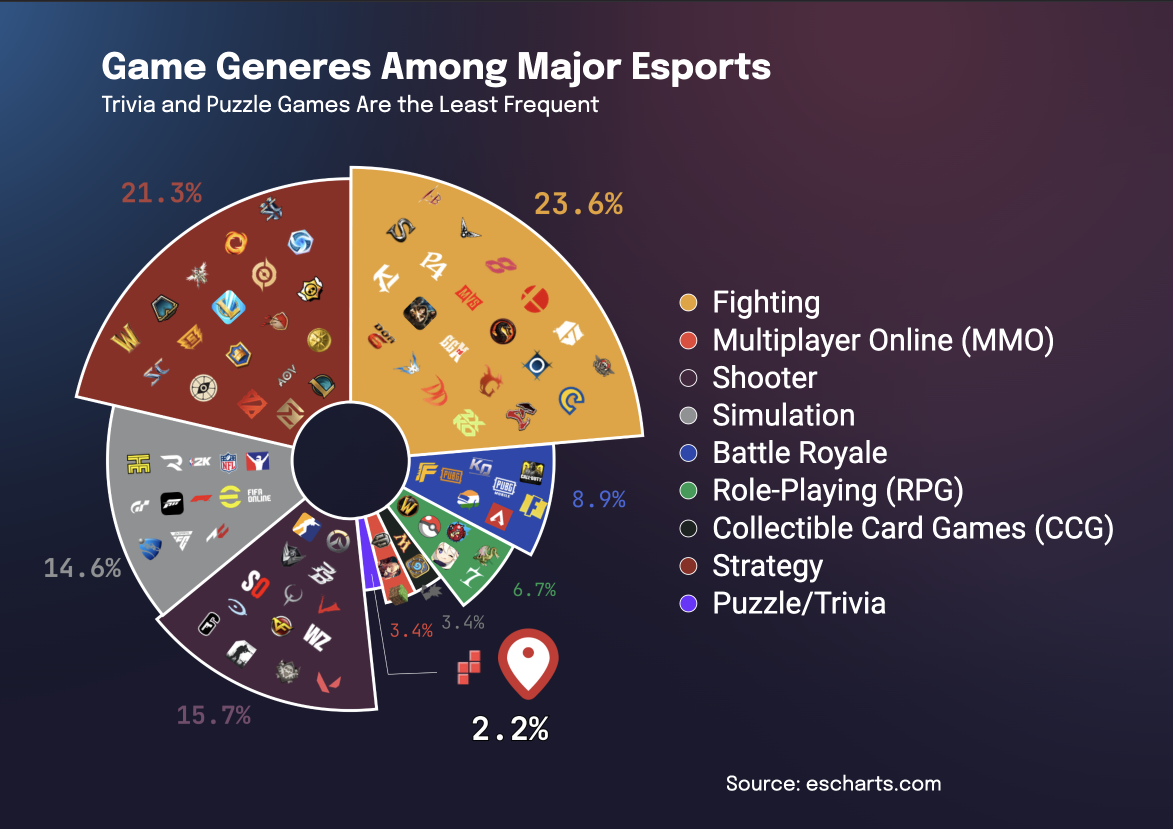
Genre names come from a shared understanding between players and the people who make games, so they overlap and change over time [2]. The infographic on this page looks at one corner of the subject, the genres of the major esports, using data from Esports Charts (escharts.com). Fighting games are the largest group at 23.6%, with puzzle and trivia games the smallest at 2.2%.
Game genres list
| Genre | What you do | Main subgenres | Well known examples |
|---|---|---|---|
| Action | Fast reactions and hand-eye coordination | Platform, beat ’em up, stealth, survival, rhythm | Super Mario Bros., Metal Gear Solid, Guitar Hero |
| Shooter | Fight with guns or other ranged weapons | First-person, third-person, hero shooter | Doom, Counter-Strike, Overwatch, Gears of War |
| Fighting | Close combat, usually one against one | 2D, 3D, platform fighters | Street Fighter, Tekken, Super Smash Bros. |
| Battle royale | Scavenge and survive as the play area shrinks, last player or team wins | Mostly shooters | PUBG, Fortnite, Free Fire, Apex Legends |
| Action-adventure | Combat mixed with exploration and puzzles | Survival horror, Metroidvania | The Legend of Zelda, Resident Evil |
| Adventure | Explore, talk to characters and solve puzzles | Text, graphic and point-and-click adventures, visual novels | Zork, Monkey Island |
| Role-playing (RPG) | Develop a character through a story, with stats and choices | Action RPG, MMORPG, tactical RPG, roguelike, monster taming | The Witcher 3, World of Warcraft, Pokémon |
| Simulation | Recreate a real or imagined activity | Construction and management, life, vehicle simulation | SimCity, The Sims, Microsoft Flight Simulator |
| Strategy | Plan and manage resources to beat opponents | Real-time, turn-based, 4X, tower defence, MOBA, auto battler | StarCraft II, Civilization, League of Legends, Dota 2 |
| Sports and racing | Play a real sport or race vehicles | Team sports, racing, sim racing | EA Sports FC, NBA 2K, Gran Turismo, Rocket League |
| Puzzle | Solve logic, pattern or tile problems | Tile-matching, logic, hidden object, physics | Tetris, Candy Crush Saga, Portal |
Other common labels describe something other than gameplay, for example party games, horror games, card and board games, casual games, sandbox or open world games, and educational games [2]. A game can be “open world” and also an RPG, so these labels sit alongside the main genres rather than replacing them.
Action, shooter and fighting games
Action games test reaction speed and timing. In platform games you leap and climb between platforms suspended in the level, which is where the name comes from [2]. Fighting games focus on close combat between a small number of evenly matched characters, usually one against one, and most have a large cast of playable characters and a competitive multiplayer mode [2].
Shooters are usually split by camera: first-person, where you see through your character’s eyes, and third-person, where the camera sits behind them. First-person shooters were called “Doom clones” for several years after Doom came out in 1993, and the term first-person shooter took over by around 2000 [3]. Hero shooters such as Overwatch and Valorant give each character its own abilities and borrow ideas from MOBAs [2].
Battle royale games mix survival and scavenging with last player standing rules. A large number of players start with little equipment, hunt for weapons and armour, and try to stay inside a safe area that shrinks as the match goes on [2].
Role-playing, adventure and simulation games
In a role-playing game you control a character (or a party) whose skills and equipment improve as you play, usually through a long story with choices. Action RPGs use real-time combat, tactical RPGs use turn-based battles on a grid, and massively multiplayer online RPGs (MMORPGs) such as World of Warcraft put thousands of players in a shared world. Roguelikes, named after the 1980 game Rogue, typically use randomly generated levels and permanent death, so each run starts from scratch.
Adventure games put the story and puzzles first, with little or no combat. Simulation games recreate an activity, from running a city or a theme park to flying a plane or living an ordinary life, as in The Sims [2].
Strategy, sports and puzzle games
Strategy games are about planning. Most are either turn-based or real-time, and focus either on overall strategy or on the tactics of a single battle [2]. MOBAs such as League of Legends and Dota 2 combine real-time strategy, role-playing and action. Two teams each control one hero per player, helped by computer-controlled units marching down set lanes, and the first team to destroy the other’s base wins. Unlike in a traditional real-time strategy game, players don’t build structures or units [2]. Sports games simulate real sports to varying degrees of accuracy, and racing games are usually grouped with them [2].
Puzzle games range from falling-block games like Tetris to tile-matching mobile games and logic puzzles [2]. They have a huge casual audience but very little professional competition, which is why they are the smallest esports genre on the infographic.
Esports game genres
Esports games are multiplayer games played competitively at professional level. They are mostly first-person shooters, which reward reaction speed and coordination, real-time strategy games, which reward planning and managing many units at once, or MOBAs, which need both [2]. Fighting, card and battle royale games are also major esports genres [4].
The infographic, based on Esports Charts data, gives each genre’s share of major esports titles. It puts MOBAs under strategy and sports and racing games under simulation.
| Genre | Share of major esports |
|---|---|
| Fighting | 23.6% |
| Strategy (including MOBAs) | 21.3% |
| Shooter | 15.7% |
| Simulation (sports and racing) | 14.6% |
| Battle royale | 8.9% |
| Role-playing | 6.7% |
| Collectible card games | 3.4% |
| Multiplayer online (MMO) | 3.4% |
| Puzzle and trivia | 2.2% |
The graphic doesn’t say whether these shares count games, tournaments or viewing, and it has no date, so treat the figures as a rough guide. The shares add up to 99.8% because of rounding.
Which esports genres pay the most
A count of games gives a very different picture from the money. Esports Earnings lists more fighting games than any other genre (190 of the 690 entries in its genre lists), but they have paid out only about $47 million in prize money between them [5]. MOBAs are the other way round: just 30 games, but about $705 million in prize money, $382 million of it from Dota 2 alone [5].
| Genre (Esports Earnings) | Games listed | Total prize money | Biggest game |
|---|---|---|---|
| Multiplayer online battle arena | 30 | $705m | Dota 2 |
| First-person shooter | 143 | $555m | Counter-Strike: Global Offensive |
| Battle royale | 17 | $431m | Fortnite |
| Strategy | 70 | $148m | StarCraft II |
| Sports | 102 | $125m | Rocket League |
| Collectible card game | 20 | $53m | Hearthstone |
| Fighting game | 190 | $47m | Street Fighter 6 |
| Racing | 68 | $20m | iRacing |
| Role-playing game | 10 | $17m | World of Warcraft |
| Puzzle game | 17 | $0.5m | Tetris |
Prize money totals are our sum of the per-game figures Esports Earnings lists, which cover all years on record [5]. Fighting games have so many entries partly because each version of a series is counted separately. Esports Earnings lists 15 separate Street Fighter games and eight Tekken games, for example [5].
Questions about game genres
What are the kinds of video games?
The main kinds are action, shooter, fighting, action-adventure, adventure, role-playing, simulation, strategy, sports and racing, and puzzle games. Battle royale and MOBA games are newer genres built from these.
How many video game genres are there?
There is no fixed number. Most lists use around 8 to 12 main genres, each with several subgenres, and new ones keep appearing as games mix ideas. MOBAs took off in the early 2010s, growing out of the Defense of the Ancients mod for Warcraft III [2].
What are 5 examples of game genres?
Shooter (Call of Duty), role-playing (The Witcher 3), strategy (Civilization), sports (EA Sports FC) and puzzle (Tetris).
What genre is Fortnite?
Fortnite Battle Royale is a battle royale game, and Wikipedia lists it as one of the best known in the genre [2]. It has paid out more esports prize money than any other battle royale game, about $209 million [5].
What is the most popular esports genre?
By number of games, fighting games, which make up 23.6% of major esports in the infographic. By prize money, MOBAs, led by Dota 2 and League of Legends [5].
Sources
- Esports Charts (escharts.com), the data source named on the infographic.
- Wikipedia, List of video game genres.
- Wikipedia, Video game genre.
- Wikipedia, Esports.
- Esports Earnings, Esports Games by Genre, prize money on record as of November 2026.
Last reviewed 9 November 2026