How do you find the right career?
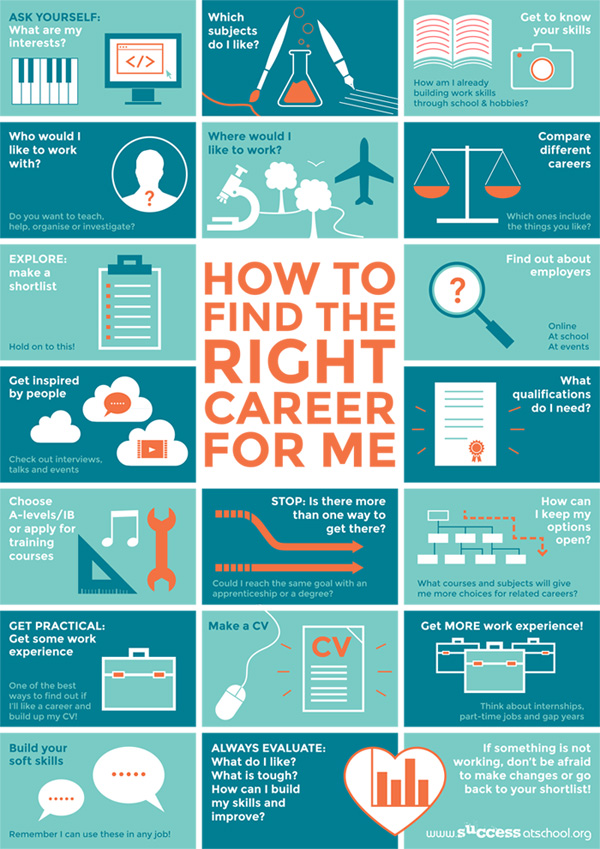
Finding your career is less about one big decision and more about a cycle you repeat: learn what you enjoy and are good at, research the jobs that fit, try them out through real experience, and adjust. The Success at School flowchart above sets this out for students in five stages: ask yourself, explore, stop and check your routes, get practical, and always evaluate [1]. The same approach works at 15, at 25 or when changing career at 45.
Step 1: Start with your interests and skills
Before looking at job titles, work out what you actually like doing. The flowchart’s first questions are simple ones: what are my interests, which subjects do I like, and how am I already building work skills through school and hobbies [1]? Playing in a band, running a club or fixing bikes all build skills an employer will recognise, such as teamwork, organisation and problem solving.
Next, think about who and where. Do you want to teach, help, organise or investigate? Would you rather work outdoors, in a lab, in an office or on the move [1]? These questions echo the Holland Codes, a widely used model from the psychologist John L. Holland that sorts work interests into six types: realistic (doers), investigative (thinkers), artistic (creators), social (helpers), enterprising (persuaders) and conventional (organisers) [2]. It underpins interest tests such as the Strong Interest Inventory [2], and seeing which types sound most like you is a quick way to narrow the field.
If you are in England, the National Careers Service has a free skills assessment that suggests job types from your answers [3].
Step 2: Explore careers and make a shortlist
Use your answers to compare different careers and pick out the ones that include the things you like. Write them down: the flowchart’s advice is to make a shortlist and hold on to it, because you will keep coming back to it [1].
Then research each one properly:
- What the job involves day to day. The National Careers Service has hundreds of job profiles covering typical tasks, working hours, pay and how to get in [3].
- Who the employers are. Look online, ask at school or college and go to careers fairs and events [1].
- What real people say. Interviews, talks and online videos from people in the job are often more useful than official descriptions [1].
- What qualifications you need. Some careers require a specific degree; many do not.
Step 3: Check every route into the job
Before choosing your next course, stop and ask whether there is more than one way to get there. Could you reach the same goal through an apprenticeship rather than a degree [1]? In England, apprenticeships combine paid work with study, with at least 20% of your working hours set aside for training. They run from intermediate level (equivalent to GCSE) up to degree apprenticeships at level 6 and 7, equivalent to a bachelor’s or master’s degree, and take from 8 months to 6 years [4]. You need to be 16 or over and not in full-time education to start one [4].
It also pays to keep your options open. Ask which A-levels, IB subjects or training courses lead to the widest range of related careers [1]. If you are unsure between two paths, choosing subjects that keep both open is often the safer move.
Step 4: Get practical experience
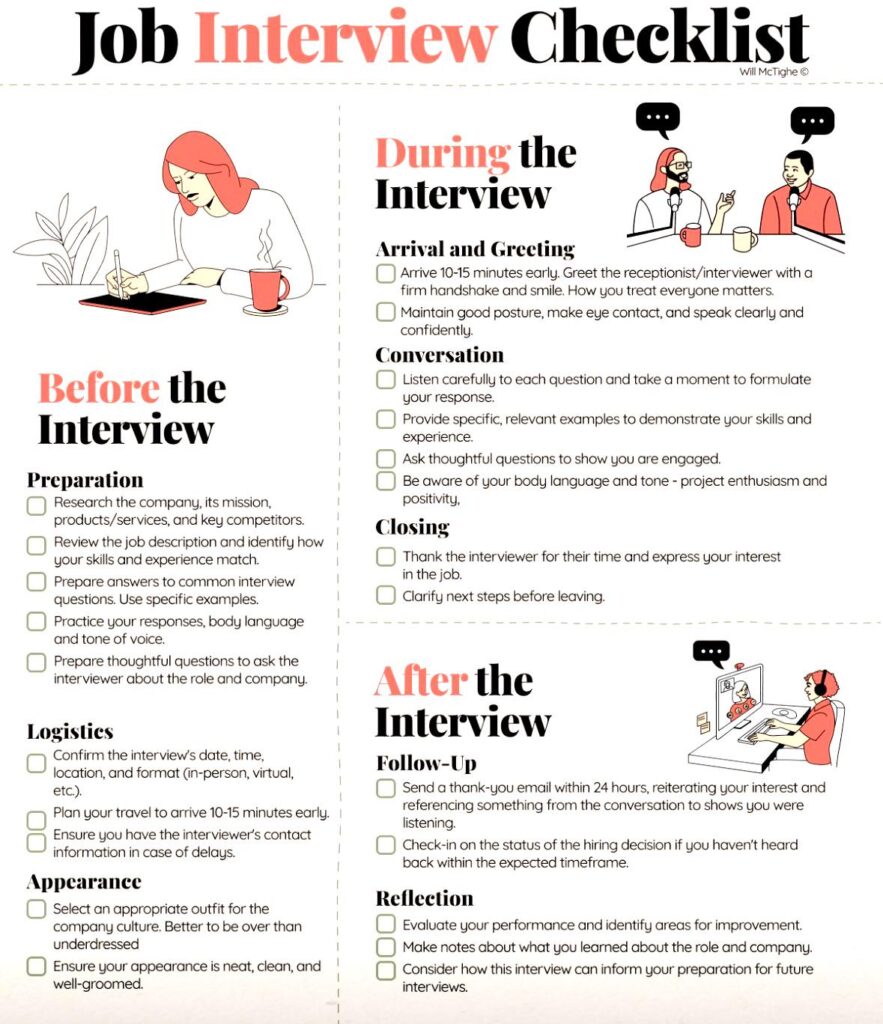
Work experience is one of the best ways to find out whether you will actually like a career, and it builds your CV at the same time [1]. A week shadowing someone can confirm a choice or save you years on the wrong path. After your first placement, the flowchart’s advice is to get more: internships, part-time jobs, volunteering and gap years all count [1].
Alongside this, make a CV and keep it up to date, and work on soft skills such as communication, teamwork and time management. These are useful in any job, so they are never wasted even if your plans change [1].
Step 5: Keep evaluating and change course if you need to
Finding the right career is not a one-off decision. Keep asking yourself what you like, what you find tough and how you can build your skills [1]. If something is not working, the flowchart’s last message is not to be afraid to make changes or go back to your shortlist [1]. Plenty of people change direction more than once, and every role adds skills you can take with you.
If you are changing career as an adult
The same steps apply, with a few differences. You already have work experience, so start by listing the skills you use now and which parts of your job you enjoy. Look for careers that use those transferable skills rather than starting from scratch. Short courses, evening study or a higher or degree apprenticeship can let you retrain while earning [4], and the National Careers Service offers free advice for adults who want to change career or return to work [3].
Questions about finding your career
How do I figure out what career is right for me?
List your interests, favourite subjects and skills, decide what kind of work and workplace suit you, and use them to make a shortlist of careers. Then test the shortlist with research and work experience [1].
Is there a free career test?
Yes. In England, the National Careers Service has a free online skills assessment [3]. Many other free tests are based on the Holland Codes (RIASEC) model [2].
Do I need a degree to get a good career?
Not always. Degree apprenticeships give a bachelor’s or master’s level qualification while you work and earn [4]. Check the qualifications each career on your shortlist actually requires.
What if I choose the wrong career?
Change course. Go back to your shortlist, keep the skills you have built and use them in the next role [1].
Sources
- Success at School, Infographic: How to Find the Right Career for Me, the original infographic.
- Wikipedia, Holland Codes.
- National Careers Service, skills assessment, job profiles and careers advice.
- GOV.UK, Become an apprentice.
Last reviewed 2 November 2026