Job interview preparation checklist
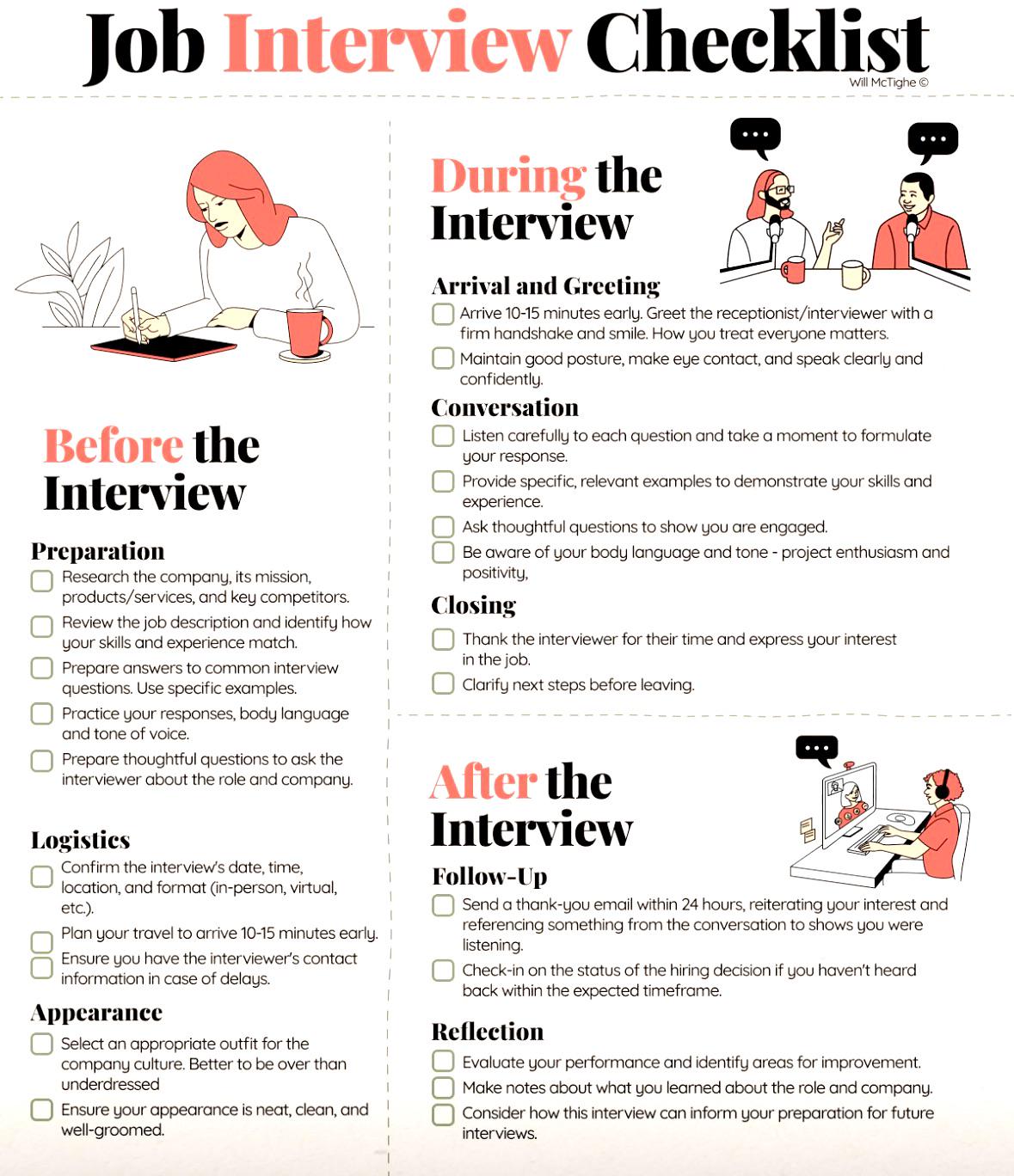
Most of what decides an interview happens before you walk in. Will McTighe’s checklist above splits the work into before, during and after the interview, and the UK National Careers Service and the US Department of Labor give much the same advice [1][2][3]. Use this as your list for the days before.
Research the company
- Read the company’s website: what it does, its products or services, its mission and its main competitors [1][2].
- Look for recent news, such as new products, expansion or awards, that you could mention.
- Check who will interview you, if you know, and what they do.
Match yourself to the job
- Go through the job description line by line and note the skills and experience the employer wants [2].
- Reread your CV or application form so your answers match what you sent [2].
- For each main requirement, pick a real example from your work, studies or life that shows you can do it [1][2].
- Prepare a 30 to 60 second summary of your experience and what you would bring to the role, which the Department of Labor suggests as an answer to “tell me about yourself” [3].
Prepare your answers and questions
- Prepare answers to common questions: why you want the job, your strengths and weaknesses, a time you solved a problem, and why you are leaving your current role.
- Structure examples with the STAR method: the Situation, the Task, the Action you took and the Result [2].
- Practise out loud, including your body language and tone of voice, ideally with someone who will give you honest feedback [1].
- Write down three or four thoughtful questions to ask about the role, the team and the company [1].
Sort out the logistics
- Confirm the date, time, place and format: in person, phone or video [1].
- Plan your journey to arrive 10 to 15 minutes early, with time to spare for delays [1][2].
- Save the interviewer’s phone number or email in case you are running late [1][2].
- For an online interview, test your computer, camera, microphone and internet connection, and be ready 5 to 10 minutes before the start [2].
- Choose an outfit that suits the company’s culture. If in doubt, McTighe’s advice is that it is better to be overdressed than underdressed [1].
What to bring to a job interview
- Spare printed copies of your CV and any portfolio or work samples.
- The job description, your notes and your questions.
- A pen and notepad.
- Any documents the employer asked for, such as ID or certificates.
- Directions and the interviewer’s contact details.
What to do on the day
First impressions start before the interview does. Be polite to everyone you meet, including reception staff, because, as the checklist puts it, how you treat everyone matters [1]. Turn your phone off [2].
- Greeting: smile, make eye contact and introduce yourself clearly. Sit up straight and speak at a steady pace [1].
- Answering: listen to the whole question and take a moment to think before you answer [1]. Answer as directly as you can, then back it up with a specific example [1][3].
- If you don’t know: say so honestly and explain how you would find out, rather than guessing.
- Your questions: ask the questions you prepared, plus any that came up in the conversation. It shows you are engaged [1].
- Closing: thank the interviewers for their time, say you are interested in the job, and ask about the next steps and when you can expect to hear [1][3].
After the interview
- Send a thank-you email within 24 hours. Keep it short, repeat your interest and mention something specific from the conversation to show you were listening [1][3].
- Follow up if you hear nothing. If the expected timeframe passes, a polite email asking about the status of the decision is fine [1].
- Reflect while it is fresh. Note the questions you were asked, what went well and what you would answer differently, and what you learned about the role [1].
- Ask for feedback if you are unsuccessful. Many employers will tell you why, and it is the quickest way to improve for the next one.
Common interview mistakes to avoid
- Not knowing what the company does or what the job involves.
- Giving vague answers with no examples.
- Running late without letting anyone know.
- Criticising a current or former employer.
- Having no questions to ask at the end.
- Forgetting to follow up afterwards.
Questions about job interviews
What should I do the night before an interview?
Reread the job description and your notes, lay out your clothes and documents, check your route or test your video setup, and get a good night’s sleep.
How early should you arrive for a job interview?
Aim to arrive 10 to 15 minutes early for an in-person interview, and be ready 5 to 10 minutes before an online one [1][2].
What is the STAR method?
A way of structuring examples: describe the Situation, the Task you faced, the Action you took and the Result. It helps you give complete, specific answers [2].
Should you send a thank-you email after an interview?
Yes. Send it within 24 hours, thanking the interviewer and briefly restating your interest in the role [1][3].
What questions should I ask at the end of an interview?
Ask about the day-to-day work, how success is measured, the team, training and the next steps in the process [1].
Sources
- Will McTighe, Job Interview Checklist, the infographic on this page.
- National Careers Service, Interview tips.
- US Department of Labor, Interview tips.
Last reviewed 2 November 2026