What is moringa oleifera?
Moringa oleifera is a fast-growing, drought-resistant tree native to northern India and widely grown across South and Southeast Asia, Africa and other tropical regions [2]. It has a lot of common names: drumstick tree (after its long, thin seed pods), horseradish tree (the roots taste like horseradish), ben tree (after the oil in its seeds) and malunggay in the Philippines [2]. India is the largest producer, harvesting about 1.2 million tonnes of pods a year [2].
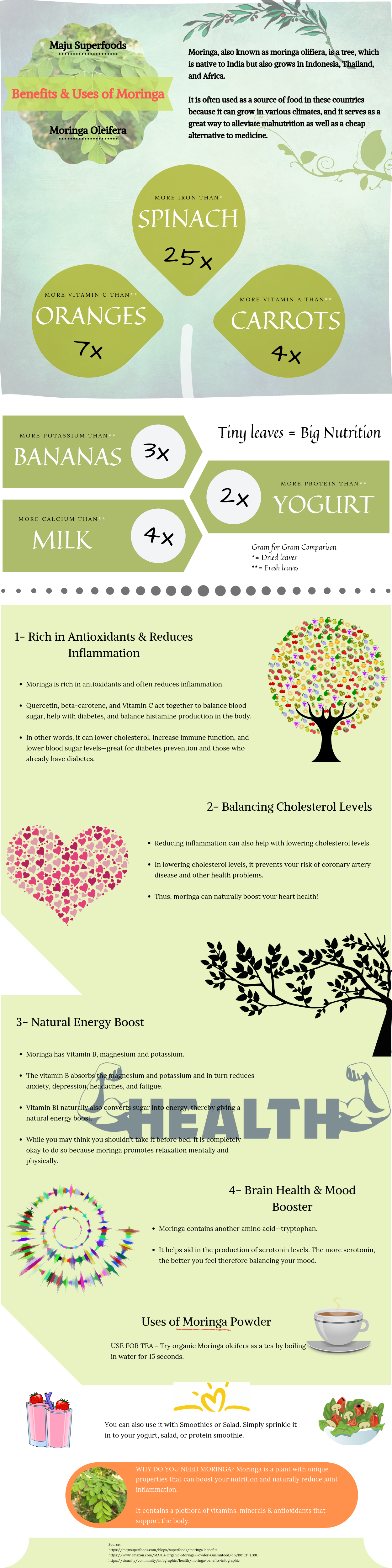
Because it grows quickly in poor soil and dry weather, moringa has long been promoted as a cheap source of nutrition in places with food shortages. The Maju Superfoods infographic above, made by a seller of moringa powder, sums up that reputation in one line: “tiny leaves, big nutrition” [1].
Moringa oleifera uses
Almost every part of the tree is used, and the uses fall into four groups.
As food
The leaves are the most widely eaten part. They can be eaten raw or cooked, and are often added to clear broth soups such as the Filipino dishes tinola and utan, or chopped finely as a garnish, as in the Kerala dish thoran [2]. The young pods, called drumsticks, are a common vegetable in South Asia: they are parboiled, cut into lengths and cooked in curries and soups until soft [2]. Seeds from mature pods can be cooked and eaten, and in Nigeria they are fried as a snack or added to sauces for their bitter flavour [2]. The flowers are cooked too.
As a powder
Outside the regions where it grows, most people buy moringa as dried leaf powder or capsules. The infographic suggests three ways to use the powder: as a tea, made by steeping it in boiling water briefly; stirred into smoothies; or sprinkled over salads and yogurt [1]. It has an earthy, slightly bitter taste, so small amounts in food or drinks with stronger flavours work best.
Oil and other uses
Moringa seeds contain an edible oil, known as ben oil, which is used in cooking, as a food supplement and as a base for cosmetics, hair and skin products [2]. The seeds can also be used to make biofuel [2]. Ground seeds act as a natural coagulant: added to muddy water they bind the particles so they settle, which is why moringa seed is used for simple water purification [2]. Ground, debittered seed can be added to wheat flour to raise its protein, iron and calcium content [2].
In traditional medicine
The leaves, seeds, bark, roots, sap and flowers are all used in traditional medicine across South Asia and Africa [3]. Traditional use is not proof that a remedy works, which is why the research below matters.
How nutritious is moringa?
Moringa leaves are genuinely nutritious, but the popular claims tend to overstate it. The infographic says that, gram for gram, moringa has 25 times the iron of spinach (dried leaves) and, for fresh leaves, 7 times the vitamin C of oranges, 4 times the vitamin A of carrots, 3 times the potassium of bananas, 2 times the protein of yogurt and 4 times the calcium of milk [1]. US Department of Agriculture data for fresh leaves tells a more modest story [4]:
| Per 100 g, raw | Fresh moringa leaves | Comparison food | Moringa compared |
|---|---|---|---|
| Protein | 9.4 g | Whole milk yogurt, 3.5 g | about 2.7 times |
| Calcium | 185 mg | Whole milk, 113 mg | about 1.6 times |
| Iron | 4.0 mg | Spinach, 2.7 mg | about 1.5 times |
| Vitamin C | 51.7 mg | Oranges, 53.2 mg | about the same |
| Potassium | 337 mg | Bananas, 358 mg | about the same |
| Vitamin A | 378 µg | Carrots, 835 µg | about half |
The ratios are our arithmetic from the USDA figures. Fresh leaves beat yogurt on protein and milk on calcium, but match oranges and bananas rather than beating them, and have less vitamin A than carrots. The big iron multiplier comes from comparing dried leaves with fresh spinach. Drying removes the water and concentrates everything: one leaf powder sample in a 2015 review held 103.1 mg of iron per 100 g [3]. That is a fair comparison weight for weight, but you eat a teaspoon of powder, not a bowl, so the iron you actually get is much smaller.
Moringa oleifera benefits: what the research says
Maju Superfoods credits moringa with four benefits: antioxidants and less inflammation, lower cholesterol, more energy, and better mood and brain health [1]. The research supports some of this more cautiously than the marketing does.
- Antioxidants. Moringa leaves contain vitamin C, beta-carotene and plant compounds such as quercetin, which act as antioxidants [3]. Most evidence that this reduces inflammation in the body comes from animal and laboratory studies [3].
- Blood sugar and cholesterol. A 2015 review in Phytotherapy Research found five small human studies using powdered leaf that reported lower blood sugar and improved blood fats [3]. The authors called for larger human trials with standardised products, so these are early findings rather than proven treatments.
- Energy and mood. The leaves contain B vitamins, magnesium, potassium and the amino acid tryptophan [1][4]. We found no human trials showing that moringa improves energy, anxiety or mood, and the infographic’s statement that vitamin B “absorbs” magnesium and potassium has no support in the sources we checked.
- Malnutrition. Moringa is often promoted to help undernourished children, but the 2015 review found no human clinical trials testing it for that [3].
Even the seller now describes cholesterol and blood sugar as areas that have been studied and says more research and clinical trials are needed [1]. Treat moringa as a nutritious leafy food, not a medicine, and speak to your doctor before using it alongside treatment for diabetes or any other condition.
Is moringa safe?
The leaves have a long history as food and look safe in normal amounts. The 2015 review found no adverse effects in the human studies it covered, which used up to 50 g of leaf powder in one dose and 8 g a day for 40 days [3]. Laboratory studies suggest compounds in the bark and roots can be harmful in excess, and moringa may interact with some prescription medicines, including the diabetes drug sitagliptin [2]. Regulators are not all convinced: in November 2025 Food Standards Australia New Zealand rejected an application to approve moringa leaves, pods and oil as a novel food, citing insufficient safety evidence, so it cannot be sold as food in Australia [2].
Questions about moringa oleifera
What is moringa oleifera used for?
Mainly as food: the leaves are eaten fresh or as powder and the young pods are cooked as a vegetable. The seeds give ben oil and can purify water, and many parts are used in traditional medicine [2][3].
What are the benefits of moringa leaves?
They are a good source of protein, calcium, iron and vitamin C, and contain antioxidants [3][4]. Small human studies suggest leaf powder may lower blood sugar and improve blood fats, but bigger trials are needed [3].
How do you use moringa powder?
Stir about a teaspoon into smoothies, yogurt, soups or sauces, sprinkle it on salads, or steep it in hot water as a tea [1].
Is moringa better than spinach?
Fresh moringa leaves have more protein, calcium and iron than raw spinach per 100 g, but the difference in iron is about one and a half times, not 25 times [4].
Who should not take moringa?
Anyone on prescription medicines, particularly for diabetes, should check with a doctor first because of possible interactions [2]. Avoid root and bark preparations, which have shown harmful effects in laboratory studies [2].
Sources
- Maju Superfoods, Is Moringa Good For You? 5 Science Based Benefits, the seller’s article behind this infographic.
- Wikipedia, Moringa oleifera.
- Stohs SJ, Hartman MJ, Review of the Safety and Efficacy of Moringa oleifera, Phytotherapy Research, 2015.
- US Department of Agriculture, FoodData Central, SR Legacy: Drumstick leaves, raw (168416); Spinach, raw (168462); Oranges, raw (169097); Carrots, raw (170393); Bananas, raw (173944); Milk, whole (171265); Yogurt, plain, whole milk (171284).
Last reviewed 2 November 2026