Key figures from the chart
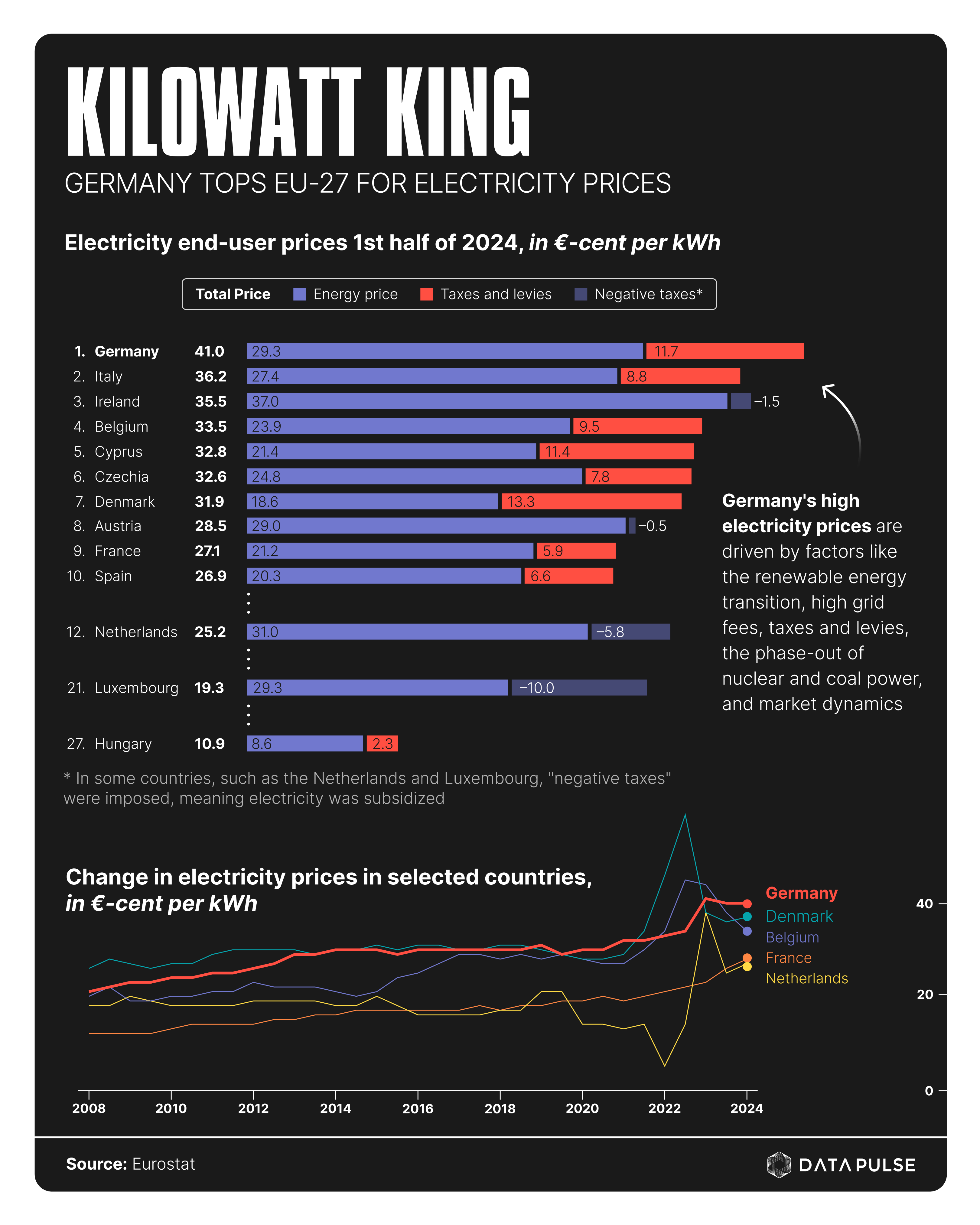
- Germany had the highest household electricity price in the EU in the first half of 2024, at 41.0 euro cents per kWh.
- Of that, 29.3 cents was the energy price and 11.7 cents was taxes and levies.
- Italy (36.2) and Ireland (35.5) were second and third. Hungary was cheapest at 10.9 cents, about a quarter of the German price.
- Ireland, Austria, the Netherlands and Luxembourg had “negative taxes”, meaning electricity was subsidised and the total was below the energy price.
- All figures are from the chart, which cites Eurostat.
Germany electricity prices compared in text
Title: Kilowatt King. Subtitle: Germany tops EU-27 for electricity prices. The upper chart is headed “Electricity end-user prices 1st half of 2024, in €-cent per kWh”. Each bar splits the price into energy price, taxes and levies, and negative taxes. The chart shows ranks 1 to 10, 12, 21 and 27 only; the other ranks are left out.
| Rank | Country | Total price | Energy price | Taxes and levies | Negative taxes |
|---|---|---|---|---|---|
| 1 | Germany | 41.0 | 29.3 | 11.7 | |
| 2 | Italy | 36.2 | 27.4 | 8.8 | |
| 3 | Ireland | 35.5 | 37.0 | -1.5 | |
| 4 | Belgium | 33.5 | 23.9 | 9.5 | |
| 5 | Cyprus | 32.8 | 21.4 | 11.4 | |
| 6 | Czechia | 32.6 | 24.8 | 7.8 | |
| 7 | Denmark | 31.9 | 18.6 | 13.3 | |
| 8 | Austria | 28.5 | 29.0 | -0.5 | |
| 9 | France | 27.1 | 21.2 | 5.9 | |
| 10 | Spain | 26.9 | 20.3 | 6.6 | |
| 12 | Netherlands | 25.2 | 31.0 | -5.8 | |
| 21 | Luxembourg | 19.3 | 29.3 | -10.0 | |
| 27 | Hungary | 10.9 | 8.6 | 2.3 |
Annotation as printed: “Germany’s high electricity prices are driven by factors like the renewable energy transition, high grid fees, taxes and levies, the phase-out of nuclear and coal power, and market dynamics.” Footnote: “In some countries, such as the Netherlands and Luxembourg, ‘negative taxes’ were imposed, meaning electricity was subsidized.”
Change in electricity prices in selected countries
The lower chart is a line chart of household prices in euro cents per kWh from 2008 to 2024 for Germany, Denmark, Belgium, France and the Netherlands. It has no data labels. Read from the lines, Germany rises from about 20 cents in 2008 to about 30 by 2014, stays near that level until 2021, climbs to a peak of about 41 in 2023 and ends at about 40, the highest of the five. Denmark has the highest single peak, close to 60 cents in 2022. The Netherlands drops to about 5 cents in 2022 before rising again. France is the lowest line for most of the period. These line readings are our estimates from the chart. Source: Eurostat. Logo: Data Pulse.
Why electricity in Germany costs so much
DataPulse Research, which made the chart, says German electricity bills combine energy costs, taxes and grid fees [1]. Its list of taxes and charges includes VAT, electricity tax, concession fees paid to municipalities, the Renewable Energy Act (EEG) surcharge, offshore grid surcharges and surcharges under the Combined Heat and Power Act [1].
The article notes that Germany ranks second for taxes and surcharges at 11.7 cents per kWh, behind Denmark at 13.3, and that Luxembourg’s energy price matches Germany’s at 29.3 cents before its negative taxes are applied [1]. It also cites Destatis figures for the third quarter of 2024, when wind (24.7%) and solar (23.8%) were Germany’s largest sources of domestic electricity, followed by coal (21.4%) and natural gas (11.4%) [1].
Germany electricity prices after 2024
Eurostat’s latest overview covers the second half of 2025 and uses medium-sized households (2,500 to 5,000 kWh a year), a narrower group than the chart. On that basis Ireland had the highest price at €0.4042 per kWh and Germany was second at €0.3869, ahead of Belgium (€0.3499) and Denmark (€0.3312) [2]. Eurostat says the EU average household price including taxes peaked in the first half of 2024 at €0.2916 per kWh, the period on this chart [2].
Notes on this infographic
- Germany checks out. Eurostat’s table for the first half of 2024, all household consumption bands, gives Germany 41.0 cents with 29.3 cents before taxes, matching the chart [3].
- Ireland and the Netherlands have been revised. When we downloaded the same Eurostat table in October 2026, it gave Ireland a total of 25.9 cents (energy 37.0, taxes minus 11.0) and the Netherlands 24.2 cents (energy 31.9, taxes minus 7.8) [3]. On those figures Ireland would rank 10th, not 3rd. France is also slightly different at 27.6 cents [3].
- Belgium. The segments shown (23.9 and 9.5) add up to 33.4, against a total of 33.5. This is rounding: Eurostat’s total is 33.46 cents [3].
- Units. Prices are in euro cents per kWh for households, including all taxes.
Questions about electricity prices in Germany
Why does Germany have such high energy costs?
The chart puts it down to the renewable energy transition, high grid fees, taxes and levies, the phase-out of nuclear and coal power, and market dynamics. In the first half of 2024, taxes and levies made up 11.7 of Germany’s 41.0 cents per kWh [1][3].
Which EU country has the most expensive electricity?
Germany, in the first half of 2024, at 41.0 cents per kWh [3]. In the second half of 2025, Eurostat’s medium household figures put Ireland first and Germany second [2].
Which EU country has the cheapest electricity?
Hungary had the cheapest household electricity in the EU in the first half of 2024, at 10.9 euro cents per kWh, about a quarter of the German price of 41.0 cents. Of Hungary's price, 8.6 cents was the energy price and 2.3 cents was taxes and levies. The figures come from the chart, which cites Eurostat.
What are negative taxes on electricity?
Negative taxes mean electricity was subsidised, so the total price was below the energy price. In the first half of 2024 the chart shows them in Ireland, Austria, the Netherlands and Luxembourg. Luxembourg had the largest, at -10.0 cents, bringing an energy price of 29.3 cents per kWh down to a total of 19.3 cents. Its energy price matches Germany's before the negative taxes are applied [1].
Sources
- DataPulse Research, Germany Has the Highest Electricity Prices in the EU, Price per kWh Compared, by Maria Fernandez, February 2025.
- Eurostat, Electricity price statistics, Statistics Explained, second half of 2025 edition.
- Eurostat, Electricity prices for household consumers, bi-annual data (nrg_pc_204), first half of 2024, all consumption bands, downloaded October 2026.
Last reviewed 29 October 2026