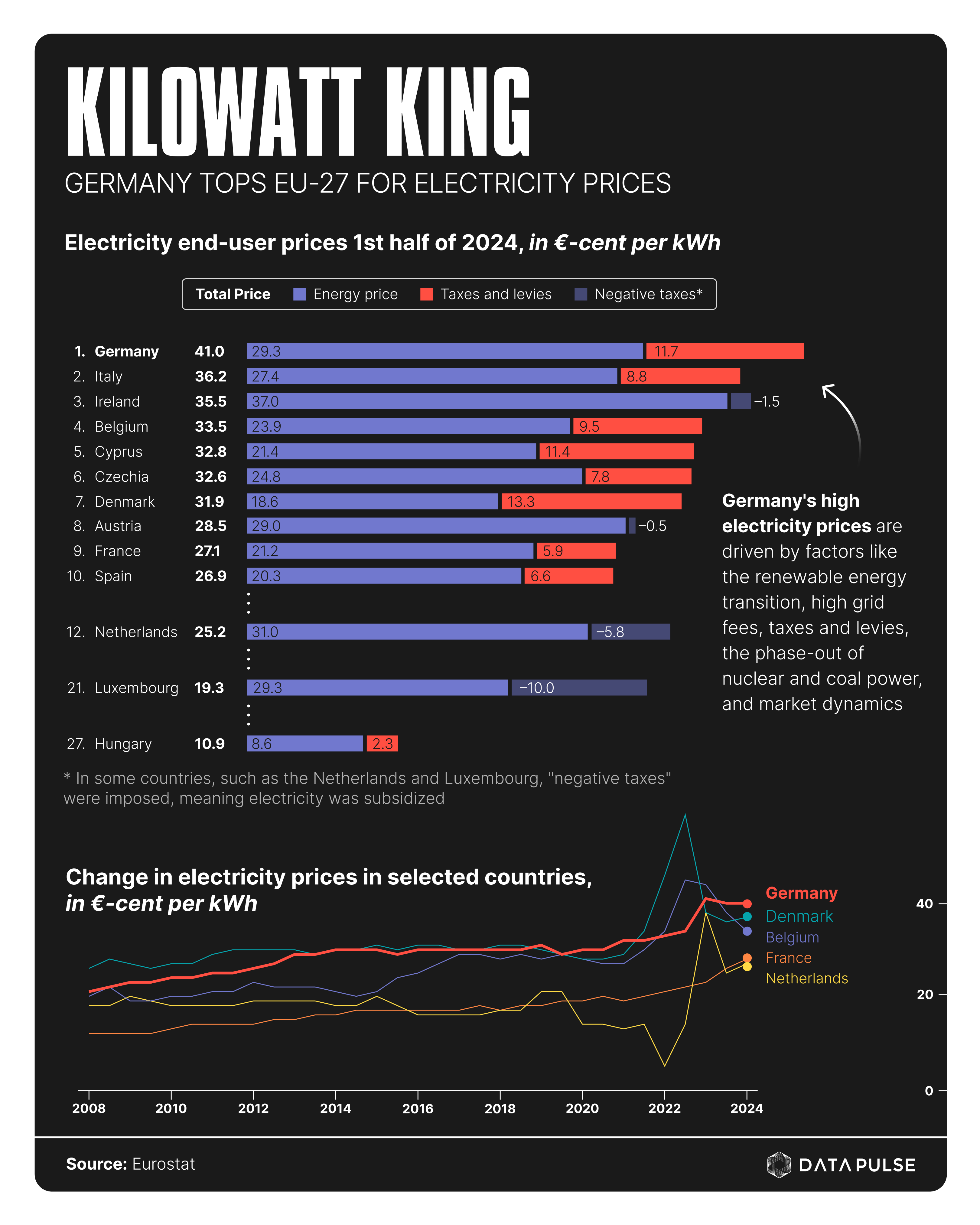
Germany electricity prices for households averaged 38.1 euro cents per kWh, including taxes, in the first half of 2026, according to Eurostat. That is the second highest in the EU after Ireland (39.2 cents) and about a third above the EU average of 28.8 cents. In the first half of 2024 Germany was the most expensive country in the EU, at 41.0 cents.
The infographic by DataPulse Research, shown here, covers that first half of 2024, when Germany topped the EU. The figures below update it to Eurostat’s latest release, for January to June 2026, and explain what makes up a German electricity bill [1][2].
Germany electricity prices compared with other EU countries
German households paid 38.1 cents per kWh in the first half of 2026, behind only Ireland. These are Eurostat’s household prices including all taxes and levies, averaged across all consumption bands [2].
| Rank | Country | Price incl. taxes (cents per kWh) | Price before taxes and levies |
|---|---|---|---|
| 1 | Ireland | 39.2 | 35.5 |
| 2 | Germany | 38.1 | 25.5 |
| 3 | Belgium | 36.0 | 28.0 |
| 4 | Italy | 35.8 | 27.2 |
| 5 | Austria | 32.6 | 24.8 |
| 6 | Poland | 31.3 | 16.5 |
| 7 | Romania | 28.3 | 21.6 |
| 8 | Cyprus | 27.8 | 20.3 |
| 9 | Czechia | 27.7 | 22.4 |
| 10 | Spain | 27.4 | 19.5 |
| EU average | 28.8 | 20.8 | |
| 15 | France | 23.9 | 16.6 |
| 27 | Hungary | 11.9 | 9.4 |
Source, Eurostat dataset nrg_pc_204, household consumers, all consumption bands, first half of 2026, downloaded 14 November 2026 [2]. Ranks are among the 27 EU countries.
What stands out is how much of Germany’s price is tax. Before taxes and levies German electricity cost 25.5 cents, only a little above the EU average of 20.8 and well below Ireland, Belgium and Italy. Taxes and levies then add 12.6 cents, against 8.0 cents on average across the EU [2].
For a typical medium-sized household using 2,500 to 5,000 kWh a year, the figures are slightly lower. Germany was at 36.2 cents in the first half of 2026, again second to Ireland (38.7), with the EU average at 28.3 [2].
How German electricity prices have changed since 2008
German household electricity has been well above the EU average for the whole period Eurostat has published comparable figures. For a medium household it rose from 21.5 cents in the first half of 2008 to about 30 cents by 2013, then stayed near that level until 2021 [2].
| First half of | Germany (cents per kWh) | EU average | France |
|---|---|---|---|
| 2008 | 21.5 | 16.0 | 12.1 |
| 2013 | 29.2 | 20.4 | 15.2 |
| 2018 | 29.9 | 21.0 | 17.5 |
| 2021 | 31.9 | 22.0 | 19.5 |
| 2023 | 41.2 | 28.9 | 23.0 |
| 2024 | 39.5 | 29.2 | 28.5 |
| 2025 | 38.4 | 28.8 | 26.7 |
| 2026 | 36.2 | 28.3 | 24.9 |
Source, Eurostat nrg_pc_204, medium households (2,500 to 5,000 kWh a year), prices including all taxes [2]. The European energy crisis pushed German prices to their peak in 2023, and they have come down each year since [3], though they are still well above 2021 levels. Germany’s own figures show the same pattern. The utility association BDEW’s average household price peaked at 47 cents in 2023 and was 39.6 cents in 2025, against 32.8 cents in 2021 [3].
What makes up a German electricity bill
Only about 40% of a German household’s electricity price is the cost of the power itself. The rest is grid fees, VAT and a set of taxes and levies. BDEW’s breakdown of the average 2025 household price of 39.6 cents per kWh is below [3].
| Component | Cents per kWh | Share of price |
|---|---|---|
| Supplier’s cost (wholesale power, sales and margin) | 16.00 | 40.4% |
| Grid fees | 10.94 | 27.6% |
| VAT (19%) | 6.33 | 16.0% |
| Electricity tax | 2.05 | 5.2% |
| Concession levy (paid to local councils) | 1.67 | 4.2% |
| Levy for industry’s grid fee rebates | 1.56 | 3.9% |
| Offshore wind liability levy | 0.82 | 2.0% |
| Combined heat and power surcharge | 0.28 | 0.7% |
Source, BDEW figures for new customers in October 2025, via Clean Energy Wire [3]. The renewable energy (EEG) surcharge, which reached 6.5 cents per kWh in 2021, was abolished in 2022 and is now paid from the federal budget, which is why it no longer appears on bills [3].
Why electricity is so expensive in Germany
German electricity is expensive mainly because of high grid fees and taxes and levies on top of a wholesale price that rose sharply in the energy crisis. DataPulse Research lists the renewable energy transition, high grid fees, taxes and levies, the phase-out of nuclear and coal power, and market dynamics as the main factors [1].
- Grid fees are the second largest part of the bill, at almost 11 cents per kWh. They are charges for using the power grid, set by the Federal Network Agency [3].
- Households pay levies and taxes in full. Energy-intensive businesses are partly or fully exempt from some of them, and households pay a levy that funds industry’s grid fee rebates [3].
- Carbon prices add to the cost of fossil power. Clean Energy Wire notes that EU emissions allowance prices quadrupled between 2020 and 2025 [3].
In the first half of 2024, the period on DataPulse’s chart, Germany had the second highest taxes and levies in the EU, at 11.7 cents per kWh, behind Denmark at 13.3 [1][2].
Is electricity in Germany getting cheaper?
Slowly. Eurostat’s figures show German household prices falling from 40.4 cents in the second half of 2025 to 38.1 cents in the first half of 2026, across all households [2].
The federal government is subsidising transmission grid costs with €6.5 billion in 2026, which Clean Energy Wire says could cut grid fees by an average of 16% for households [3]. The coalition had also promised to cut the electricity tax to the EU minimum for everyone, but in July 2025 it limited that cut to industry, leaving households paying the full rate [3].
Germany’s 2024 ranking and revised figures
DataPulse’s chart is right that Germany had the most expensive household electricity in the EU in the first half of 2024. Eurostat’s current table still gives Germany 41.0 cents, of which 29.3 cents was the price before taxes, exactly as the chart shows [1][2].
Some other figures from that period have since been revised by Eurostat, though. The chart puts Ireland third at 35.5 cents, but Eurostat now gives Ireland 25.9 cents for that half year, because Eurostat now records a negative tax of 11.1 cents for Ireland in that half year, meaning government support on bills. On the revised figures Ireland was 10th, not third. Eurostat also now gives the Netherlands 24.1 cents rather than 25.2, and France 27.6 rather than 27.1 [2]. Italy (36.2) is second on both.
Questions about Germany electricity prices
What is the price of 1 kWh of electricity in Germany?
About 38 euro cents including taxes, the average for households in the first half of 2026 according to Eurostat. Medium-sized households paid 36.2 cents [2]. New contracts vary by supplier and region, and BDEW’s average for 2025 was 39.6 cents [3].
Which country has the most expensive electricity in the EU?
Ireland, at 39.2 cents per kWh in the first half of 2026, just ahead of Germany at 38.1. Germany was the most expensive in the first half of 2024 [2].
Which EU country has the cheapest electricity?
Hungary, at 11.9 cents per kWh in the first half of 2026, followed by Bulgaria (13.4) and Malta (14.7) [2].
How much electricity does a German household use?
BDEW uses 3,500 kWh a year as its benchmark household, which is about 290 kWh a month. At 2025 prices that household paid €115.60 a month for electricity [3].
What are negative taxes on electricity?
Eurostat records government subsidies and energy credits as negative taxes, so in some countries the final price is lower than the price before taxes. In the first half of 2026 the Netherlands was an example, with a price of 30.3 cents before taxes and 23.7 cents after them [2].
Sources
- DataPulse Research, Germany Has the Highest Electricity Prices in the EU, Price per kWh Compared, February 2025, from Eurostat data.
- Eurostat, Electricity prices for household consumers, bi-annual data (nrg_pc_204), first half of 2008 to first half of 2026, downloaded 14 November 2026.
- Clean Energy Wire, What German households pay for electricity, 4 December 2025, using BDEW figures.
- Eurostat, Electricity price statistics, Statistics Explained.