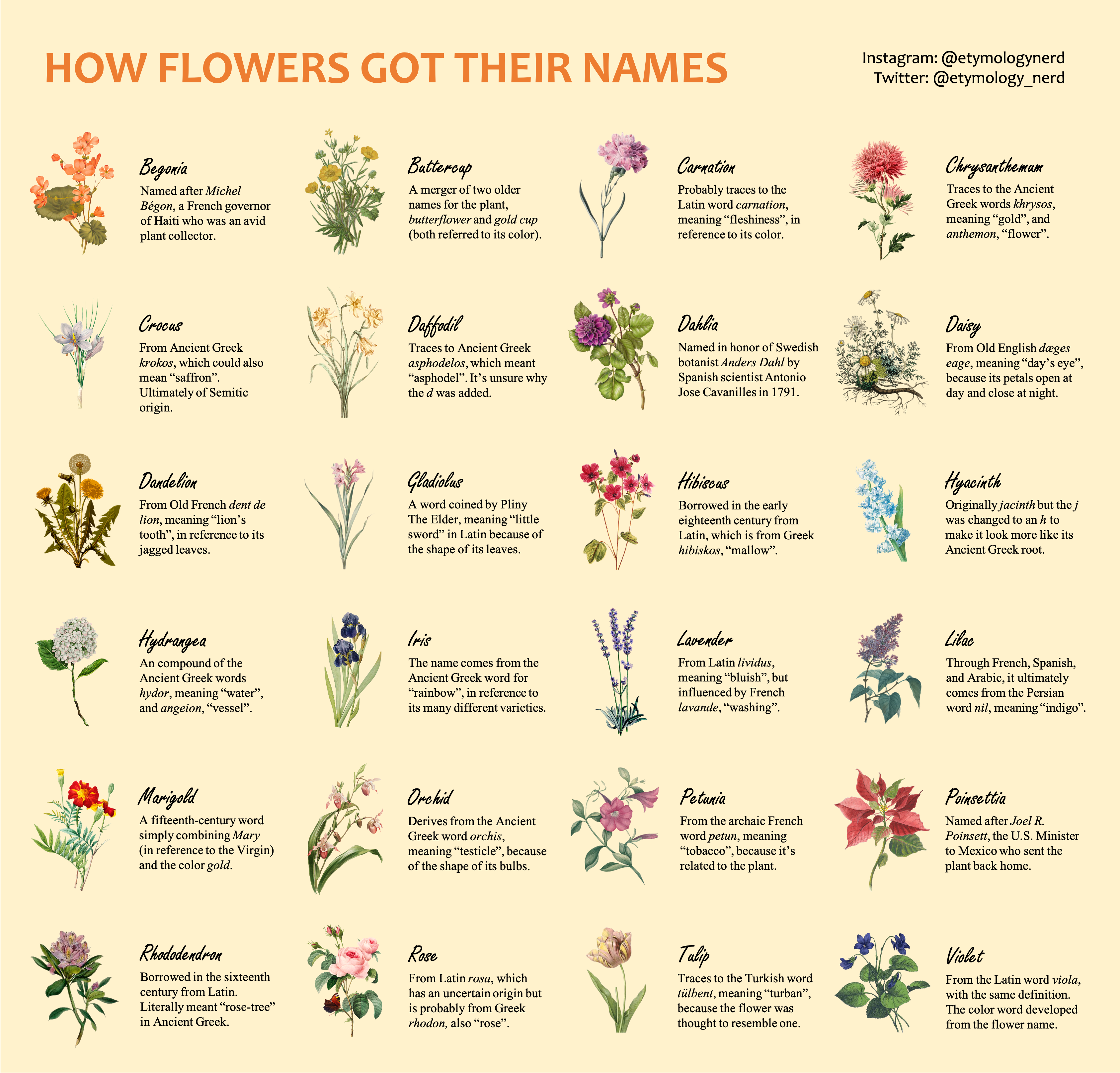
Where do flower names come from?
Most flower names come from Ancient Greek or Latin words that describe a plant’s colour or shape, such as chrysanthemum (“gold flower”) and gladiolus (“little sword”). Others honour a person, like the dahlia and begonia, borrow the name of a related plant, or were made up in English, like daisy (“day’s eye”). Knowing the root often tells you what people first noticed about the flower.
The infographic by the Etymology Nerd (the linguist Adam Aleksic) traces 24 common garden and cut flowers back to their roots. This article uses those origins, checked against dictionaries and botanical references, to explain how flower names are formed, why the same flower can have several names, and what some of the best known names actually mean.
Flower names and their meanings
These are the origins of 24 familiar flower names, in alphabetical order. Where the infographic and the dictionaries differ, the table gives the dictionary version and the difference is explained further down.
| Flower | Root language | Original word and meaning |
|---|---|---|
| Begonia | Person | Michel Bégon, French governor of Saint-Domingue (now Haiti) and plant collector [1] |
| Buttercup | English | Butter plus cup, from the yellow colour, merging older names such as butterflower and gold cup [2] |
| Carnation | Latin | carnātiō, “fleshiness”, from carō, flesh, after its pink colour [3] |
| Chrysanthemum | Greek | khrysos, gold, and anthemon, flower [4] |
| Crocus | Greek | krokos, which also meant saffron, ultimately from a Semitic language [5] |
| Daffodil | Greek | asphodelos, asphodel. The extra d may come from Dutch de affodil [6] |
| Dahlia | Person | Anders Dahl, Swedish botanist, named by Antonio José Cavanilles in 1791 [7] |
| Daisy | Old English | dæges eage, “day’s eye”, because the flower opens by day and closes at night [8] |
| Dandelion | French | dent de lion, “lion’s tooth”, after the jagged leaves [9] |
| Gladiolus | Latin | “Little sword”, from gladius, sword, after the leaf shape [10] |
| Hibiscus | Greek | hibiskos, a name for the marsh mallow [11] |
| Hyacinth | Greek | hyakinthos, a dark blue flower and a figure in Greek myth. Earlier English used jacinth [12] |
| Hydrangea | Greek | hydor, water, and angeion, vessel, after the cup-shaped seed capsules [13] |
| Iris | Greek | iris, rainbow [14] |
| Lavender | Latin | Medieval Latin lavendula, possibly from lividus, bluish, influenced by lavare, to wash [15] |
| Lilac | Persian, via Arabic | Arabic līlak, usually traced to Persian nil, indigo [16] |
| Marigold | English | Mary (the Virgin) plus gold, recorded from the 15th century [17] |
| Orchid | Greek | orchis, testicle, after the shape of the paired underground tubers [18] |
| Petunia | French, from Tupi | Old French petun, tobacco, a related plant [19] |
| Poinsettia | Person | Joel Roberts Poinsett, the first US Minister to Mexico [20] |
| Rhododendron | Greek | rhodon, rose, and dendron, tree [21] |
| Rose | Latin | rosa, probably linked to Greek rhodon [22] |
| Tulip | Turkish, from Persian | Ottoman Turkish tülbent, muslin or turban cloth, because the flower looks like a turban [23] |
| Violet | Latin | viola. The colour word came from the flower, not the other way round [24] |
The four main ways flowers get their names
Read across the list and the same few patterns keep coming up. Most flower names were coined by people trying to describe the plant in front of them, using whatever language they wrote in.
Named after the colour
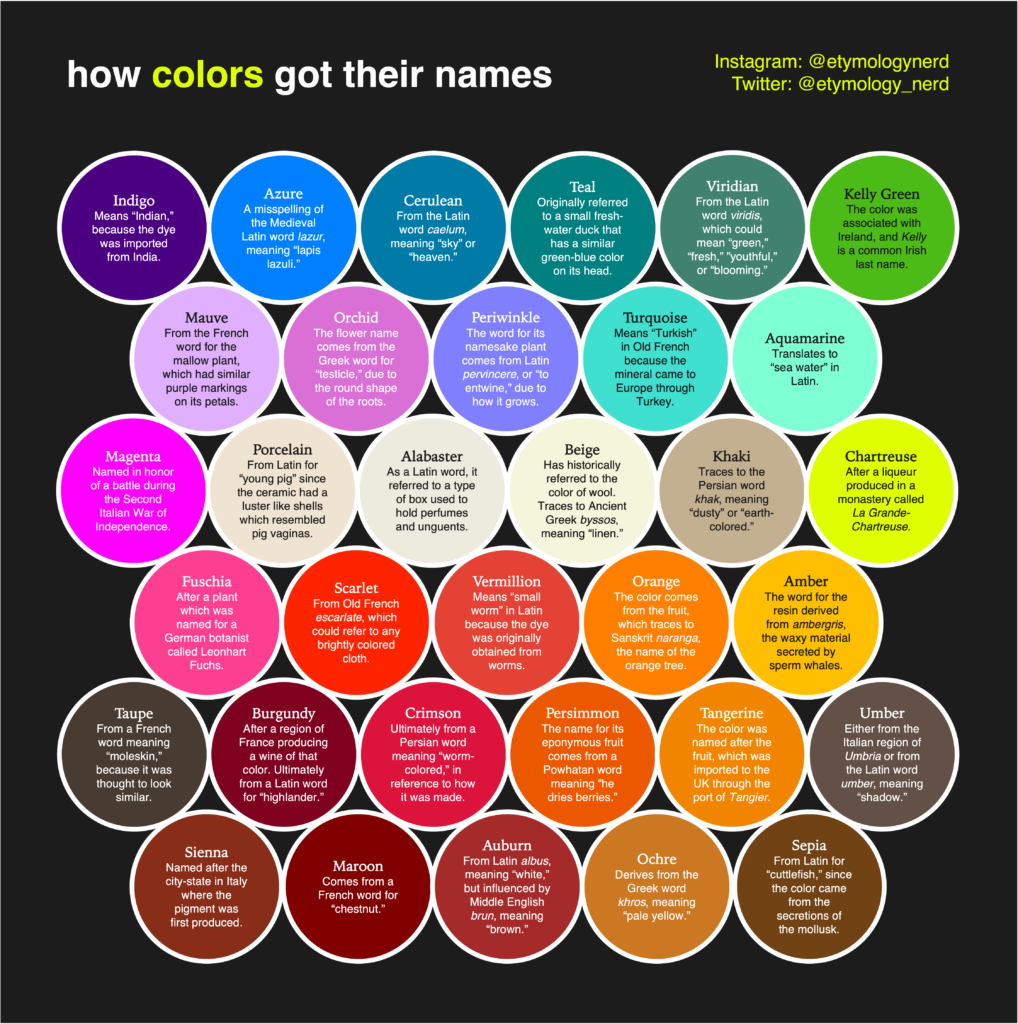
Colour is the most common starting point. Chrysanthemum means gold flower, carnation comes from the Latin for flesh (an early name for the pink colour), buttercup and marigold both refer to yellow or gold, and lilac goes back to a Persian word for indigo. Violet is an interesting case because the word for the colour came from the flower, so the flower name is the older of the two.
Named after the shape
Shape comes next. The gladiolus has sword-shaped leaves, so it is the little sword. The dandelion’s toothed leaves gave it the French name for a lion’s tooth. Hydrangea refers to the cup-like seed capsules, and tulip comes from the turban the open flower was thought to look like. Orchid is the one that surprises people. The Greek word orchis means testicle, after the shape of the pair of tubers under the ground.
Named after people
From the 17th century, botanists started naming new plants after colleagues, patrons and collectors. The French botanist Charles Plumier named the begonia after Michel Bégon, and also named the magnolia after Pierre Magnol and the fuchsia after Leonhart Fuchs [1][25][26]. Cavanilles named the dahlia after Anders Dahl in 1791 [7], Linnaeus named the camellia after the Jesuit botanist Georg Joseph Kamel [27], and the gardenia honours the Scottish naturalist Alexander Garden [28]. The poinsettia is different because its common English name came from Joel Roberts Poinsett, who is credited with bringing the plant from Mexico to the US in the 1820s, rather than from a botanist [20].
Named after another plant or a story
Some flowers took the name of something they resembled or were related to. Daffodil is a changed form of asphodel, hibiscus was the Greek name for a mallow, and petunia comes from an old French word for tobacco, which belongs to the same plant family. Hyacinth comes from Greek myth, in which the flower grew from the blood of a young man called Hyacinthus [32].
Common names and botanical names
Every flower has two kinds of name. The common name is the everyday word, like daisy or marigold, and it can change from one country or region to the next. The botanical name is the Latin two-part name used by scientists, such as Bellis perennis for the common daisy. That two-part system was set out by Carl Linnaeus in Species Plantarum, published in 1753, which is still the official starting point for the naming of most plants [29].
The two systems often overlap. Dahlia, begonia, magnolia, fuchsia, iris and rhododendron are both the common name and the genus name, which is why so many garden flowers have Latin-sounding names. Common names can also mislead. Marigold was first used for the European pot marigold, Calendula officinalis, and was later given to the unrelated Tagetes marigolds from Mexico and Central America [30]. If you are buying seeds or plants, the botanical name is the one to check.
Common mistakes about flower name origins
The Etymology Nerd’s origins hold up well against the dictionaries, with a few small slips. The graphic gives the Latin root of carnation as “carnation”, which is just the English word. The Latin is carnātiō, and Wiktionary notes a second theory that the flower name is a corruption of coronation, after its crown-like shape [3]. For lavender, the “washing” link comes from the Latin lavare, to wash, not from French. French lavande simply means lavender [15]. Its hydrangea entry starts “An compound”, a typo for “A compound”.
Questions about flower names
Which flowers are named after people?
Begonia (Michel Bégon), dahlia (Anders Dahl), poinsettia (Joel Roberts Poinsett), magnolia (Pierre Magnol), fuchsia (Leonhart Fuchs), camellia (Georg Joseph Kamel), gardenia (Alexander Garden) and zinnia (Johann Gottfried Zinn) are all named after real people [1][7][20][25][26][27][28][31].
Why is a daisy called a daisy?
Daisy comes from the Old English dæges eage, meaning “day’s eye”, because the flower opens in the morning and closes at night [8].
What does the word tulip mean?
Tulip comes through French from the Ottoman Turkish tülbent, a word for muslin or turban cloth, because the open flower was thought to look like a turban. Turban is from the same root [23].
Where does the word orchid come from?
Orchid comes from the Ancient Greek orchis, meaning testicle, after the shape of the paired tubers that many orchids have under the ground [18].
Why do flowers have Latin names?
Latin was the shared language of science in Europe when plants were first classified, so botanists used it to give every plant one name that people anywhere could recognise. Linnaeus’s Species Plantarum of 1753 is the starting point for the botanical names still used today [29].
What is the oldest flower name in English?
It is hard to name one, but daisy is among the oldest. It was already in use in Old English as dæges eage, more than a thousand years ago [8]. Rose and lily also came into Old English early, from Latin.
Sources
- Wikipedia, Begonia
- Wiktionary, buttercup
- Wiktionary, carnation
- Wikipedia, Chrysanthemum
- Wiktionary, crocus
- Etymonline, daffodil
- Wikipedia, Dahlia
- Wikipedia, Bellis perennis
- Wikipedia, Taraxacum (dandelion)
- Wiktionary, gladiolus
- Wikipedia, Hibiscus
- Wiktionary, hyacinth
- Wikipedia, Hydrangea
- Etymonline, iris
- Wiktionary, lavender
- Wiktionary, lilac
- Wiktionary, marigold
- Wikipedia, Orchis
- Wiktionary, petunia
- Wikipedia, Poinsettia
- Wikipedia, Rhododendron
- Wikipedia, Rose
- Wiktionary, tulip
- Wiktionary, violet
- Wikipedia, Magnolia
- Wikipedia, Fuchsia
- Wikipedia, Camellia
- Wikipedia, Gardenia
- Wikipedia, Species Plantarum
- Wikipedia, Tagetes
- Wikipedia, Zinnia
- The Etymology Nerd, Infographics (the creator’s original page)
- Wikipedia, Hyacinth (plant)
Last reviewed 11 November 2026