How often does academia mention prejudice?
Academia mentions prejudice far more often now than it did 50 years ago, but the most recent data show a small fall. David Rozado’s analysis of millions of academic abstracts found that terms such as racism, sexism, homophobia, transphobia and Islamophobia were rare before the 1970s, rose sharply from the 2010s and peaked around 2021. By August 2024 most had dipped slightly. Antisemitism is the exception, as its highest point came in the early 1940s.
Rozado, an associate professor at Otago Polytechnic in New Zealand who studies language trends with data [4], measures how often each word appears as a share of all the words in paper abstracts each year. His chart, which accompanies this article, covers 1900 to 6 August 2024 using abstracts from S2ORC, the Semantic Scholar Open Research Corpus [1][3]. Each pair of terms is counted together, so “racism” and “racist” form one series, and so on.
Prejudice terms in academic papers since 1900
Each prejudice term took off at a different time, which roughly follows when each issue entered public debate. The approximate dates below are read from Rozado’s chart, where each panel has its own scale [1].
| Terms | When use took off | Approximate peak | Position in 2024 |
|---|---|---|---|
| Racism, racist | 1960s, then much faster after the mid 2010s | About 2020 to 2021 | Around two thirds of the peak |
| Sexism, sexist | Early 1970s | A first high around 1980 and a second, slightly higher one around 2022 | Around three quarters of the peak |
| Homophobia, homophobic | 1980s | Late 1990s, with a second high in the mid 2010s | Around half of the peak |
| Islamophobia, Islamophobic | Early 2000s | Late 2010s | Around two thirds of the peak |
| Transphobia, transphobic | About 2010 | Early 2020s | Still close to the peak |
| Antisemitism, antisemitic | Already in use in the early 1900s | Early 1940s | A steady, much lower level since about 1950 |
The terms differ hugely in how common they are. Racism and racist are by far the most used, reaching roughly 16 in every million words of abstracts at their peak. Transphobia and transphobic peak at under half a word per million, about 40 times less often [1]. Treat the 2024 figures with some care, as they cover only part of the year.
Why mentions of prejudice rose in academic research
Rozado’s work describes the rise without proving a single cause. In his 2022 study of 175 million abstracts in all fields, he found that the use of prejudice terms grew steadily and widely across academic publishing from the 1980s, then rose much faster after about 2014 [2]. One statistical factor he derived explains 56% of the variation in 25 prejudice terms in scholarly writing, and it shows that steady growth followed by a marked increase after 2014 [2].
He also found that new prejudice terms often appear in academic writing first and spread to the news later. That was the case for homophobia and ageism in the 1970s and for Islamophobia, ableism and transphobia in later years [2]. Fatphobia went the other way, showing up in the news before it reached academic papers [2].
The timing of each term’s rise lines up with wider events. Sexism took off with the women’s movement of the 1970s, homophobia with gay rights campaigning and the AIDS era of the 1980s and 1990s, and Islamophobia after the September 2001 attacks. The jump in racism terms around 2020 came alongside the protests that followed George Floyd’s murder in the United States. These are matches in timing rather than tested causes, and Rozado’s research doesn’t claim to show what drove each change.
Antisemitism follows a different pattern because it was already a subject of academic writing before the Second World War. The highest values on the chart fall in the early 1940s, during the Holocaust [1]. Rozado’s chart notes that some isolated early spikes in other series are due to what appear to be corrupted date stamps in the source data, so single early peaks shouldn’t be read too literally [1].
Are mentions of prejudice in academia declining?
Yes, slightly. Rozado wrote in September 2024 that “the most recent data indicate a slight decline in mentions of prejudice in scholarly papers over the past few years, following a peak around 2021” [1]. Five of the six term pairs on his chart were below their highs in 2024, and only transphobia was still close to its peak.
In the same post he reports that several terms linked to diversity, equity and inclusion (DEI) were still rising in academic papers with no sign of slowing [1]. He suggests attention may be moving away from denouncing prejudice, with words such as racist and sexist, and towards more positively framed terms such as fairness and inclusion, plus words that highlight disadvantage such as marginalised and underrepresented [1]. He is careful to add that this is hard to confirm, given the natural ebb and flow of word popularity and the risk of picking examples to fit a story [1].
Prejudice terms in academia and the news media
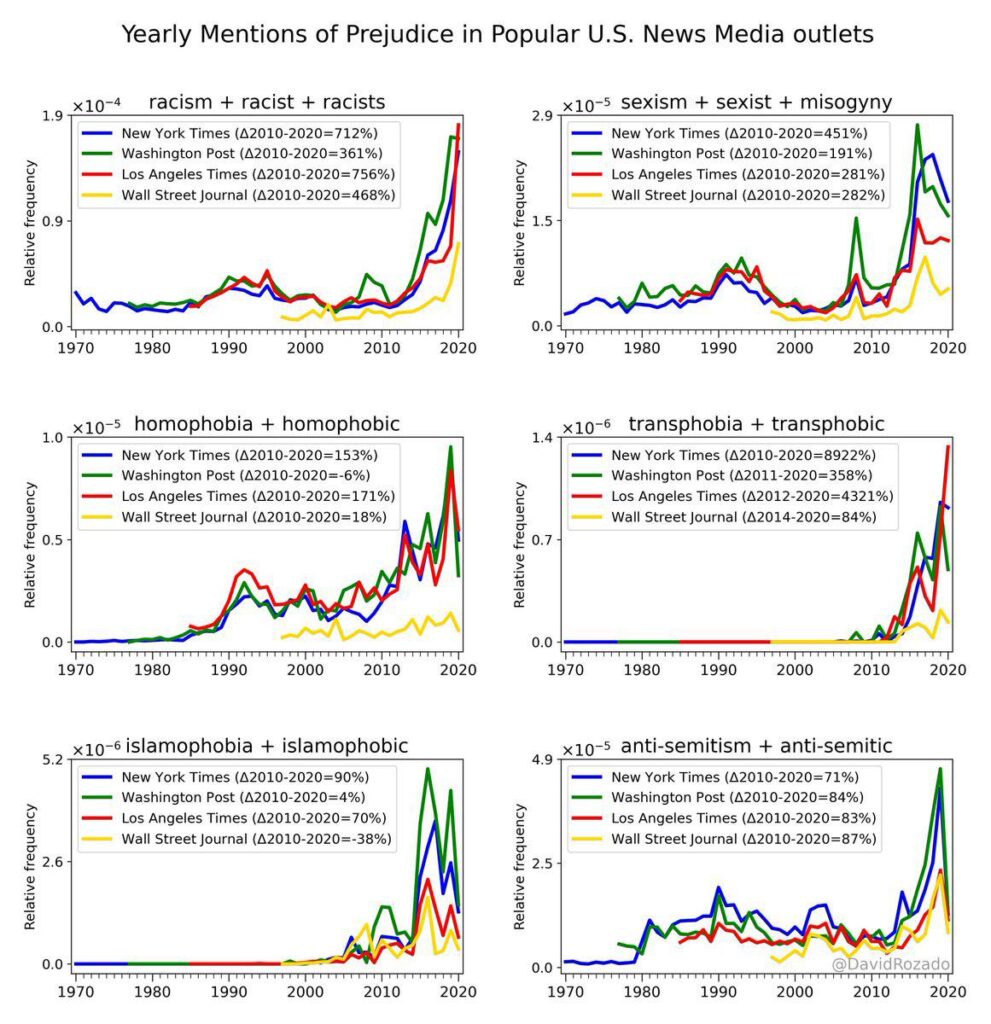
The same rise appears in newspapers, but it started later and was sharper. Rozado’s earlier study of 27 million news and opinion articles published between 1970 and 2019 in 47 popular US outlets found that words for prejudice based on ethnicity, gender, sexual orientation and religion increased markedly within the 2010s [5]. In his 2022 comparison, academic use grew gradually from the 1980s while news use stayed flat until the early 2010s, after which both rose abruptly, and more steeply in the news [2].
The news trend turned first. In June 2023 Rozado reported that mentions of ethnic prejudice were already down in some of the most influential American newspapers, with a similar pattern in the UK, though he said it was too early to say the trend had ended [6]. Academic papers reached their peak around the same time and have dipped since [1]. If you want the news side in more detail, see the related chart of mentions of prejudice in US news media from 1970 to 2020.
How word frequency studies work and their limits
Studies like this count words, not ideas. The method is simple. Take a large body of text, count how often a word appears each year, and divide by the total number of words that year so that the growth of publishing doesn’t distort the trend. That makes it easy to compare decades, but it has limits you should keep in mind.
- A mention isn’t an endorsement. A paper can mention racism to study it, measure it, deny it or criticise the term itself, and all count the same.
- Only abstracts are counted, so a paper that discusses prejudice at length in its main text but not in the summary is missed.
- Fields have grown at different rates. Growth in social science, health and education research can raise the share of prejudice terms even if individual disciplines haven’t changed much.
- Wording shifts over time. Older papers may have written “racial prejudice” or “discrimination” where newer ones write “racism”, so a single pair of words can understate earlier interest.
- Early data are thin. Far fewer papers were indexed in the early 20th century, which makes single years noisy, and the chart applies no smoothing [1].
Rozado’s chart is still a useful picture of how academic language has changed, as long as you read it as a measure of vocabulary rather than of how much prejudice exists.
Questions about academia mentions of prejudice
Are mentions of racism in academic papers declining?
Slightly. Mentions of racism and racist in abstracts peaked around 2020 to 2021 and were around two thirds of that level in the 2024 data, which ran to 6 August 2024 [1].
Which prejudice term is most common in academic papers?
Racism and racist are the most common of the six pairs Rozado tracked, appearing roughly 40 times more often than transphobia and transphobic at their respective peaks [1].
When was antisemitism mentioned most in academic papers?
The early 1940s. It is the only one of the six terms with substantial use before the Second World War, and it has stayed at a lower, fairly steady level since about 1950 [1].
Where does the data come from?
The chart uses paper abstracts from S2ORC, the Semantic Scholar Open Research Corpus run by the Allen Institute for AI, as downloaded on 6 August 2024 [1][3]. The chart labels it “SSORC”.
What is an academia mention?
In this context it means a use of a word in academic writing, here counted in paper abstracts. People searching the phrase are often looking for the Mentions feature on Academia.edu, which sends users emails saying their name has been mentioned in a paper uploaded there. That is a separate thing from this research.
Sources
- David Rozado, Mentions of Prejudice in Academic Papers, A Declining Trend Amidst Ongoing DEI Growth?, Substack, 10 September 2024. The post this chart comes from.
- David Rozado, The Academic Literature and its Increasing Emphasis on Prejudice and Social Justice, Substack, 10 August 2022, summarising his paper in Academic Questions.
- Allen Institute for AI, S2ORC, the Semantic Scholar Open Research Corpus.
- David Rozado, curriculum vitae.
- David Rozado and others, Prevalence of Prejudice-Denoting Words in News Media Discourse, A Chronological Analysis, Social Science Computer Review.
- David Rozado, Is the Great Awokening really winding down?, Substack, 19 June 2023.
Last reviewed 13 November 2026