Key points from the infographic
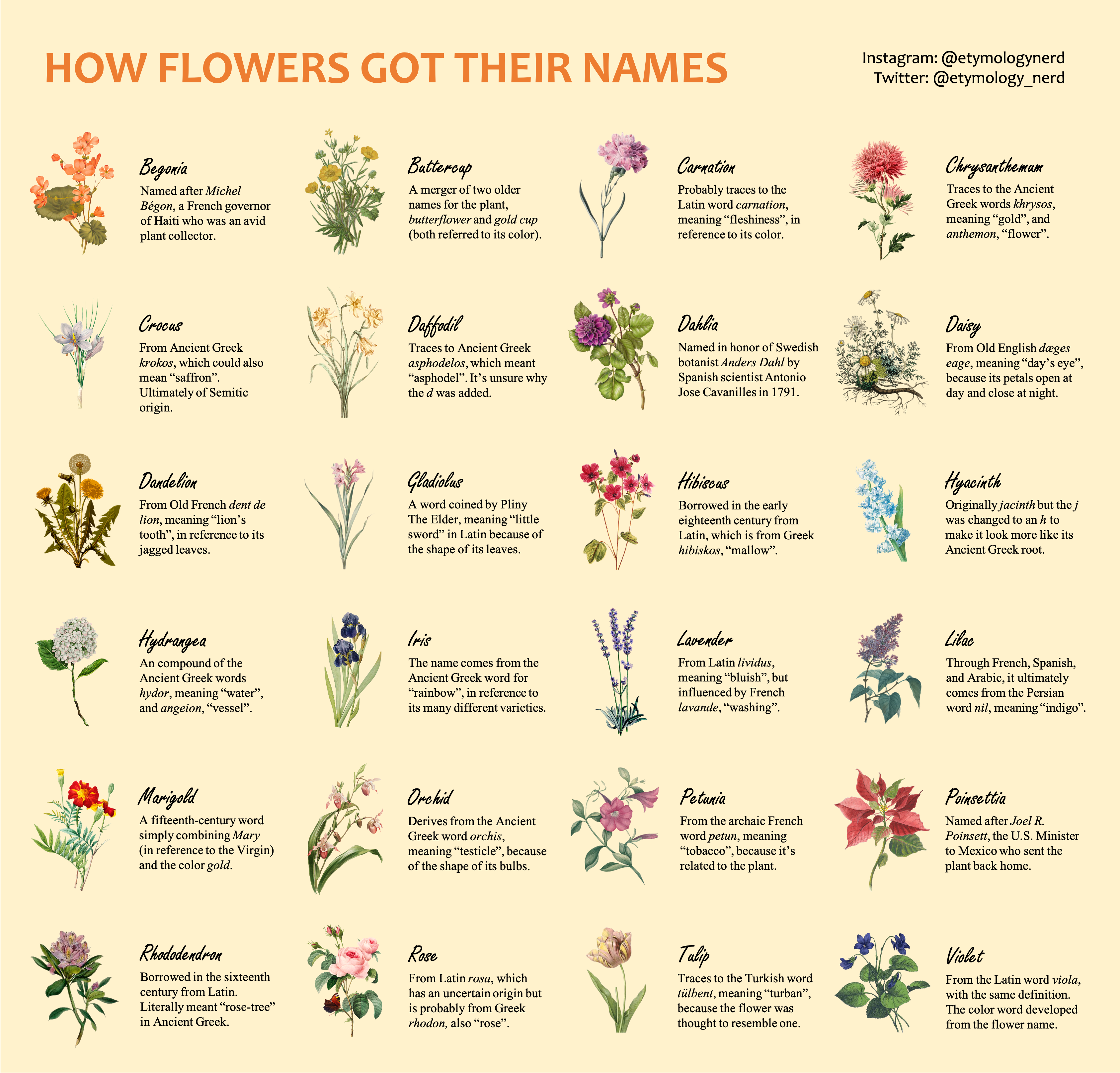
- The chart explains the names of 24 flowers, in alphabetical order from begonia to violet.
- Three flowers are named after people: begonia (Michel Bégon), dahlia (Anders Dahl) and poinsettia (Joel R. Poinsett).
- Most names come from Ancient Greek or Latin, often describing the plant’s colour or shape: chrysanthemum is “gold flower”, gladiolus “little sword”, hydrangea “water vessel”.
- Some names were built in English, such as daisy (“day’s eye”), buttercup and marigold.
- All 24 entries are from the infographic. We checked each one against a dictionary or reference page.
All 24 flower names in text
The middle column keeps the infographic’s wording, including its American spelling. The right column is our check.
| Flower | What the infographic says | What we checked |
|---|---|---|
| Begonia | Named after Michel Bégon, a French governor of Haiti who was an avid plant collector. | Confirmed. Bégon governed Saint-Domingue, the French colony that is now Haiti [1]. |
| Buttercup | A merger of two older names for the plant, butterflower and gold cup (both referred to its color). | Wiktionary gives butter plus cup, from the yellow colour [24]. |
| Carnation | Probably traces to the Latin word carnation, meaning “fleshiness”, in reference to its color. | The Late Latin word is carnātiō [2]. See the notes. |
| Chrysanthemum | Traces to the Ancient Greek words khrysos, meaning “gold”, and anthemon, “flower”. | Confirmed [3]. |
| Crocus | From Ancient Greek krokos, which could also mean “saffron”. Ultimately of Semitic origin. | Confirmed, from Greek krókos and an ancient Semitic language [4]. |
| Daffodil | Traces to Ancient Greek asphodelos, which meant “asphodel”. It’s unsure why the d was added. | Confirmed. The d may come from Dutch de affodil [5]. |
| Dahlia | Named in honor of Swedish botanist Anders Dahl by Spanish scientist Antonio Jose Cavanilles in 1791. | Confirmed [6]. |
| Daisy | From Old English dæges eage, meaning “day’s eye”, because its petals open at day and close at night. | Confirmed [7]. |
| Dandelion | From Old French dent de lion, meaning “lion’s tooth”, in reference to its jagged leaves. | Confirmed [8]. |
| Gladiolus | A word coined by Pliny The Elder, meaning “little sword” in Latin because of the shape of its leaves. | “Little sword” confirmed [9]. We did not check the Pliny attribution. |
| Hibiscus | Borrowed in the early eighteenth century from Latin, which is from Greek hibiskos, “mallow”. | Greek hibískos was the name for a mallow, Althaea officinalis [10]. |
| Hyacinth | Originally jacinth but the j was changed to an h to make it look more like its Ancient Greek root. | The Greek root is Hyacinth, a figure in Greek myth [11]. |
| Hydrangea | An compound of the Ancient Greek words hydor, meaning “water”, and angeion, “vessel”. | Confirmed. The name refers to the shape of the seed capsules [12]. |
| Iris | The name comes from the Ancient Greek word for “rainbow”, in reference to its many different varieties. | Rainbow confirmed [13]. See the notes. |
| Lavender | From Latin lividus, meaning “bluish”, but influenced by French lavande, “washing”. | See the notes [14]. |
| Lilac | Through French, Spanish, and Arabic, it ultimately comes from the Persian word nil, meaning “indigo”. | From French, from Arabic līlak [15]. Persian step not checked. |
| Marigold | A fifteenth-century word simply combining Mary (in reference to the Virgin) and the color gold. | Confirmed [16]. |
| Orchid | Derives from the Ancient Greek word orchis, meaning “testicle”, because of the shape of its bulbs. | Confirmed. The shape is of the paired underground tubers [17]. |
| Petunia | From the archaic French word petun, meaning “tobacco”, because it’s related to the plant. | Confirmed. French took pétun from a Tupi Guarani language [18]. |
| Poinsettia | Named after Joel R. Poinsett, the U.S. Minister to Mexico who sent the plant back home. | Confirmed. Poinsett was the first US minister to Mexico [19]. |
| Rhododendron | Borrowed in the sixteenth century from Latin. Literally meant “rose-tree” in Ancient Greek. | Confirmed, from rhódon and déndron [20]. |
| Rose | From Latin rosa, which has an uncertain origin but is probably from Greek rhodon, also “rose”. | Confirmed [21]. |
| Tulip | Traces to the Turkish word tülbent, meaning “turban”, because the flower was thought to resemble one. | Confirmed [22]. |
| Violet | From the Latin word viola, with the same definition. The color word developed from the flower name. | Confirmed [23]. |
How flowers got their names
Read together, the 24 entries show four common routes to a flower name.
- Colour. Chrysanthemum (gold), carnation (flesh), lilac (indigo in the graphic’s account), violet and marigold.
- Shape. Gladiolus (sword-shaped leaves), dandelion (toothed leaves), hydrangea (seed capsules shaped like a water vessel [12]), orchid (tubers) and tulip (a turban).
- People and myth. Begonia, dahlia and poinsettia honour real people. Hyacinth takes its name from a figure in Greek myth whose blood, in the story, became the flower [11].
- Another plant. Daffodil comes from asphodel, hibiscus from a Greek name for a mallow, and petunia from a word for tobacco, a related plant.
Flowers named after people
The begonia was named by the French botanist Charles Plumier, who found six new species in the Antilles and named them after Michel Bégon [1]. Antonio José Cavanilles, director of the Royal Gardens of Madrid, flowered dahlia plants sent to him from Mexico and in 1791 named them after Anders Dahl [6]. The poinsettia takes its English name from Joel Roberts Poinsett, who is credited with introducing it to the US in the 1820s [19].
Notes on this infographic
- Carnation. The graphic gives the Latin word as carnation. The Late Latin form is carnātiō, “fleshiness”, from carō, flesh. Wiktionary also notes a second theory, that the flower name is a French corruption of coronation, from its likeness to a crown [2].
- Begonia. At the time, Haiti was the French colony of Saint-Domingue [1].
- Iris. Etymonline confirms the Greek word means rainbow, and links it to Iris, messenger of the gods, who appeared as a rainbow [13]. It does not give the graphic’s reason, “its many different varieties”.
- Lavender. Wikipedia gives a different main line from the graphic. It traces the word through Old French lavandre to Latin lavare, to wash, from the use of the plant in bathing [14].
- Hydrangea. The graphic’s “An compound” is a typo for “A compound”.
- The infographic shows no sources and no date.
Questions about flower name origins
Which flowers are named after people?
Three of the 24 flowers on the chart are named after people. The begonia honours Michel Bégon, a French governor of what is now Haiti, the dahlia honours Swedish botanist Anders Dahl, and the poinsettia honours Joel R. Poinsett, the US Minister to Mexico. Antonio José Cavanilles named the dahlia in 1791 [6], and Poinsett is credited with introducing the poinsettia to the US in the 1820s [19].
Why is a daisy called a daisy?
The name daisy comes from Old English dæges eage, meaning "day's eye", because the flower's petals open in the day and close at night [7]. It is one of several flower names built in English rather than taken from Greek or Latin, alongside buttercup, a merger of butterflower and gold cup, and marigold.
What does the word tulip mean?
The word tulip traces to the Turkish tülbent, meaning "turban", because the flower was thought to resemble one [22]. It is one of several flower names that come from shape, along with gladiolus, from the Latin for "little sword" after its leaves, and orchid, from the Ancient Greek orchis, after the shape of its tubers.
Where does the word lavender come from?
The infographic traces lavender to the Latin lividus, meaning "bluish", influenced by the French lavande, "washing". Wikipedia gives a different main line, tracing the word through Old French lavandre to the Latin lavare, to wash, from the use of the plant in bathing [14].
Sources
- Wikipedia, Begonia
- Wiktionary, carnation
- Wikipedia, Chrysanthemum
- Wiktionary, crocus
- Etymonline, daffodil
- Wikipedia, Dahlia
- Wikipedia, Bellis perennis
- Wikipedia, Taraxacum (dandelion)
- Wiktionary, gladiolus
- Wikipedia, Hibiscus
- Wikipedia, Hyacinth (plant)
- Wikipedia, Hydrangea
- Etymonline, iris
- Wikipedia, Lavandula
- Wiktionary, lilac
- Wiktionary, marigold
- Wikipedia, Orchis
- Wikipedia, Petunia
- Wikipedia, Poinsettia
- Wikipedia, Rhododendron
- Wikipedia, Rose
- Wikipedia, Tulip
- Wiktionary, violet
- Wiktionary, buttercup
- The Etymology Nerd, Infographics
Last reviewed 29 October 2026