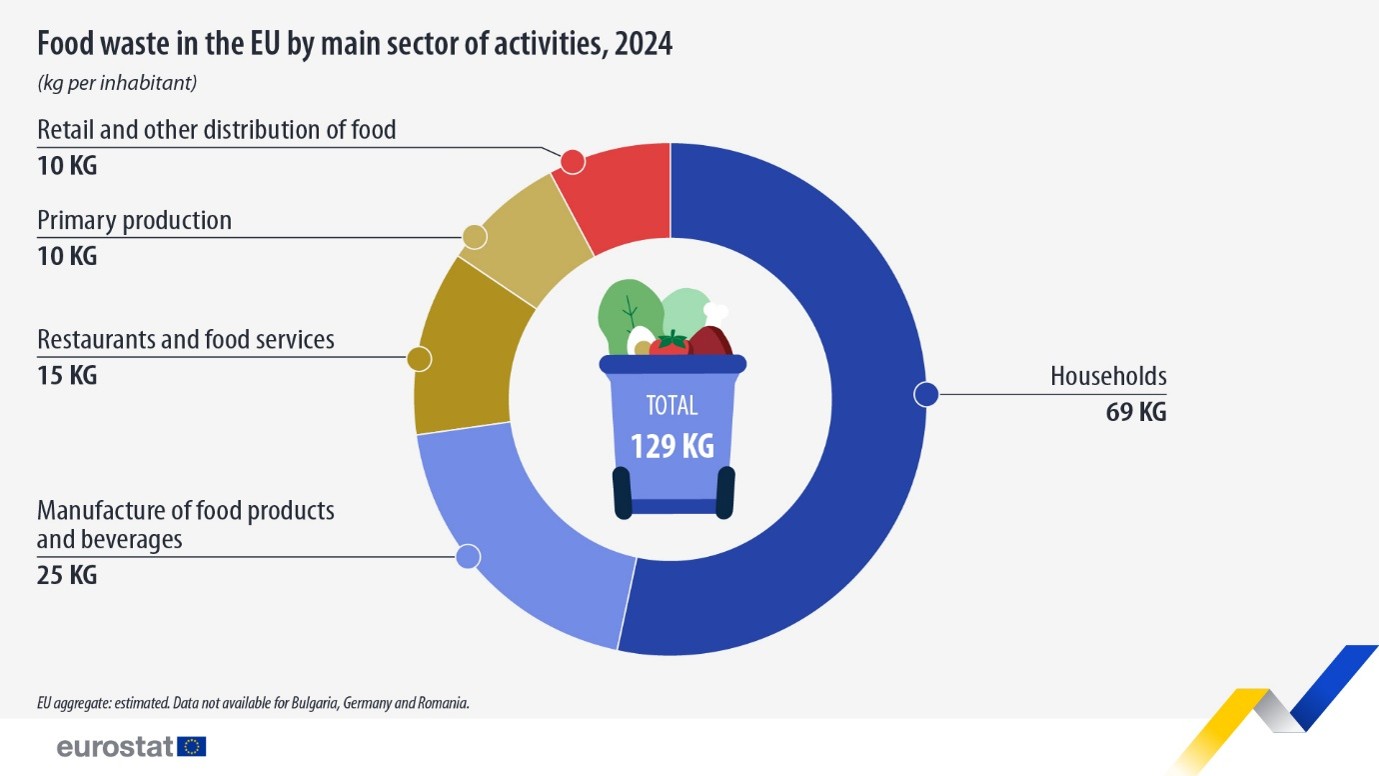
The EU throws away around 58 million tonnes of food a year, which works out at 129 kg for every person. Eurostat’s latest figures, for 2024, show that households cause more than half of it (69 kg each), with the rest spread across food factories, restaurants, shops and farms. The total has barely moved since EU countries started measuring it in 2020.
How much food is wasted in the EU?
Around 58 million tonnes of food were wasted in the EU in 2024, or 129 kg per inhabitant, according to Eurostat. That is roughly 2.5 kg for every person, every week.
The weekly figure is our own division of Eurostat’s annual total, but it makes the scale easier to picture. It’s food that was bought, grown or made to be eaten and was thrown away instead.
The figure covers both edible food and the parts nobody is expected to eat, such as bones, peel and eggshells. Eurostat counts food as waste once it has entered the food supply chain and is then thrown away, whether on a farm, in a factory, in a shop or at home. Food that is never harvested, or that can’t be sold for safety reasons, is a “food loss” and isn’t included.
The 2024 EU total is an estimate. Bulgaria, Germany and Romania hadn’t sent their 2024 data when Eurostat published it in September 2026, so Eurostat filled those gaps with each country’s closest earlier year. That is why the infographic by Eurostat notes that the EU figure is estimated.
Food waste by sector
Households are by far the biggest source of food waste in the EU, followed by the businesses that make food and drink. The figures below are Eurostat’s 2024 estimates.
| Sector | Food waste per person (kg) | Share of the total |
|---|---|---|
| Households | 69 | 53% |
| Manufacture of food products and beverages | 25 | 19% |
| Restaurants and food services | 15 | 12% |
| Primary production (farming and fishing) | 10 | 8% |
| Retail and other distribution of food | 10 | 8% |
| Total | 129 | 100% |
In tonnes, households threw away 31 million tonnes of food in 2024. Processing and manufacturing came next with more than 11 million tonnes. Restaurants and food services produced under 7 million tonnes, and farms and shops each produced under 5 million tonnes, according to Eurostat.
Household food waste is almost twice the waste from farming and food manufacturing combined. Eurostat points out that those two sectors already have ways to cut waste, for example by selling or reusing discarded parts as by-products. Households don’t, which is one reason the home is where most of the waste builds up.
Why households waste the most food
Most household food waste comes down to buying more than you use and not using what you’ve bought in time. The European Commission lists the main reasons people throw food away at home.
- Storing food badly, for example at the wrong fridge temperature or out of a cool, dark cupboard.
- Not planning meals or shopping, so food goes off before it’s needed.
- Offers such as “buy one, get one free” that lead to impulse buys and buying too much.
- Misreading “best before” and “use by” dates, so edible food is thrown away.
- Not knowing how to use up leftovers or ingredients already in the cupboard.
- Packs that are too big or hard to empty.
- Throwing away bruised or odd-looking fruit and vegetables that are still fine to eat.
- Busy lives, low perceived value of food and fussy eaters.
Date labels on their own make a real difference. A 2018 European Commission study estimated that up to 10% of the food waste generated in the EU each year is linked to date marking. The Commission’s later research, with more than 25,000 consumers across every EU country, found a low level of understanding of date marks everywhere.
Has food waste in the EU gone down?
No. EU food waste has stayed at 128 to 129 kg per person every year since measurement began in 2020, according to Eurostat’s food waste dataset (env_wasfw).
| Year | Total food waste (million tonnes) | Total per person (kg) | Households per person (kg) |
|---|---|---|---|
| 2020 | 57.0 | 128 | 71 |
| 2021 | 57.4 | 129 | 71 |
| 2022 | 57.5 | 129 | 68 |
| 2023 | 57.5 | 128 | 69 |
| 2024 | 57.9 | 129 | 69 |
Inside that flat total, the mix has shifted a little. Waste from primary production fell from 14 kg to 10 kg per person between 2020 and 2024, while waste from food manufacturing rose from 22 kg to 25 kg. Restaurants and food services went from 13 kg to 15 kg. These figures come from the same Eurostat dataset, and countries keep revising earlier years as their methods improve (Eurostat received 24 revisions in the latest round), so small changes should be read with care.
Which EU country wastes the most food?
Cyprus reported the most food waste per person in 2024, at 295 kg, followed by Denmark (261 kg) and Greece (208 kg). Spain reported the least, at 54 kg, according to Eurostat.
| Country | Total food waste per person, 2024 (kg) | Household food waste per person, 2024 (kg) |
|---|---|---|
| Cyprus | 295 | 78 |
| Denmark | 261 | 87 |
| Greece | 208 | 87 |
| Portugal | 161 | 105 |
| France | 145 | 62 |
| Belgium | 137 | 65 |
| Italy | 137 | 103 |
| Malta | 136 | 86 |
| Latvia | 134 | 86 |
| Sweden | 132 | 60 |
| Ireland | 131 | 41 |
| Luxembourg | 130 | 81 |
| Poland | 130 | 70 |
| Netherlands | 129 | 51 |
| Austria | 128 | 69 |
| Croatia | 122 | 55 |
| Finland | 104 | 60 |
| Czechia | 101 | 60 |
| Estonia | 101 | 48 |
| Hungary | 87 | 60 |
| Slovenia | 79 | 35 |
| Slovakia | 72 | 49 |
| Lithuania | 68 | 37 |
| Spain | 54 | 24 |
| EU average | 129 | 69 |
| Norway (not in the EU) | 137 | 72 |
| Iceland (not in the EU) | 127 | 54 |
Bulgaria, Germany and Romania had not reported 2024 data. Some national figures are estimates, and Spain’s and Finland’s household figures use a definition that differs from the standard one, according to Eurostat’s data flags.
Don’t read this table as a straight league table of wasteful countries. Eurostat warns that small countries (under 10 million people) that export a lot of raw and processed food can show high totals, mostly from their food industry. That helps explain Cyprus and Denmark, whose household figures are much closer to the average than their totals. Methods also change. Lithuania’s total fell from 144 kg in 2023 to 68 kg in 2024, which probably reflects a change in how it was measured rather than a real halving of waste in a year.
For household waste alone, Portugal (105 kg) and Italy (103 kg) reported the highest figures in 2024, and Spain (24 kg) and Slovenia (35 kg) the lowest.
Food waste around the world
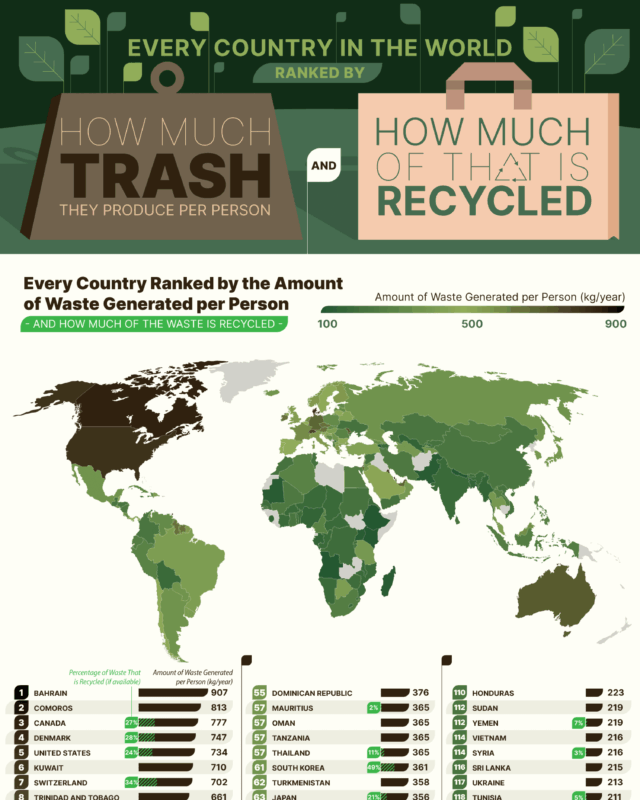
The world wasted about 1.05 billion tonnes of food in 2022, or 132 kg per person, according to the UN Environment Programme’s Food Waste Index Report 2024. That is almost a fifth of all the food available to consumers.
UNEP’s figure covers shops, food services and homes only. Households were responsible for 60% of it, food services for 28% and retail for 12%. UNEP says households wasted more than 1 billion meals a day in 2022, at a time when 783 million people were affected by hunger.
Before food even reaches shops, more is lost. The Food and Agriculture Organization estimates that around 14% of all food produced globally is lost between harvest and retail, as quoted by the European Commission.
UNEP found that household food waste is not just a problem for rich countries. Average household waste in high-income, upper-middle-income and lower-middle-income countries differed by just 7 kg per person. Hotter countries appear to waste more at home, possibly because people eat more fresh food with inedible parts and cold chains are weaker. Only four G20 countries (Australia, Japan, the UK and the USA) and the EU had food waste estimates good enough to track progress to 2030.
Why food waste is a problem
Food waste costs money, adds to climate change and uses land, water and energy to grow food nobody eats. The European Commission puts the market value of the EU’s food waste at around €132 billion a year and says it accounts for about 16% of the greenhouse gas emissions from the EU food system.
Globally, food loss and waste together generate 8 to 10% of annual greenhouse gas emissions, almost five times the emissions of aviation, according to UNEP. They also take up the equivalent of almost a third of the world’s farmland and cost the global economy roughly USD 1 trillion a year.
There is a social side too. While the EU wastes 129 kg of food per person, 8.5% of its population can’t afford a quality meal (with meat, chicken, fish or a vegetarian equivalent) every second day, the European Commission notes, citing Eurostat.
EU targets to cut food waste by 2030
EU countries must cut food waste by 10% in processing and manufacturing and by 30% per person in shops, restaurants and homes by 2030. These binding targets came in with the 2025 amendment of the Waste Framework Directive (Directive (EU) 2025/1892).
Progress is measured against each country’s average food waste in 2021 to 2023, although a country can choose 2020 instead, according to the European Commission. The Commission must review the targets by the end of 2027, including whether to add targets for 2035 and for primary production. The wider goal is the UN’s Sustainable Development Goal 12.3, which aims to halve food waste per person at retail and consumer level by 2030.
The flat EU figures show how big the task is. Using Eurostat’s rounded EU figures, shops, restaurants and homes together produced about 93 kg per person a year on average in 2021 to 2023, and 94 kg in 2024. A 30% cut would bring that down to roughly 65 kg. That is our own rough calculation at EU level, as the legal targets apply to each country separately.
How to reduce food waste at home
The quickest wins are planning what you buy, storing it properly and using it up before it goes off. These steps follow the causes the European Commission identifies.
- Check what you already have before you shop, and plan a few meals around it.
- Make a list and stick to it, and think twice about multi-buy offers on fresh food.
- Store food properly. Keep the fridge cold and put dry goods somewhere cool and dark.
- Learn the difference between date labels. “Use by” is about safety, so don’t eat food after it. “Best before” is about quality, so food is often fine after that date. The European Commission makes this distinction on its date marking page.
- Use leftovers for lunches or another meal, and freeze food you won’t eat in time.
- Don’t throw away fruit and vegetables just because they look bruised or odd.
Businesses have a strong reason to act as well. Research by the World Resources Institute and WRAP across 1,200 business sites found that most companies saved $14 or more for every $1 they invested in cutting food waste, as the European Commission reports.
Questions about food waste
How much food does each person waste on average per year?
In the EU, 129 kg per person in 2024, counting farms, factories, shops, restaurants and homes, according to Eurostat. Of that, 69 kg was wasted at home. Worldwide, UNEP estimates 132 kg per person across shops, food services and homes in 2022.
Which country wastes the most food?
In the EU, Cyprus reported the highest total in 2024 at 295 kg per person, then Denmark and Greece. For household waste alone, Portugal (105 kg) and Italy (103 kg) were highest. Eurostat warns that methods and food industries vary, so country totals aren’t fully comparable.
What percentage of food is wasted?
Almost a fifth (19%) of the food available to consumers worldwide is wasted in shops, food services and homes, according to UNEP. On top of that, the FAO estimates around 14% of food is lost between harvest and retail.
What counts as food waste?
Under the EU definition, food waste is any food that has entered the food supply chain and is then thrown away, including inedible parts such as bones and peel. Crops left unharvested or food that can’t be sold for safety reasons count as food losses instead.
Why is food waste bad for the environment?
Growing, transporting and disposing of food that nobody eats wastes land, water and energy and releases greenhouse gases. UNEP says food loss and waste cause 8 to 10% of global emissions, and the European Commission puts food waste at about 16% of emissions from the EU food system.
Is food waste in the EU going down?
Not yet. Eurostat’s figures have stayed at 128 to 129 kg per person every year from 2020 to 2024. The EU’s binding 2030 targets are meant to change that.
Sources
- Eurostat, Food waste and food waste prevention, estimates (Statistics Explained, data extracted September 2026), including the infographic “Food waste in the EU by main sector of activities, 2024”
- Eurostat, Food waste and food waste prevention by NACE Rev. 2 activity (env_wasfw) (dataset updated 28 September 2026, accessed 22 November 2026)
- European Commission, Food waste
- European Commission, Food waste reduction targets
- European Commission, Date marking and food waste prevention
- UN Environment Programme, World squanders over 1 billion meals a day (27 March 2024) and the Food Waste Index Report 2024
The infographic “Food waste in the EU by main sector of activities, 2024” is by Eurostat and is shared unchanged under the Creative Commons CC BY 4.0 licence, in line with Eurostat’s copyright notice. The data comes from Eurostat (env_wasfw). The per-week figure and the 2030 target estimate above are our own calculations from Eurostat data, and Eurostat is not responsible for them. Its use here does not imply any endorsement by Eurostat or the European Commission.