What the orchid tree of life is
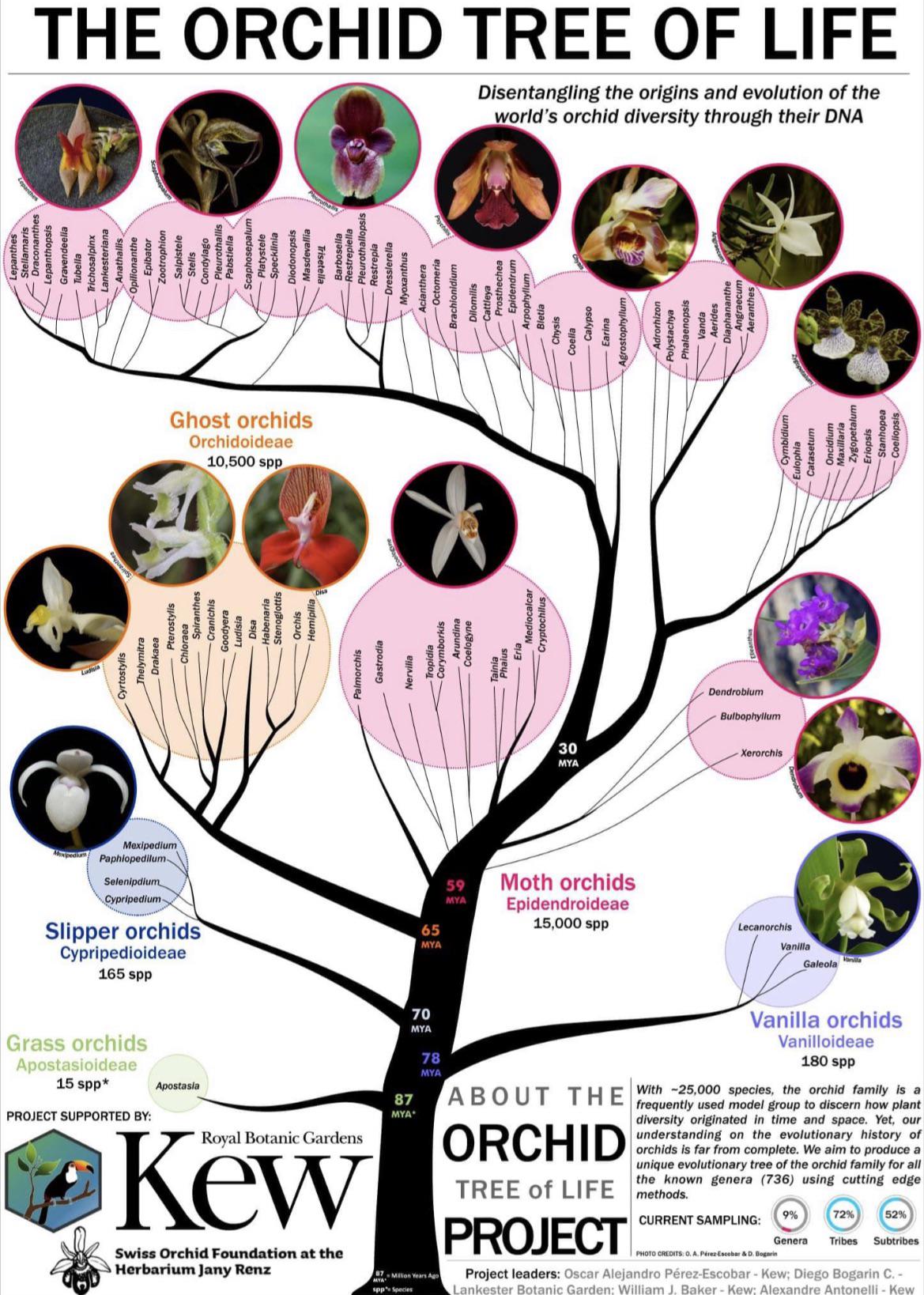
A tree of life is a family tree of species, worked out from how closely their DNA matches. The Orchid Tree of Life project, led from the Royal Botanic Gardens, Kew with the Lankester Botanical Garden in Costa Rica, set out to build one for the whole orchid family, aiming to sample at least one species from every one of the 736 known genera [1][2]. Kew explains why DNA is used: classifying plants by shape and colour can mislead, because similar flowers evolve in unrelated groups, while DNA shows actual relationships [1].
When the poster on this page was made, the project had sampled 9% of genera, 72% of tribes and 52% of subtribes. The main results were published in New Phytologist in 2024. That tree covers all five subfamilies, 17 of the 22 tribes, 40 of the 49 subtribes, 285 of the 736 genera and 1,921 species, about 7% of the 29,524 accepted orchid species [2]. It is the most complete orchid family tree so far.
The five orchid subfamilies
Every orchid belongs to the family Orchidaceae, which is divided into five subfamilies. They branched off from the main line one after another, which is why the family tree has a long trunk with the oldest groups at the bottom. The poster gives these branching dates and species counts, shown here next to current counts from other sources:
| Subfamily | Common name | Branched off (poster) | Species (poster) | Species (current sources) |
|---|---|---|---|---|
| Apostasioideae | Grass orchids | 87 million years ago | 15 | 16, in two genera [2] |
| Vanilloideae | Vanilla orchids | 78 million years ago | 180 | About 180, in 15 genera [3] |
| Cypripedioideae | Slipper orchids | 70 million years ago | 165 | 169, in five genera [2] |
| Orchidoideae | Terrestrial orchids such as Orchis, Disa and Habenaria | 65 million years ago | 10,500 | About 3,630 [4] |
| Epidendroideae | Includes moth orchids (Phalaenopsis) | 59 million years ago | 15,000 | More than 15,000, in 576 genera [5] |
Two things on the poster need correcting. It calls Orchidoideae the ghost orchids, but the best known ghost orchid, Dendrophylax lindenii of Florida and Cuba, is in Epidendroideae [6]. And its count of 10,500 species for Orchidoideae is far above the figure of around 3,630 usually given [4]. The poster also spells the slipper orchid genus Selenipedium as “Selenipdium”.
- Grass orchids are small, grass-like plants found from India and Japan to New Guinea and northern Australia. They are the sister group to all other orchids, and the 2024 study sees their scattered range as what is left of a once much wider distribution [2].
- Vanilla orchids include the plants that vanilla comes from. Apart from orchids grown for their flowers, vanilla orchids are the only ones with any commercial use [7].
- Slipper orchids such as Paphiopedilum and Cypripedium have a slipper-shaped pouch that traps visiting insects, forcing them to climb out past the pollen and stigma [8]. The 2024 study suggests their ancestor lived across a warm northern belt and later moved south [2].
- Orchidoideae are ground-dwelling orchids, including genera such as Orchis, Spiranthes, Goodyera and Disa [4].
- Epidendroideae is larger than all the other subfamilies together. Most are tropical epiphytes, and it includes the familiar houseplant and florist orchids: Phalaenopsis, Cattleya, Dendrobium, Oncidium and Cymbidium [5].
When and where orchids evolved
Molecular dating studies have put the start of the orchid family’s diversification anywhere from 112 to 76 million years ago [2]. The 2024 study estimates that the orchid lineage split from its closest relatives about 120 million years ago, and that the most recent common ancestor of all living orchids lived about 83 million years ago (give or take 10 million years), in the Late Cretaceous, alongside the dinosaurs [2]. The poster’s 87 million years for the first split is within that range.
The same study changed the picture of where orchids started. An earlier analysis had pointed to Australia, but the new tree places the first orchids in Laurasia, the northern supercontinent that later broke up into North America, Europe and Asia [2]. Orchids then spread to the rest of the world, partly through long-distance dispersal of their dust-like seeds. The oldest orchid fossil yet found supports a northern history: a pollen packet from an epidendroid orchid stuck to a fungus gnat preserved in Baltic amber, dated to 55 to 40 million years ago [2].
Despite that long history, most living orchid species are young. The 2024 study found that most of today’s species arose in the last 5 million years, with the fastest rates of new species forming in Panama and Costa Rica, where mountains are still rising [2]. About 30% of living orchid species are in tropical Asia, mostly in Epidendroideae [2].
Why orchids grow on trees
A lot of people searching for an orchid tree of life are really asking how orchids and trees are connected. Most orchid species live on trees as epiphytes, rooted on bark rather than in soil, but they are not parasites. An epiphyte takes its water and nutrients from rain, mist and debris that collects around it, and uses the tree only for support and light [9].
Growing on trees turned out to be one of the main reasons there are so many orchids. A 2015 study from the University of Wisconsin-Madison, which dated the orchid family tree using fossils, found three waves of faster species formation, starting about 60, 40 and 33 million years ago [7]. The first followed the evolution of pollinia, packets of thousands of pollen grains carried off by an insect in one go. The second followed the move into trees and into tropical mountains with constant cloud and rain, and the third followed the spread into the Andes as they were being pushed up. Pollination by orchid bees, moths and butterflies also sped things up [7]. The 2024 study found the same pattern, with the fastest-forming species among tropical American epiphytes such as the tribe Epidendreae and the groups that include Maxillaria and Oncidium [2].
Some features that make orchids unusual did not make a difference. The Wisconsin study found that tiny seeds, the need for fungi to germinate, the fused male and female flower parts, and deceptive pollination (used by about a third of orchids) did not on their own speed up the formation of new species [7].
Questions about the orchid tree of life
How many species of orchids are there?
About 29,500. The 2024 Kew-led study used 29,524 accepted species, based on the World Checklist of Vascular Plants, in 736 genera [2]. The poster’s figure of about 25,000 is an older estimate.
How old are orchids?
The common ancestor of all living orchids lived about 83 million years ago, in the Late Cretaceous, and the orchid lineage itself is about 120 million years old [2]. Most of today’s species are less than 5 million years old.
Where did orchids originate?
In Laurasia, the northern supercontinent, according to the 2024 study. Earlier work had suggested Australia [2].
Which orchid subfamily is the largest?
Epidendroideae, with more than 15,000 species in 576 genera, more than the other four subfamilies combined [5]. It is also the youngest of the five.
What is the relationship between an orchid and a tree?
Most orchid species are epiphytes that grow on trees for light and support without taking anything from the tree [7][9]. Moving into trees was one of the main triggers for the rapid spread of new orchid species [7].
Sources
- Royal Botanic Gardens, Kew, Exploring the orchid family tree, by Eddie Johnston, 28 February 2022 (archived copy).
- Pérez-Escobar, O.A., Bogarín, D., Przelomska, N.A.S. et al., The origin and speciation of orchids, New Phytologist 242 (2024), 700 to 716.
- Wikipedia, Vanilloideae.
- Wikipedia, Orchidoideae.
- Wikipedia, Epidendroideae.
- Wikipedia, Dendrophylax lindenii.
- ScienceDaily, Family tree for orchids explains their astonishing variability, University of Wisconsin-Madison, 3 September 2015.
- Wikipedia, Cypripedioideae.
- Wikipedia, Epiphyte.
Last reviewed 6 November 2026