Human evolution timeline in order
The table below sets out the main hominin species and milestones in date order, using the Smithsonian’s Human Origins Program dates for each species [2][3]. Dates are approximate and are revised as new fossils are found, so treat them as the current best estimates rather than fixed points.
| When | Species or event | Why it matters |
|---|---|---|
| 8 to 6 million years ago | Last common ancestor of humans, chimpanzees and gorillas | The human line separates from the other African apes [2] |
| 7 to 6 million years ago | Sahelanthropus tchadensis | Oldest known hominin, with small canines and signs of upright walking [3] |
| 6.2 to 5.8 million years ago | Orrorin tugenensis | Early hominin from Kenya [3] |
| 5.8 to 5.2 million years ago | Ardipithecus kadabba | Followed by Ardipithecus ramidus about 4.4 million years ago [3] |
| 4.2 to 3.8 million years ago | Australopithecus anamensis | Earliest Australopithecus, walking on two legs [3] |
| 3.85 to 2.95 million years ago | Australopithecus afarensis | The species of the “Lucy” skeleton [3] |
| 3.3 million years ago | Lomekwi stone tools, Kenya | Oldest known stone tools, made before the genus Homo [5] |
| 2.4 to 1.4 million years ago | Homo habilis | One of the earliest members of our genus [3] |
| 1.89 million to 110,000 years ago | Homo erectus | Modern body proportions; first hominin known outside Africa [3][6] |
| 1.76 million years ago | Acheulean handaxes | First major advance in stone tool making [4] |
| 700,000 to 200,000 years ago | Homo heidelbergensis | Built hearths by about 790,000 years ago [3] |
| 400,000 to 40,000 years ago | Homo neanderthalensis | Neanderthals of Europe and western Asia [3] |
| About 300,000 years ago | Homo sapiens | Our species evolves in Africa [3] |
| 100,000 to 50,000 years ago | Homo floresiensis | Small-bodied human from the Indonesian island of Flores [3] |
| 70,000 to 50,000 years ago | Main spread of Homo sapiens out of Africa | Ancestors of everyone living outside Africa today [7] |
| About 40,000 years ago | Last Neanderthals | Leaves Homo sapiens as the last surviving human species [3] |
When did humans first appear?
It depends on what you mean by human. The human line goes back 6 to 7 million years, to the point where the ancestors of people and chimpanzees separated in Africa. The Smithsonian describes human evolution as the process by which people’s physical and behavioural traits evolved from apelike ancestors over about six million years, and notes that all early human fossils from between 6 and 2 million years ago come from Africa [2].
Our genus, Homo, appears much later, around 2.4 million years ago with Homo habilis [3]. Our own species is younger still. Homo sapiens evolved in Africa about 300,000 years ago, during a period of sharp climate change [3]. That date comes mainly from fossils found at Jebel Irhoud in Morocco, dated in 2017 to around 315,000 years ago, which pushed the origin of our species back by more than 100,000 years [8].
The main stages of human evolution
You will often see human evolution split into five, six or seven stages, but there is no official list. The Smithsonian says most scientists recognise 15 to 20 different species of early humans and do not all agree on how they are related [2]. A more useful way to think about it is in broad stages, each defined by a change in body or behaviour.
The earliest hominins (7 to 4.4 million years ago)
Sahelanthropus, Orrorin and Ardipithecus were still largely apelike, with small brains, but show early signs of walking upright. Walking on two legs is one of the oldest human traits, and it had evolved by more than 4 million years ago [2].
The australopiths (4.2 to about 1.2 million years ago)
Australopithecus walked upright on the ground but kept long arms suited to climbing. Brains stayed close to ape size. The robust Paranthropus species, with very large teeth and jaws for tough plant food, lived alongside early Homo until about 1.2 million years ago [3].
Early Homo and the first tools (from about 3.3 to 1.4 million years ago)
Stone tools are older than our genus: the Lomekwi tools from Kenya date to 3.3 million years ago [5]. Cut-marked animal bones and simple stone tools become common from about 2.6 million years ago, around the time Homo habilis appears, and point to a diet with more meat and marrow [3].
Homo erectus and the move out of Africa (1.89 million to 110,000 years ago)
Homo erectus had long legs and shorter arms, much closer to our own body shape [3]. It was the first hominin to leave Africa: fossils at Dmanisi in Georgia date to about 1.8 million years ago [6]. Large handaxes appear about 1.76 million years ago, and the earliest evidence of hearths falls within its time range [3][4].
Archaic humans (700,000 to 40,000 years ago)
Homo heidelbergensis, Neanderthals and their eastern relatives the Denisovans had brains close to or within the modern range. Neanderthals made a wide range of tools, controlled fire, made clothing and hunted large animals [3].
Modern humans (300,000 years ago to now)
Homo sapiens collected and cooked shellfish by 164,000 years ago and made special fishing tools by 90,000 years ago [3]. After several earlier moves out of Africa that left few descendants, one expansion between about 70,000 and 50,000 years ago gave rise to everyone living outside Africa today [7].
Human evolution before the apes
Some timelines start much further back, with the first cells. The infographic by Mark Belan for Visual Capitalist does this, treating human evolution as a 4 billion year chain that runs from single cells through fish, early four-legged animals, mammals and primates to people [1]. It is a useful reminder that many parts of your body are far older than our species: a backbone, jaws, lungs and limbs all appeared hundreds of millions of years before the first apes.
A few of the key steps, with current dates:
- First life. The oldest direct fossil evidence of life is about 3.48 billion years old, and life may have started as early as 4.1 billion years ago [9].
- Early chordates. Pikaia, one of the earliest known animals with a notochord, the forerunner of the spine, lived about 505 million years ago [10].
- Fish on land. Tiktaalik, a fish with limb-like fins, lived about 375 million years ago and is often used to show the move from water to land [11].
- Placental mammals. Juramaia, a small shrew-like mammal on the line leading to placental mammals, lived about 160 million years ago [12].
- Apes. Aegyptopithecus, an early relative of apes and monkeys, dates to about 33 million years ago, and the ape Proconsul to 21 to 17 million years ago [13][14].
Some dates on the graphic are out by a wide margin, so it is worth knowing the right figures. It puts Dickinsonia at 800 million years ago, but this early animal lived in the late Ediacaran, about 567 to 550 million years ago [15]. The early primate Plesiadapis is shown at 90 million years ago, but it lived in the late Paleocene and early Eocene, roughly 60 to 50 million years ago [16]. Aegyptopithecus (shown at 50 million years ago) and Proconsul (35 million) are both younger than shown, as above. The graphic also dates Homo sapiens to 160,000 years ago, an older estimate that the Jebel Irhoud finds replaced with about 300,000 years [3][8], and credits early Homo with building the wheel, which modern humans invented within roughly the last 6,000 years [17].
Human evolution was not a straight line
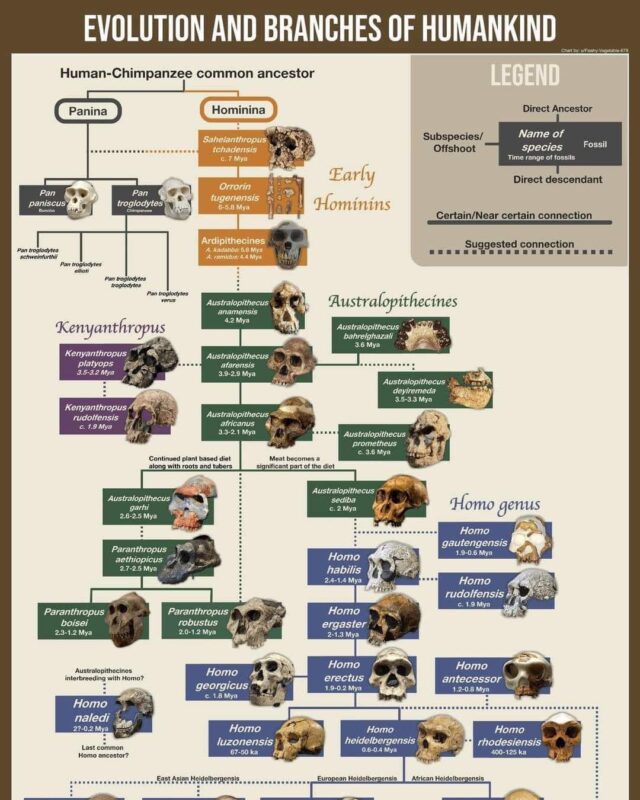
The classic “march of progress” picture, with an ape turning step by step into a modern person, is misleading. Several human species often lived at the same time. Homo erectus shared East Africa with Homo habilis and Paranthropus boisei, and at the end of its range, around 143,000 years ago, it overlapped with Homo sapiens in Indonesia [3]. Neanderthals were not our ancestors but a sister group: Neanderthals and modern humans share a common ancestor that lived between 700,000 and 300,000 years ago [3].
The groups also mixed. Neanderthals interbred with modern humans who had left Africa, and studies estimate that roughly 1% to 4% of the DNA of people of Eurasian descent comes from Neanderthals [18]. How the different lineages branched and relate to each other is covered in more detail on our page about the evolution and branches of humankind.
Are humans still evolving?
Yes. Evolution is a change in the genetic make-up of a population over generations, and that does not stop [2]. What it will produce is much harder to say. The infographic ends with the idea of a “Great Averaging”, where people from around the world mix so much that physical differences between populations blur, and other suggestions that humans may become taller and lighter with smaller brains [1]. These are hypotheses rather than forecasts, and you should read them that way.
Questions about the human evolution timeline
What are the 7 stages of human evolution in order?
There is no official set of seven. A common simplified order is Sahelanthropus or Ardipithecus, Australopithecus, Homo habilis, Homo erectus, Homo heidelbergensis, Neanderthals and Homo sapiens. Neanderthals were a sister group rather than our direct ancestors, so the list is not a single line of descent [3].
When did mankind start to exist?
The human line split from the other apes between 7 and 6 million years ago. The genus Homo appeared around 2.4 million years ago, and Homo sapiens about 300,000 years ago in Africa [2][3].
What humans existed 400,000 years ago?
Homo heidelbergensis in Africa and Europe, the earliest Neanderthals in Europe, and Homo erectus in Asia [3]. Homo sapiens had not yet appeared.
When did humans leave Africa?
Homo erectus reached Georgia by about 1.8 million years ago [6]. Homo sapiens left in several waves, but most people outside Africa today descend from a single expansion between about 70,000 and 50,000 years ago [7].
How long have Neanderthals been extinct?
About 40,000 years. Neanderthals lived from about 400,000 years ago, and all traces of them disappear by around 40,000 years ago [3].
Sources
- Mark Belan, Visualized, The 4 Billion Year Path of Human Evolution, Visual Capitalist, 9 June 2023. The original infographic.
- Smithsonian National Museum of Natural History, Introduction to Human Evolution, Human Origins Program.
- Smithsonian Human Origins Program, Human species (individual species pages, with dates for each).
- Smithsonian Human Origins Program, Stone Tools.
- Wikipedia, Lomekwi.
- Wikipedia, Dmanisi hominins.
- Wikipedia, Recent African origin of modern humans.
- Wikipedia, Jebel Irhoud.
- Wikipedia, Earliest known life forms.
- Wikipedia, Pikaia.
- Wikipedia, Tiktaalik.
- Wikipedia, Juramaia.
- Wikipedia, Aegyptopithecus.
- Wikipedia, Proconsul.
- Wikipedia, Dickinsonia.
- Wikipedia, Plesiadapis.
- Wikipedia, Wheel.
- Wikipedia, Interbreeding between archaic and modern humans.
Last reviewed 8 November 2026