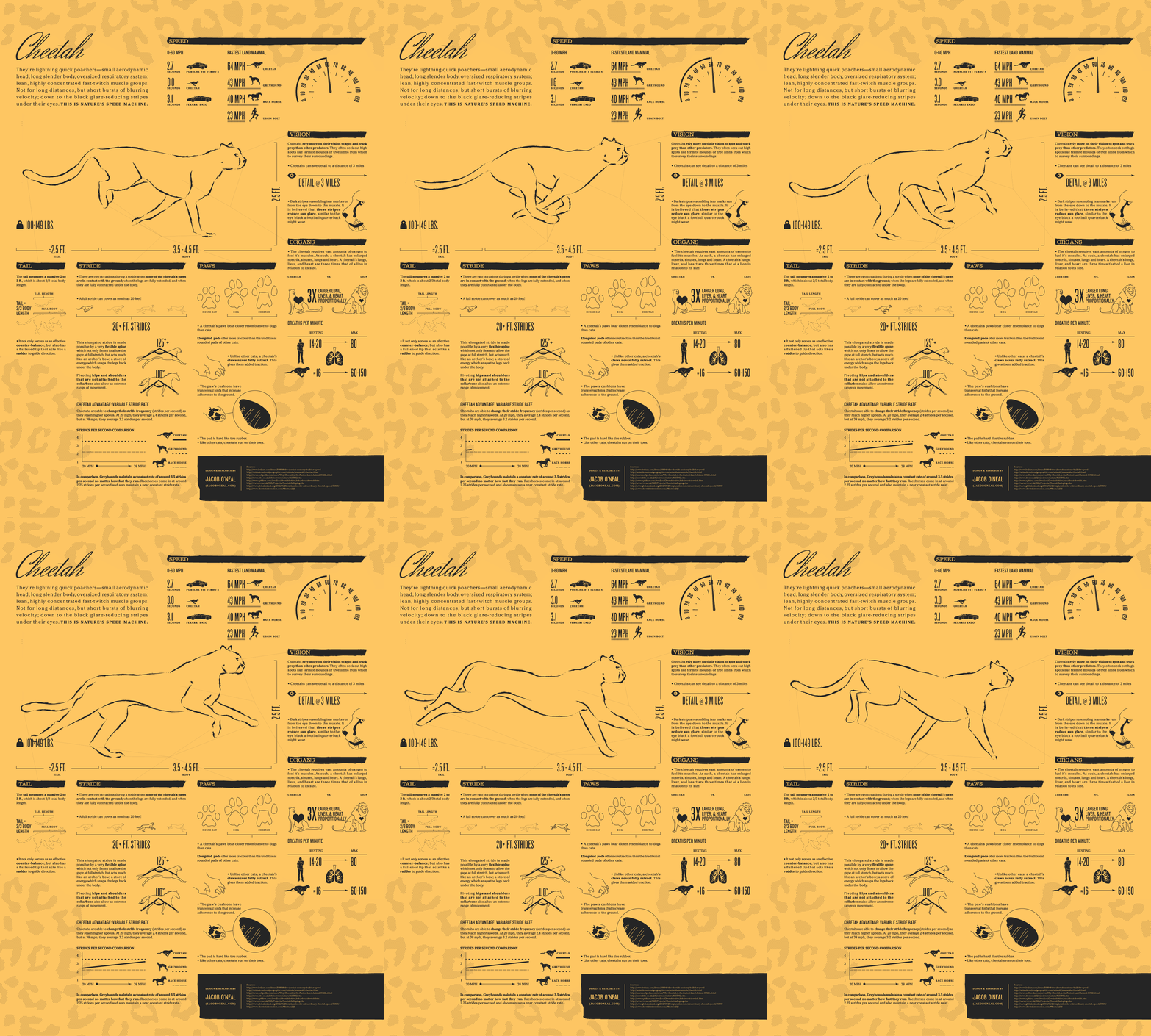
Key figures from the infographic
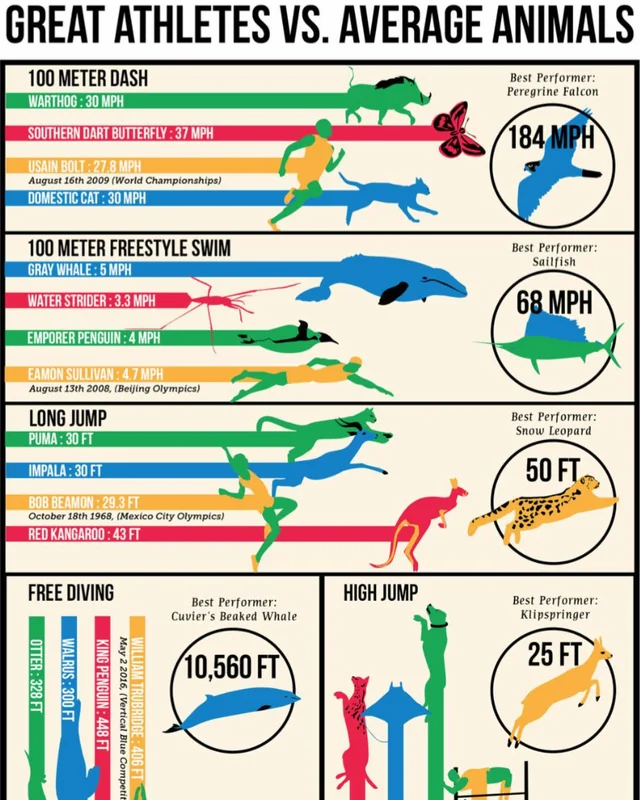
- Top speed 64 mph, against 43 mph for a greyhound, 40 mph for a racehorse and 23 mph for Usain Bolt.
- 0 to 60 mph in 3.0 seconds, between a Porsche 911 Turbo S (2.7) and a Ferrari Enzo (3.1).
- Strides of 20 feet or more, at 2.4 strides a second at 20 mph rising to 3.2 at 38 mph.
- Lungs, liver and heart three times larger than a lion’s in proportion to body size, and up to 150 breaths a minute at full effort.
- A body 3.5 to 4.5 feet long, a tail of about 2.5 feet and a weight of 100 to 149 lb.
All figures are from the graphic by Jacob O’Neal, which lists eight web sources including National Geographic, the BBC and the Royal Veterinary College.
The cheetah infographic in text
The intro reads: “They’re lightning quick poachers, small aerodynamic head, long slender body, oversized respiratory system; lean, highly concentrated fast-twitch muscle groups. Not for long distances, but short bursts of blurring velocity… This is nature’s speed machine.”
| Section | What the graphic says |
|---|---|
| Speed, 0 to 60 mph | Porsche 911 Turbo S 2.7 seconds; cheetah 3.0 seconds; Ferrari Enzo 3.1 seconds (spelled “Ferarri”) |
| Fastest land mammal | Cheetah 64 mph; greyhound 43 mph; race horse 40 mph; Usain Bolt 23 mph |
| Size | Weight 100 to 149 lb; tail about 2.5 ft; body 3.5 to 4.5 ft; height 2.5 ft |
| Vision | Cheetahs rely more on vision than other predators and survey from termite mounds or tree limbs; they “can see detail to a distance of 3 miles”; the dark tear stripes are “believed” to reduce sun glare |
| Organs | Enlarged nostrils, sinuses, lungs and heart; lungs, liver and heart “three times that of a lion in relation to its size” |
| Breaths per minute | Human 14 to 20 resting, 80 at maximum; cheetah about 16 resting, 60 to 150 at maximum |
| Tail | 2 to 3 ft, about two thirds of body length; a counterbalance with a flattened tip that “acts like a rudder” |
| Stride | Twice in each stride no paw touches the ground; a stride “can cover as much as 20 feet”; a flexible spine works “much like an archer’s bow”; hips and shoulders not attached to the collarbone; leg angle 125° or more against 110° for a horse |
| Stride rate | 2.4 strides per second at 20 mph and 3.2 at 38 mph; greyhounds hold about 3.5 and racehorses about 2.25 at any speed |
| Paws | Closer to a dog’s than a cat’s; elongated pads for traction; claws “never fully retract”; pads with transverse folds, “hard like tire rubber”; cheetahs run on their toes |
The credit box reads “Design and research by Jacob O’Neal (jacoboneal.com)”. O’Neal says he made the animated GIF in 2013 as an experiment: 120 frames in two colours at about 500 kb. He says it went viral and began his career as an infographic creator [1].
How fast a cheetah really runs
Figures for top speed vary with the method. Britannica gives up to 114 km/h (71 mph), held only over short distances, and 0 to 96.5 km/h (60 mph) in under three seconds; it adds that cheetahs usually reach 80 to 100 km/h (50 to 62 mph) during a hunt [2]. The Cheetah Conservation Fund says more than 70 mph in just over three seconds [4].
The best field measurement comes from a 2013 study in Nature that fitted GPS collars to five wild cheetahs in Botswana and recorded 367 runs. The fastest was 25.9 metres per second (58 mph, or 93 km/h), and most hunts were at moderate speeds [3]. Wikipedia’s summary puts the cheetah at 93 to 104 km/h (58 to 65 mph) [5], which includes the graphic’s 64 mph.
The Cheetah Conservation Fund puts the stride at top speed at seven metres [4], about 23 feet, in line with the graphic’s “20+ ft”. It credits the flexible spine, semi-retractable claws, long legs and tail for the speed [4].
Notes on this infographic
- Usain Bolt’s 23 mph is his average, not his top speed. His 100 m world record of 9.58 seconds, set in 2009 [7], works out at 23.3 mph on average by our arithmetic. Britannica notes that top sprinters reach their maximum speed, more than 40 km/h (25 mph), between 55 and 65 metres into the race [7].
- Race horse: some American Quarter Horses have been clocked at up to 88.5 km/h (55 mph) over short races [8], faster than the graphic’s 40 mph.
- Weight: Wikipedia gives adults as 21 to 65 kg (46 to 143 lb) [5]; the graphic’s 100 to 149 lb covers only the heavier end. Head and body length is 1.1 to 1.5 m (3 ft 7 in to 4 ft 11 in), close to the graphic’s 3.5 to 4.5 ft [5].
- Greyhound: 43 mph matches the peak racing speed Wikipedia reports [6].
- Animation: the cheetah’s 0 to 60 figure counts up from 0.0 to 3.0 in the animated file, so a still copy may show 0.0.
Questions about cheetah speed
How fast can a cheetah run?
The graphic says 64 mph. Britannica gives a maximum of 71 mph [2], and the fastest speed measured on wild cheetahs with GPS collars was 58 mph [3].
Has a cheetah ever reached 100 mph?
No source we checked reports that. The highest figure we found is Britannica’s 114 km/h, or 71 mph [2].
What is the fastest running animal on Earth?
The cheetah is the fastest land animal [8]. On the graphic its 64 mph is half as fast again as a greyhound’s 43 mph.
Sources
- Jacob O’Neal. Cheetah, Animagraffs (portfolio page)
- Encyclopaedia Britannica. How fast are cheetahs?
- Wilson AM et al. Locomotion dynamics of hunting in wild cheetahs. Nature, 2013
- Cheetah Conservation Fund UK. Cheetah facts
- Wikipedia. Cheetah
- Wikipedia. Greyhound
- Encyclopaedia Britannica. Usain Bolt
- Wikipedia. Fastest animals
Last reviewed 29 October 2026