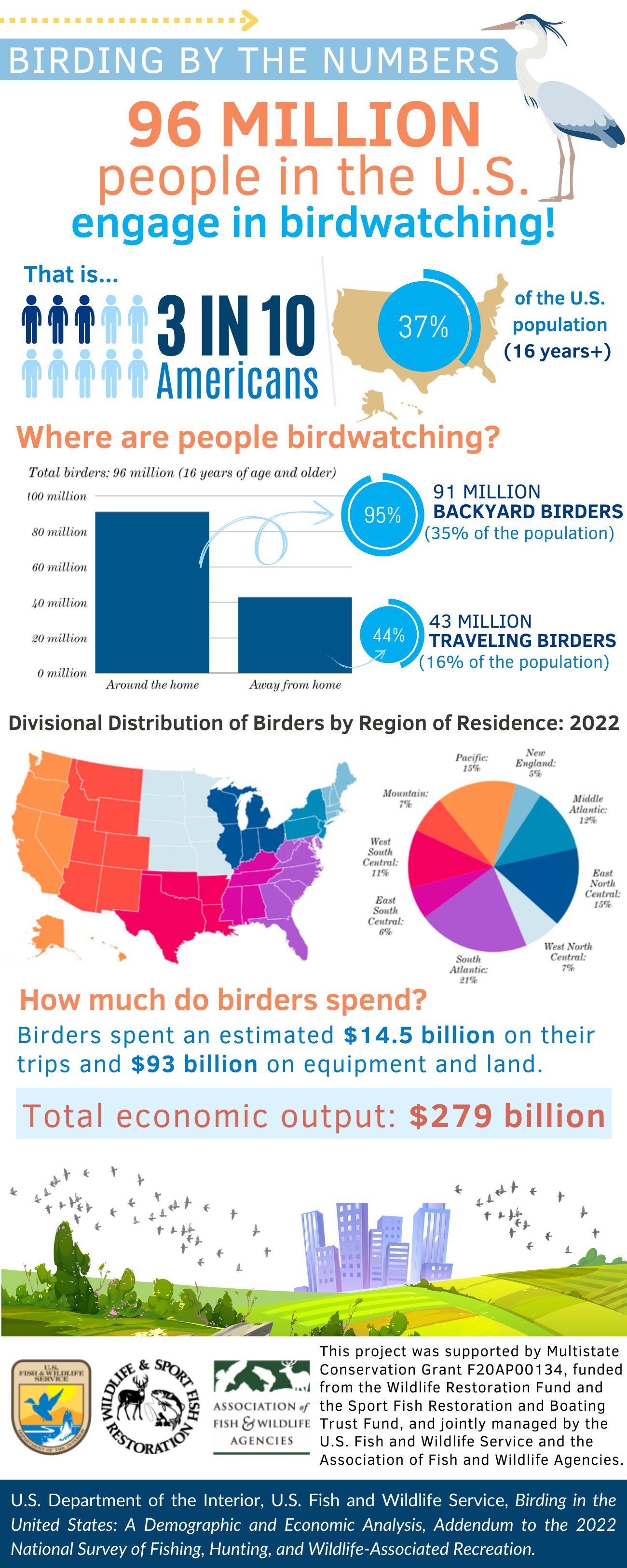
About 96 million people aged 16 and over watched birds in the United States in 2022, 37% of that population, according to the U.S. Fish and Wildlife Service (FWS). Most of them, 91 million, watch birds around the home, and 43 million travel to see them. Birders spent $107.6 billion on trips and equipment, which FWS says generated $279 billion of economic output.
Those figures come from Birding in the United States, an FWS addendum to the 2022 National Survey of Fishing, Hunting, and Wildlife-Associated Recreation, and the infographic by FWS shown here sums up its headline numbers. Below we go through the full report, from who birders are and where they live to what they spend and how birding compares with fishing and hunting.
How many people birdwatch in the US
96 million Americans aged 16 and over are birders, 37% of everyone in that age group. The FWS birding report (Report 2022-4, November 2024) takes this from the wildlife-watching section of the 2022 National Survey, which completed about 59,000 detailed wildlife-watching interviews.
The survey uses a strict definition. To count as a birder you must have either taken a trip of a mile or more from home mainly to watch birds, or closely watched or tried to identify birds around your home. Noticing birds while mowing the lawn or sitting on a beach doesn’t count, and nor do visits to zoos or watching captive birds. So the 96 million are people who take a real interest in birds, not everyone who happens to see one.
The infographic also uses the phrase “3 in 10 Americans”, and so does the FWS story that launched it. The survey’s own rate of 37% of people aged 16 and over is closer to 4 in 10 adults, so the 37% figure is the one to quote.
The 2025 State of the Birds report, written by the US committee of the North American Bird Conservation Initiative, rounds the same survey result to “nearly 100 million Americans” and says no other outdoor recreational activity brings together so many people.
Backyard birding is far more common than birding trips
Watching birds at home is by far the most common way to bird. FWS counts 91 million backyard birders, 95% of all birders and 35% of the population aged 16 and over, against 43 million who travelled a mile or more from home to watch birds, 44% of birders and 16% of the population. Many people do both, which is why the two groups add up to more than 96 million.
Birders spent a combined 7.5 billion days birding in 2022, according to the FWS report. The average birder spent 78 days watching birds. Backyard birders averaged 67 days and those who travelled averaged 34 days away from home, which FWS puts down to how easy it is to watch birds from your own window.
Who birdwatches in America
The typical American birder is around 49 years old, equally likely to be a man or a woman, and more likely than average to have a higher income and education. That is the profile FWS draws from the survey, though it stresses that millions of birders fall outside it.
Age
Birding gets more popular with age. The largest group of birders is people aged 65 and over (23.1 million), followed by 55 to 64 year olds (18.9 million), and 44% of all birders are over 55, according to the FWS report. Working from its Table 1, about 45% of 55 to 64 year olds and 43% of people 65 and over are birders, against 30% to 36% in each younger age group.
Men and women
Unlike hunting and fishing, birding is split evenly between the sexes. Women and men each make up 49% of birders, with 1% of other genders. Participation rates are close too, at 36% of women and 38% of men. Birders who travel are slightly more likely to be men (51%).
Income, education and background
The higher your income and education, the more likely you are to be a birder, up to a point. FWS found that participation rises with household income until the over $200,000 group, where it dips. Using its Table 2, about 23% of people in households earning under $10,000 are birders, compared with 45% of those earning $150,000 to $199,999.
Education follows the same pattern. FWS puts participation at 25% for people who didn’t finish high school, 40% for those with some college and 47% for people with a bachelor’s degree, before it falls to 36% for people with a graduate degree.
Three in four birders (75%) identify as White, but Asian Americans have the highest participation rate of any group at 47%. The rate is 34% for Hispanic Americans, 26% for African Americans and 19% for all other groups, all below the 37% national average.
City and country
People in less crowded places are more likely to watch birds. Big metropolitan areas of 1 million people or more have the most birders (41.7 million) but the lowest participation rate, 35%, FWS says. Smaller metro areas and places outside cities are all above that, at roughly 39% to 41%.
Where America’s birders live
The South Atlantic has the most birders and New England the fewest. FWS reports birding by the nine US Census Bureau divisions rather than by state, and the South Atlantic (Delaware, Maryland, DC, Virginia, West Virginia, the Carolinas, Georgia and Florida) is home to about 20.6 million birders, 21% of the national total.
The Pacific and East North Central divisions follow with 15% each, then the Middle Atlantic with 12% and the West South Central with 11%, according to the regional breakdown in the FWS infographic. New England has about 4.7 million birders, 5% of the total.
Participation rates tell a different story from raw numbers. The highest rate is in the East South Central division (Kentucky, Tennessee, Mississippi and Alabama) at 41%, followed by the West North Central (the Dakotas, Nebraska, Kansas, Minnesota, Iowa and Missouri) at 40%, the FWS report says. Birders in the East North Central (Wisconsin, Michigan, Illinois, Indiana and Ohio) were the most dedicated, averaging 96 days of birding each, while Pacific birders spent the most days birding away from home, at 61.
How much birders spend
American birders spent $107.6 billion on birding in 2022, $14.5 billion on trips and $93.1 billion on equipment and land. Those are the totals in Table 9 of the FWS birding report.
| What birders spent money on (2022) | Total |
|---|---|
| Trip spending (food, lodging, transport and other trip costs) | $14.5 billion |
| Wildlife-watching equipment (bird food, feeders, nest boxes, binoculars, cameras, field guides) | $12.6 billion |
| Auxiliary equipment (tents, packs, camping gear, blinds, GPS) | $3.5 billion |
| Special equipment (boats, campers, trucks, cabins) | $35.7 billion |
| Other items (land leasing and ownership, plantings, memberships, books, magazines) | $41.3 billion |
| Total | $107.6 billion |
Big purchases make up most of the money. Land bought or leased for watching, photographing or feeding wildlife accounts for about $31 billion of the “other items” spending, FWS says, and special equipment such as boats and campers makes up 38% of equipment spending. On trips, 49% went on food and lodging and 36% on transport.
Averaged across all 96 million birders, that comes to $3,738 each in 2022, including $339 on trips and $182 on everyday birding gear such as bird food and binoculars. Women spent more than men, $3,991 on average against $3,565.
The survey has no separate spending question for birding, so FWS estimates these amounts by taking the share of wildlife-watching days that were spent watching birds and applying it to wildlife-watching spending. Treat them as careful estimates rather than receipts.
What birding is worth to the US economy
Birding generated $279 billion of total economic output in 2022 and supported 1.4 million jobs, FWS estimates. That is much bigger than the $107.6 billion birders spent, because the total also counts the knock-on effects of that spending as it moves through the economy.
The FWS report gives the example of a bird house. Part of the price stays with the shop that sells it, the shop buys from a wholesaler, which pays the manufacturer, and the people employed at each stage spend their wages in turn. FWS modelled these effects with the IMPLAN input-output model, and these are its estimates for 2022.
- produced $279.5 billion of total industry output and $152 billion of value added (the contribution to GDP)
- supported 1,405,000 jobs paying $90.2 billion in labour income
- generated about $22.2 billion in federal tax, $9.4 billion in state tax and $7.0 billion in county tax
The State of the Birds 2025 report adds those taxes together as $38 billion a year.
How birding compares with fishing and hunting
Far more Americans watch birds than fish or hunt. The 2022 National Survey found 39.9 million anglers and 14.4 million hunters aged 16 and over, against 96 million birders and 148.3 million wildlife watchers of all kinds.
Wildlife watching is the bigger category. It covers anyone who closely observed, fed or photographed wildlife, including mammals and fish, and those 148.3 million people spent $250.2 billion in 2022, according to the National Survey. Birders are the largest group within it.
The groups overlap a lot. FWS found that 24% of birders also fish, a further 8% hunt and another 6% both fish and hunt. Men who bird are much more likely than women who bird to also fish (31% against 17%) or hunt (12% against 4%). Looked at the other way, 58% of anglers and 53% of hunters are birders, according to unpublished National Survey results quoted in the State of the Birds 2025 report.
Is birdwatching getting more popular?
Probably, but the official numbers can’t prove it. FWS changed the 2022 survey to shorter questionnaires and an online format people could fill in themselves, and it says this means the results can’t be compared with earlier surveys to measure a trend, in its Birdwatching in America article.
That means older birder counts from earlier surveys and the 96 million figure aren’t measured the same way, so a rise between them could reflect the new method as much as new birders. FWS does say that phone cameras and bird identification apps have made birding easier to get into than in the past.
Why birders matter for bird conservation
Birders are watching a shrinking population. North America has lost about 2.9 billion breeding adult birds since 1970, nearly 30% of the total, according to research published in Science and summarised by the Cornell Lab of Ornithology. Grassland birds have fallen by 53%, about 720 million birds, and forests have lost 1 billion.
The State of the Birds 2025 report says those losses are continuing and that one third of US bird species need conservation action. Even ducks, which had risen strongly since 1970, have trended down in recent years. Its Tipping Point list covers species that have lost more than half their populations in the past 50 years.
Birders help in a practical way. FWS encourages people to record what they see and submit it to a database such as eBird, because those sightings show scientists where birds go and what they need along the way, as its guide to getting started in birding explains.
Questions about birdwatching statistics
How many birdwatchers are there in the US?
There were 96 million birders aged 16 and over in the US in 2022, 37% of that age group, according to FWS. That includes 91 million who watch birds around the home and 43 million who travel to watch them.
What percentage of Americans are birders?
37% of Americans aged 16 and over are birders. Participation is highest among 55 to 64 year olds (about 45%) and people with a bachelor’s degree (47%), and lowest among people who didn’t finish high school (25%).
How much do Americans spend on birdwatching?
Birders spent $107.6 billion in 2022, about $3,738 per birder on average. Most of it went on equipment and land ($93.1 billion), with $14.5 billion on trips.
What is the average age of a birdwatcher?
The average US birder is 49 years old. Men who bird average 50 and women 49, while birders of other genders are considerably younger, at 35 on average.
Which part of the US has the most birders?
The South Atlantic division, from Delaware down to Florida, has the most birders, about 20.6 million. The highest participation rate is in the East South Central states of Kentucky, Tennessee, Mississippi and Alabama, where 41% of people aged 16 and over bird. FWS doesn’t publish state-by-state birder counts in this report.
Is birdwatching good for your mental health?
Research suggests it is. A 2022 study in Scientific Reports used the Urban Mind smartphone app to collect 26,856 assessments from 1,292 people and found that everyday encounters with birds were linked to improvements in mental wellbeing that lasted over time, including for people diagnosed with depression. The State of the Birds 2025 report collects this and other studies on birds and wellbeing.
What counts as a birder in the survey?
FWS only counts you as a birder if you took a trip of a mile or more from home mainly to watch birds, or closely watched or tried to identify birds around your home. Casually noticing birds, visiting a zoo or watching captive birds doesn’t count. The figures come from the 2022 National Survey of Fishing, Hunting, and Wildlife-Associated Recreation, which FWS has run since 1955.
The infographic shown here was created by Rosalie Wetzel of the U.S. Fish and Wildlife Service and is published by FWS as a public domain image. Its use here does not imply endorsement by FWS, the U.S. Department of the Interior or the U.S. Government.
Sources
- U.S. Fish and Wildlife Service, Birding in the United States, A Demographic and Economic Analysis (Report 2022-4, addendum to the 2022 National Survey, November 2024)
- U.S. Fish and Wildlife Service, 2022 National Survey of Fishing, Hunting, and Wildlife-Associated Recreation (October 2023)
- U.S. Fish and Wildlife Service, Birdwatching in America (9 December 2024) and Full Birding Addendum Infographic
- U.S. Fish and Wildlife Service, Birding, How to Get Started and Make It Count for Conservation
- North American Bird Conservation Initiative (US committee), State of the Birds 2025, including Birds Strengthen American Communities and Tipping Point Species
- Cornell Lab of Ornithology, Nearly 3 Billion Birds Gone Since 1970
- Scientific Reports, Smartphone-based ecological momentary assessment reveals mental health benefits of birdlife (2022)