Most gemstones are simple minerals, usually oxides or silicates of common elements such as aluminium, silicon, magnesium and beryllium. Diamond is pure carbon (C), ruby and sapphire are aluminium oxide (Al2O3) and emerald is beryl, Be3Al2(SiO3)6. The colour almost always comes from tiny amounts of metals such as chromium, iron, titanium or copper sitting in the crystal.
What gemstones are made of
Gemstones are mostly crystals of a single mineral, and the mineral decides the chemical formula. The same mineral can produce several different gems, because a trace of one metal changes the colour without changing the basic formula. That is why the chemical composition of gemstones is usually written as a short formula plus a note on which impurity gives the colour.
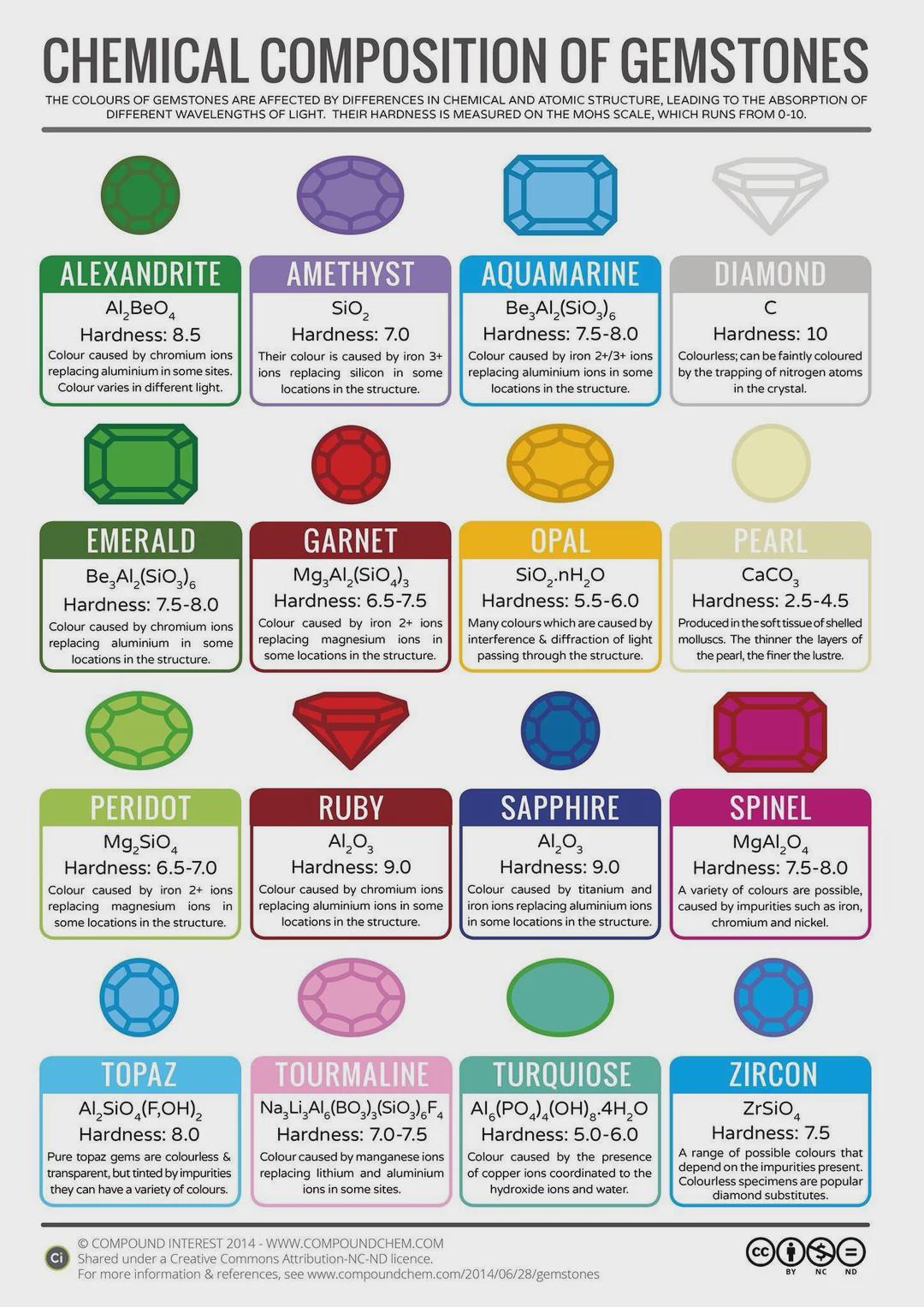
The table below gives the formula and Mohs hardness for 16 popular gemstones, the same set covered in the Compound Interest infographic by Andy Brunning [1]. Formulas and hardness values were checked against the mineral entries on Wikipedia [5][6][7][8][9][10] and GIA [2][3][11][12]. Two of the formulas on the original graphic are wrong, and the corrected versions are used here (more on that below).
| Gemstone | Mineral | Chemical formula | Mohs hardness | Main cause of colour |
|---|---|---|---|---|
| Alexandrite | Chrysoberyl | BeAl2O4 | 8.5 | Chromium |
| Amethyst | Quartz | SiO2 | 7 | Iron with natural irradiation |
| Aquamarine | Beryl | Be3Al2(SiO3)6 | 7.5 to 8 | Iron |
| Diamond | Diamond | C | 10 | Usually colourless, tinted by nitrogen or boron |
| Emerald | Beryl | Be3Al2(SiO3)6 | 7.5 to 8 | Chromium |
| Garnet (pyrope) | Garnet group | Mg3Al2(SiO4)3 | 6.5 to 7.5 | Iron |
| Opal | Hydrated silica | SiO2·nH2O | 5.5 to 6 | Diffraction of light |
| Pearl | Organic (nacre) | CaCO3 plus conchiolin | 2.5 to 4.5 | Layers of nacre |
| Peridot | Olivine | (Mg,Fe)2SiO4 | 6.5 to 7 | Iron |
| Ruby | Corundum | Al2O3 | 9 | Chromium |
| Sapphire | Corundum | Al2O3 | 9 | Iron and titanium |
| Spinel | Spinel | MgAl2O4 | 7.5 to 8 | Various impurities, cobalt for pure blue |
| Topaz | Topaz | Al2SiO4(F,OH)2 | 8 | Colourless when pure, tinted by impurities |
| Tourmaline (elbaite) | Tourmaline group | Na(Li1.5Al1.5)Al6Si6O18(BO3)3(OH)4 | 7 to 7.5 | Manganese in pink stones |
| Turquoise | Turquoise | CuAl6(PO4)4(OH)8·4H2O | 5 to 6 | Copper |
| Zircon | Zircon | ZrSiO4 | 7.5 | Varies with impurities |
A few of these formulas are simplifications. Garnet is a group of minerals with the general formula X3Y2(SiO4)3, and Mg3Al2(SiO4)3 is only pyrope, one member of it [7]. Tourmaline is also a group, and most gem tourmaline is the species elbaite [8]. Peridot always contains some iron in place of magnesium, which is where its green comes from [9].
Common errors in gemstone formula charts
Gemstone formula charts are widely shared, and some of the figures on them are wrong. The Compound Interest infographic above is a good quick reference, but two of its formulas and its description of the Mohs scale need correcting, so use the figures in the table instead.
- Turquoise is CuAl6(PO4)4(OH)8·4H2O [6]. The graphic leaves out the copper, even though its own text says copper causes the colour, and it spells the name “Turquiose”. GIA describes turquoise as a hydrated copper and aluminium phosphate [12].
- The tourmaline formula on the graphic, Na3Li3Al6(BO3)3(SiO3)6F4, does not balance. Elbaite, the usual gem tourmaline, is Na(Li1.5Al1.5)Al6Si6O18(BO3)3(OH)4 [8].
- The Mohs scale runs from 1 to 10, with talc at 1, not from 0 to 10 [4].
Alexandrite is written Al2BeO4 on the graphic. That is the same composition as the usual BeAl2O4 for chrysoberyl, just in a different order [10].
Why gemstones have colour
A gemstone looks coloured because it absorbs some wavelengths of visible light and lets the rest through. Compound Interest gives the simple example that something which absorbs every colour except red looks red [1].
In most gems the absorbing atoms are transition metals, the block of metals in the middle of the periodic table. Their partly filled d orbitals let electrons take in visible light and jump to a higher energy level [1]. Many minerals are colourless when pure, and Compound Interest points out that even a small amount of a transition metal sitting in place of another atom can give an intense colour [1]. Chromium, iron, titanium, manganese and copper do most of the work across the stones in the table.
There are other causes too. In blue sapphire the colour comes from charge transfer, with electrons moving between iron 2+ and titanium 4+ ions [1]. Amethyst owes its violet to iron impurities combined with natural irradiation, and heating it can turn it yellow or green [5]. Opal is different again, as its play of colour comes from light being diffracted by its internal structure rather than from absorption [1].
Why alexandrite changes colour
Alexandrite looks green in daylight and red under incandescent light. Daylight is richer in green light, to which our eyes are more sensitive, while incandescent light is richer in red [1]. Chromium is the impurity behind both colours.
Sapphire chemical composition
Sapphire is aluminium oxide, Al2O3, the mineral corundum. GIA explains that corundum is made only of aluminium and oxygen and is colourless when pure [11]. When the trace elements are iron and titanium the stone is blue sapphire, and only a few hundredths of a percent is enough to colour it. The more iron it contains, the darker the blue [11].
The name sapphire covers any corundum that is not red. Pink, yellow, orange, green, violet and colourless corundum are all sold as sapphire, and GIA calls them fancy sapphires [11]. Chromium gives the pink of pink sapphire and, in larger amounts, the red of ruby [11].
Emerald chemical composition
Emerald is beryl, Be3Al2(SiO3)6, a beryllium aluminium silicate. It is the green to bluish green variety of the mineral, and GIA notes that beryl also includes aquamarine and stones in other colours [3]. Compound Interest puts the green down to chromium ions replacing some of the aluminium [1].
Aquamarine has exactly the same formula. Its blue comes from iron instead [1]. GIA adds that the trade does not fully agree on how green a stone has to be to count as emerald rather than green beryl [3].
Gemstones that share a mineral
Several famous pairs are chemically the same stone in different colours.
- Ruby and sapphire are both corundum, Al2O3. Chromium makes ruby red, and the stronger the chromium, the stronger the red [2].
- Emerald and aquamarine are both beryl, Be3Al2(SiO3)6 [3].
- Amethyst is the violet variety of quartz, SiO2, the same mineral as ordinary rock crystal [5].
- Alexandrite is a variety of chrysoberyl, BeAl2O4 [10].
How hard gemstones are on the Mohs scale
The Mohs scale ranks minerals from 1 to 10 by which one can scratch another. The German mineralogist Friedrich Mohs introduced it in 1812, and it is an ordinal scale, so a 9 is not simply nine times harder than a 1 [4].
Diamond sits at 10 and corundum (ruby and sapphire) at 9, followed by alexandrite at 8.5 and topaz at 8. Most quartz and beryl gems are 7 to 8. Opal and turquoise are softer at around 5 to 6, and pearl, at 2.5 to 4.5, can be scratched by many everyday materials. Softer stones scratch and wear more easily, so they need more care in rings and bracelets that take knocks every day.
Questions about the chemical composition of gemstones
What is the chemical formula of a diamond?
C. Diamond is pure carbon. Tiny amounts of other elements change its colour, with boron giving blue and nitrogen giving yellow, while structural defects can make it brown [13].
What is the chemical composition of ruby?
Al2O3, aluminium oxide (corundum), coloured red by chromium [2].
What two gemstones are actually the same mineral?
The best known pair is ruby and sapphire, which are both corundum [2]. Emerald and aquamarine are another pair, both beryl [3].
What is the only birthstone that is not a mineral?
Pearl is the usual answer. It is made by molluscs and is mostly calcium carbonate in the form of aragonite, held together by an organic protein called conchiolin [14].
Which gemstones contain copper?
Turquoise is the main one, as copper is part of its formula, CuAl6(PO4)4(OH)8·4H2O, and gives it its blue to green colour [6][12].
Are gemstones made of silicates?
Many are. Emerald, aquamarine, garnet, peridot, topaz, tourmaline and zircon are all silicates. Ruby, sapphire, spinel and alexandrite are oxides, and turquoise is a phosphate.
Sources
- Compound Interest, Andy Brunning, What Causes the Colour of Gemstones?, 2014. The original page for the infographic.
- GIA, Ruby Description
- GIA, Emerald Description
- Wikipedia, Mohs scale
- Wikipedia, Amethyst
- Wikipedia, Turquoise
- Wikipedia, Garnet
- Wikipedia, Elbaite and Tourmaline
- Wikipedia, Peridot
- Wikipedia, Chrysoberyl
- GIA, Sapphire Description
- GIA, Turquoise Description
- Wikipedia, Diamond
- Wikipedia, Pearl
Last reviewed 14 November 2026