Germany hosts more Ukrainian refugees than any other EU country, about 1.3 million people under temporary protection at the end of September 2026, according to Eurostat. That is almost 30% of the EU total. Destatis counted 1,409,565 Ukrainian nationals living in Germany at the end of 2025, more than ten times the 134,894 recorded in January 2021, before Russia’s full scale invasion.
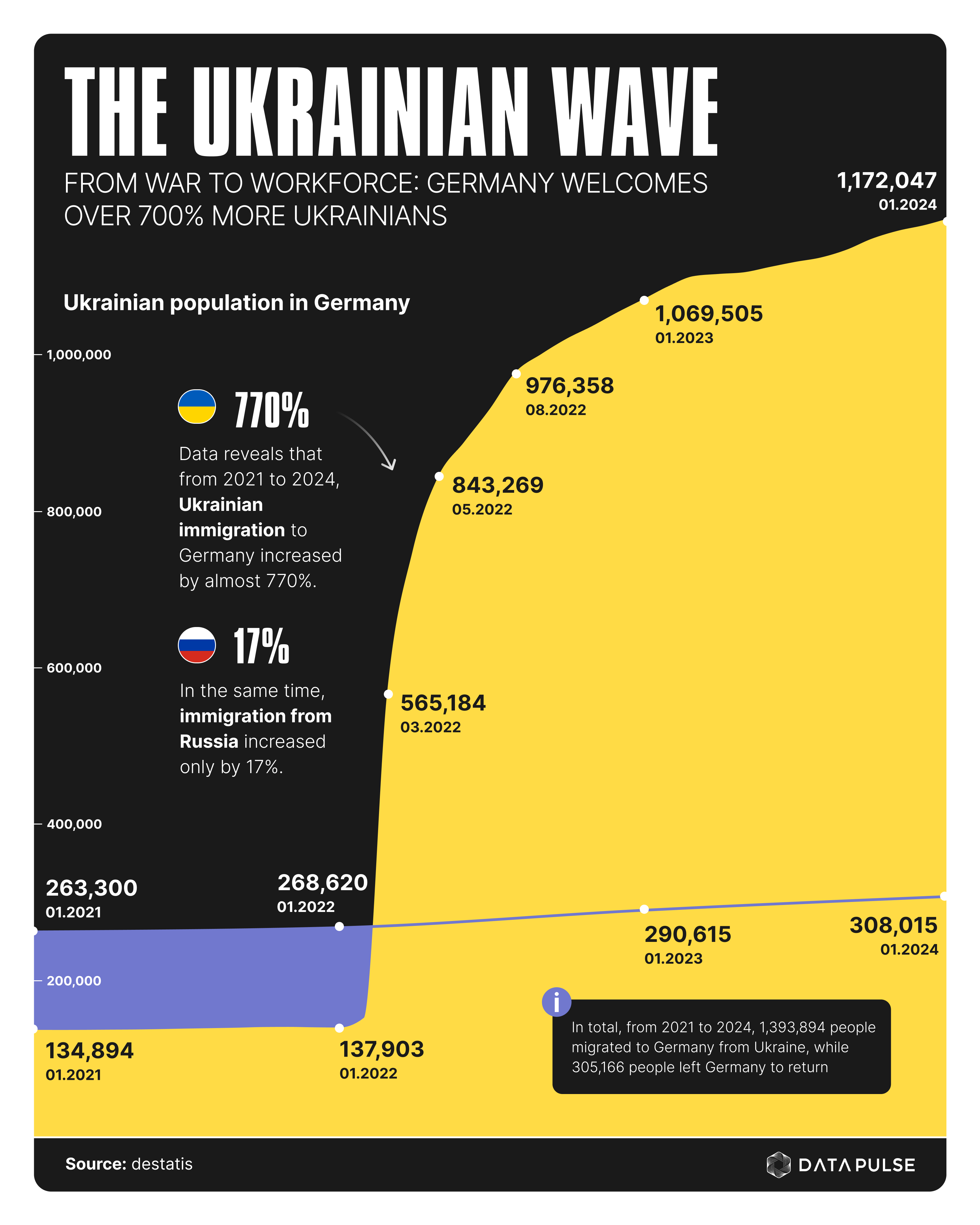
This article covers how many Ukrainians have come to Germany since 2022, how that compares with the rest of Europe, who the refugees are, how many have left again and what status they hold. DataPulse Research’s infographic, The Ukrainian Wave, shows the jump in the Ukrainian population in Germany between 2021 and 2024 using Destatis figures.
How many Ukrainian refugees are in Germany?
About 1.3 million. Eurostat counts 1,300,070 people who fled Ukraine and were under temporary protection in Germany at the end of September 2026, 29.7% of everyone under temporary protection in the EU [1]. Almost all of them, 98.5% across the EU, are Ukrainian citizens. The rest are mainly people from other countries who were living in Ukraine when the war began [1].
A wider count of every Ukrainian national living in Germany, refugee or not, comes from the Central Register of Foreigners. Destatis puts that at 1,409,565 on 31 December 2025, which makes Ukrainians the second largest foreign nationality in Germany after Turks (1,520,400) and 10.0% of the foreign population [2]. The difference between the two numbers is mainly Ukrainians who were already living, working or studying in Germany before 2022 or who hold another kind of residence permit.
Ukrainian immigration to Germany since 2021
The Ukrainian population in Germany rose by about 770% between January 2021 and January 2024, almost all of it in the months after February 2022. The DataPulse infographic, using Destatis data, shows how sudden it was [3].
| Date | Ukrainian nationals in Germany | Russian nationals in Germany |
|---|---|---|
| January 2021 | 134,894 | 263,300 |
| January 2022 | 137,903 | 268,620 |
| March 2022 | 565,184 | not given |
| May 2022 | 843,269 | not given |
| August 2022 | 976,358 | not given |
| January 2023 | 1,069,505 | 290,615 |
| January 2024 | 1,172,047 | 308,015 |
| 31 December 2025 (Destatis) | 1,409,565 | 284,225 |
The figures to January 2024 are from DataPulse’s graphic and the end of 2025 figures are from Destatis’s table of the foreign population [3] [2]. The number of Ukrainians more than quadrupled in the first five weeks of the war. By the federal interior ministry’s count, almost 239,000 refugees had entered Germany by 23 March 2022 [4].
The graphic describes the 770% rise as an increase in “immigration”. Strictly it is the rise in the number of Ukrainians living in Germany, not in yearly arrivals. The infographic also says 1,393,894 people moved to Germany from Ukraine between 2021 and 2024 and 305,166 left, which gives net migration of about 1.09 million (our arithmetic), close to the population rise of about 1.04 million [3].
Russian immigration to Germany followed a very different pattern. The number of Russian nationals rose by only 17% from 2021 to 2024, and Destatis’s 2025 figure of 284,225 is lower than the 2024 figure on the graphic [3] [2]. DataPulse notes that many Russian migrants to Germany are ethnic Germans from Russia whose families settled there in the 18th century [3].
Ukrainian refugees in Germany compared with the rest of Europe
Germany has the largest number of Ukrainian refugees in the EU, but not the most relative to its population. These are Eurostat’s figures for the end of September 2026 [1].
| Country | People under temporary protection | Share of EU total |
|---|---|---|
| Germany | 1,300,070 | 29.7% |
| Poland | 858,545 | 19.6% |
| Czechia | 391,720 | 9.0% |
| EU total | about 4.4 million | 100% |
Across the EU there were 9.7 people under temporary protection for every 1,000 residents. Czechia had the highest ratio at 35.9 per 1,000, followed by Slovakia (28.0) and Cyprus (27.4) [1]. Germany’s figure works out at roughly 15 per 1,000 (our arithmetic). Numbers in Germany are still edging up, by 5,515 in September 2026 alone, while Poland’s have fallen [1].
Who the Ukrainian refugees in Germany are
Most adult Ukrainian refugees are women, but the share of men has been rising. The Federal Office for Migration and Refugees (BAMF) found that men made up about 28% of adult Ukrainian refugees in Germany at the end of 2022 and about 35% by mid-2024 [5]. Across the EU, Eurostat counts 44.1% adult women, 28.0% children and 27.9% adult men among people under temporary protection [1].
BAMF also found that more than half of the Ukrainian refugees in Germany in mid-2024 had arrived in the first two months after the invasion, and that the average age was about 35 for women and 28 for men [5]. Relative to population, Ukrainian refugees are spread fairly evenly across the 16 federal states, at about 1.3% of residents, with higher shares only in the city states of Hamburg (1.9%) and Bremen (1.8%) [5]. Destatis’s register shows more women than men among all Ukrainian nationals in Germany, 820,960 against 588,605 at the end of 2025 [2].
How many Ukrainian refugees have left Germany?
A minority. BAMF found that around three quarters of Ukrainians who arrived between 24 February 2022 and 30 June 2024 were still in Germany at the end of that period, and around 15% had left [5]. Some will have gone home and some on to other countries. The register does not always record where people go, so the departure figures in DataPulse’s graphic are best read as people leaving Germany rather than people returning to Ukraine.
Residence status for Ukrainians in Germany
Most Ukrainian refugees in Germany hold a residence permit for temporary protection under section 24 of the Residence Act, which puts the EU’s temporary protection decision into German law. The EU adopted that decision on 4 March 2022, and on 15 July 2026 the Council extended it until 4 March 2028 [1]. Temporary protection gives the right to live and work in Germany without going through the asylum process. Before that was in place, a regulation of 8 March 2022 let Ukrainians who arrived after the invasion enter and stay in Germany legally without a residence permit for an initial period [4].
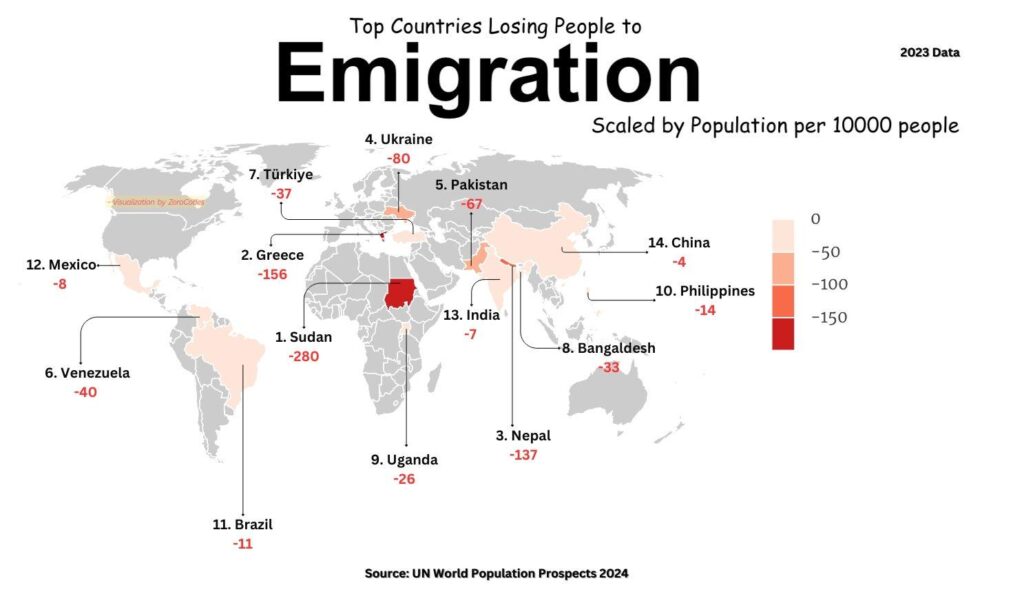
Rules on benefits and permits change, so if you are a Ukrainian in Germany or helping someone who is, check the current position with BAMF or your local foreigners’ authority (Ausländerbehörde) rather than relying on older guides. For where people are leaving their home countries more generally, see our page on countries losing people to emigration.
Questions about Ukrainian refugees in Germany
How many Ukrainian refugees are there in Europe?
About 4.4 million people who fled Ukraine were under temporary protection in the EU at the end of September 2026, according to Eurostat [1]. That does not include countries outside the EU such as the UK, Moldova and Switzerland.
How many Ukrainians live in Germany?
1,409,565 Ukrainian nationals at the end of 2025, according to Destatis’s Central Register of Foreigners figures [2]. Before the war the figure was about 135,000 [3].
Is Germany still taking Ukrainian refugees?
Yes. Temporary protection in the EU now runs until 4 March 2028, and the number of people under temporary protection in Germany was still rising slightly in 2026 [1].
Which country has taken the most Ukrainian refugees?
In the EU, Germany, with about 1.3 million people under temporary protection, followed by Poland with about 860,000 [1]. Relative to population, Czechia has taken the most.
Sources
- Eurostat, Temporary protection for persons fleeing Ukraine, monthly statistics, data to end of September 2026.
- Destatis (Federal Statistical Office), Foreign population by sex and selected citizenships, Central Register of Foreigners, 31 December 2025.
- DataPulse Research (Maria Fernandez), Refugee Numbers from Ukraine Skyrocket, Russian Migration Remains Steady, January 2025, using Destatis data.
- Wikipedia, Ukrainian refugee crisis (Germany section), citing the Federal Ministry of the Interior.
- BAMF, The change in the population structure of Ukrainian refugees in Germany between the end of 2022 and mid-2024, Brief Analysis 4/2025.