What is a logical fallacy?
A fallacy is an error in reasoning. The Purdue Online Writing Lab describes fallacies as common errors that undermine the logic of an argument, either because the argument itself is illegitimate or because the point being made is irrelevant, and notes that they are often spotted because they lack evidence for their claim [1].
It helps to separate two kinds of mistake. One is a factual error: a premise is simply wrong. The other is a fault in the reasoning, where the premises, even if true, do not support the conclusion. A logical fallacy is the second kind [5]. That is why a fallacious argument can still end in a true conclusion. The conclusion might be right; the reasons given for it just don’t get you there [4].
Fallacies matter in debate because they often sound convincing. A quick jibe, an emotional appeal or a scary chain of consequences can win an audience over even when it proves nothing. Knowing the common patterns lets you spot them in other people’s arguments and keep them out of your own.
Formal and informal fallacies
Fallacies are usually split into two groups [4][5].
- Formal fallacies are faults in the logical structure of an argument. The form itself is invalid, so the conclusion does not follow whatever the content. Affirming the consequent (“if it rained, the road is wet; the road is wet, so it rained”) is a classic example.
- Informal fallacies are faults in the content: an irrelevant point, a weak or missing premise, or a word that changes meaning part way through. Almost all the fallacies you meet in everyday debate are informal, including all 12 below.
12 common logical fallacies in debate
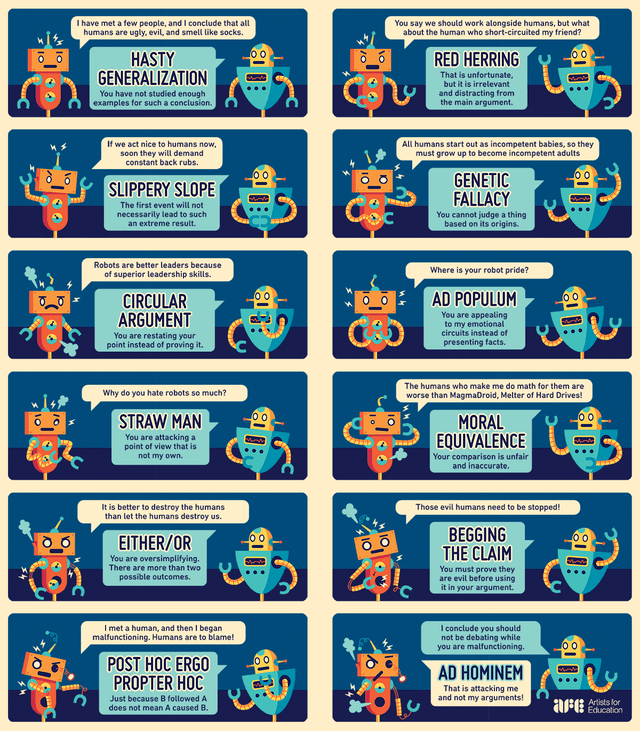
The 12 below are the ones Purdue’s writing guide lists as the common fallacies to avoid in argumentative writing [1]. They are also the 12 in Michele Rosenthal’s poster above, where an orange robot argues that humans are a problem and a teal robot calls out each bad argument. The robot lines quoted here are from the poster; the definitions follow Purdue [1].
Hasty generalization
A conclusion based on insufficient or biased evidence, reached before you have the relevant facts [1]. “I have met a few people, and I conclude that all humans are ugly, evil, and smell like socks” is the poster’s example. In a debate, watch for one anecdote or a handful of cases being used to make a claim about everyone.
Red herring
A diversion that avoids the key issue, often by skipping the opposing argument rather than answering it [1]. “You say we should work alongside humans, but what about the human who short-circuited my friend?” changes the subject without dealing with the point. The new point may be true, but it is not relevant to the one on the table.
Slippery slope
The claim that one step will lead, through a series of small steps, to an extreme result, so the first step must be stopped [1]. “If we act nice to humans now, soon they will demand constant back rubs.” Some chains of events are real, so the test is whether each link is actually supported with evidence.
Genetic fallacy
Judging a person, idea or institution by where it came from rather than on its merits [1]. On the poster: all humans start as incompetent babies, so they must grow up into incompetent adults. Purdue’s example is calling the Volkswagen Beetle an evil car because of who designed it [1].
Circular argument
Restating the claim instead of proving it [1]. “Robots are better leaders because of superior leadership skills” uses the conclusion as its own evidence. To prove it you would need something independent, such as a record of decisions that turned out well.
Ad populum (bandwagon appeal)
Persuading by pointing to what most people, or a group you want to belong to, think [1]. The bandwagon appeal (“everyone is doing it”) is the best known version, but appeals to group identity count too. Purdue’s example is “if you were a true American you would…” [1], which is what the poster’s “Where is your robot pride?” does. It is close to an appeal to emotion, and the teal robot’s reply (“you are appealing to my emotional circuits instead of presenting facts”) treats it that way.
Straw man
Oversimplifying or distorting the other side’s view and then attacking that weaker version [1]. “Why do you hate robots so much?” replies to an opinion nobody stated. In debate this often appears as “so what you’re saying is…” followed by something the speaker did not say.
Moral equivalence
Treating a minor wrong as if it were as bad as a major atrocity [1]. The poster’s robot claims the humans who make it do maths are worse than a villain who melts hard drives. Purdue’s example compares a parking attendant to Hitler [1].
Either/or (false dilemma)
Reducing a question to two options when there are more [1]. “It is better to destroy the humans than let the humans destroy us” ignores every outcome in between. Purdue’s example, “we can either stop using cars or destroy the earth”, leaves out cleaner technology, car sharing and better planning [1].
Begging the claim
Building the conclusion you need to prove into the claim itself [1]. “Those evil humans need to be stopped!” assumes they are evil. Purdue’s example is “filthy and polluting coal should be banned”, where the words “filthy and polluting” take for granted what the argument should show [1]. The name is Purdue’s; many guides call a close relative of this “begging the question” [4].
Post hoc ergo propter hoc
Latin for “after this, therefore because of this”. It assumes that because one thing happened after another, the first caused the second [1]. “I met a human, and then I began malfunctioning. Humans are to blame!” As the teal robot puts it, just because B followed A does not mean A caused B. It is behind a lot of bad reasoning about health, the economy and sport.
Ad hominem
Attacking the person instead of their argument [1]. The poster ends with the roles reversed: the teal robot tells the orange one it should not be debating while it is malfunctioning, and the orange robot points out that this attacks it, not its arguments. It is a useful reminder that the person calling out fallacies can commit one too.
How to deal with fallacies in a debate
Naming the fallacy is a start, but in a real debate it rarely wins the point on its own. These habits work better:
- Bring the discussion back to the actual claim. For a red herring or straw man, restate what was argued and ask for a response to that.
- Ask for the missing evidence. A hasty generalization, slippery slope or post hoc claim usually falls apart once someone asks how many cases, or what links each step.
- Offer the options that were left out. A false dilemma is answered by showing a third or fourth choice.
- Check your own case for the same patterns before you speak. Emotional appeals and loaded words are easy to slip into.
- Don’t assume the conclusion is false. Rejecting a claim only because the argument for it was fallacious is itself a fallacy, sometimes called the fallacy fallacy [4].
Questions about logical fallacies
How many logical fallacies are there?
There is no fixed number. Purdue’s guide lists 12 common ones [1], the Fallacy Detected site, which grew out of the poster above, lists 22 [3], and Wikipedia’s list of fallacies runs to well over a hundred, split into formal and informal types [4].
What are the most common logical fallacies?
The ones you will hear most often in arguments are ad hominem, straw man, red herring, slippery slope, either/or, hasty generalization, appeal to popularity (ad populum) and post hoc ergo propter hoc. All of them appear in Purdue’s list of common fallacies [1].
What is the difference between a fallacy and a false statement?
A false statement is a factual error in a premise. A fallacy is a fault in the reasoning that links the premises to the conclusion [5]. An argument can contain only true statements and still be fallacious, and a fallacious argument can reach a true conclusion [4].
What is an example of an ad hominem fallacy?
Dismissing someone’s argument because of who they are rather than what they said. Purdue’s example: “Green Peace’s strategies aren’t effective because they are all dirty, lazy hippies”, which attacks the people without looking at the strategies [1].
Who made the logical fallacies robot poster?
The illustrator Michele Rosenthal wrote and drew “A Look At Logical Fallacies” in February 2017 for Artists For Education, to teach logical fallacies in the classroom. Developer Thom Hines later turned it into the website Fallacy Detected [2][3].
Sources
- Purdue Online Writing Lab, Logical Fallacies.
- Michele Rosenthal, A Look At Logical Fallacies, portfolio page (February 2017, client Artists For Education). The creator’s original page for this poster.
- Fallacy Detected, The List, by Michele Rosenthal and Thom Hines.
- Wikipedia, List of fallacies.
- Scribbr, Logical Fallacies, Definition, Types, List and Examples.
Last reviewed 4 November 2026