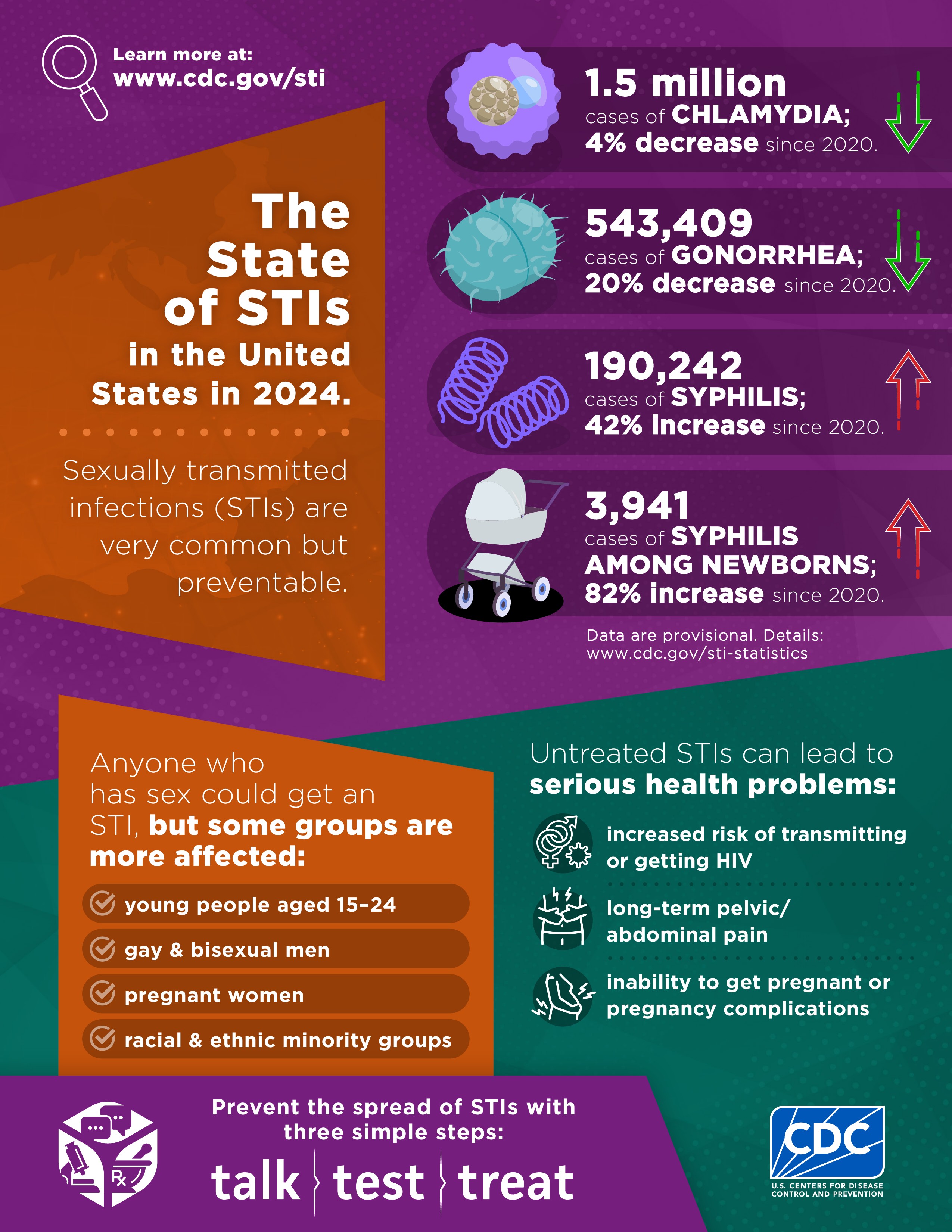
About 2.2 million cases of chlamydia, gonorrhoea and syphilis were reported in the US in 2024, according to provisional data from the Centers for Disease Control and Prevention (CDC). That is about 9% fewer than in 2023 and the third fall in a row. Chlamydia is still the most commonly reported STI, at 1.5 million cases, but syphilis passed to babies during pregnancy rose for the 12th year running, to 3,941 cases.
How many STDs are reported in the US each year
Doctors and laboratories reported 2,249,636 cases of chlamydia, gonorrhoea and syphilis in the US in 2024, down from 2,459,136 in 2023, in the CDC’s Sexually Transmitted Infections Surveillance, 2024 (Provisional). These are the three STIs that every state has to report to the CDC, so they are the only ones with a full national count each year.
| Reported cases | 2020 | 2022 | 2023 | 2024 | Change since 2020 |
|---|---|---|---|---|---|
| Chlamydia | 1,579,885 | 1,649,716 | 1,648,568 | 1,515,985 | Down 4% |
| Gonorrhoea | 677,769 | 648,056 | 601,319 | 543,409 | Down 20% |
| Syphilis, all stages | 133,965 | 207,273 | 209,249 | 190,242 | Up 42% |
| Congenital syphilis (newborns) | 2,168 | 3,773 | 3,878 | 3,941 | Up 82% |
| All three STIs | 2,391,619 | 2,505,045 | 2,459,136 | 2,249,636 | Down 6% |
The 2024 figures are provisional as of 14 August 2025. The CDC says the final numbers, due in 2026, will likely change slightly but it doesn’t expect big changes to national rates or trends. Even after three years of falls, the overall number of reported cases is 13% higher than it was a decade ago, the CDC’s Division of STD Prevention said when it released the data in September 2025.
Reported cases are only part of the picture, because many infections cause no symptoms and are never tested for. The CDC’s prevalence, incidence and cost estimates put the share of people in the US with an STI on any given day in 2018 at about one in five. STIs picked up that year will cost the American healthcare system nearly $16 billion in healthcare costs alone.
What is the most common STD in the US
HPV (human papillomavirus) is the most common STI in the US, and chlamydia is the most common one that has to be reported. The CDC’s genital HPV fact sheet calls HPV the most common STI, and its HPV overview says more than 42 million Americans have types of HPV known to cause disease, with about 13 million new infections a year. Nine in ten HPV infections clear on their own within two years.
HPV isn’t counted in the yearly surveillance report because it doesn’t have to be reported. Of the STIs that are, chlamydia is by far the most common, with 1,515,985 cases in 2024, a rate of 445.7 per 100,000 people. In the CDC’s 2018 estimates, chlamydia, trichomoniasis, genital herpes and HPV together made up 98% of all STIs people had and 93% of new ones.
Which STIs are going up and which are going down
Chlamydia, gonorrhoea and the most infectious stages of syphilis are all falling, while congenital syphilis and later stages of syphilis are not. Here is what the CDC’s 2024 provisional data shows for each.
- Chlamydia fell 8% in 2024, its second fall in a row, to 1,515,985 cases. Women account for about 62% of reported cases (943,890).
- Gonorrhoea fell 10% in 2024, its third fall in a row, to 543,409 cases. That is 20% lower than in 2020, and the drop since 2020 has been sharper among women (down 32%) than men (down 11%).
- Primary and secondary syphilis, the most infectious stages, fell 22% in 2024 to 41,496 cases, the second fall in a row.
- Syphilis of all stages fell 9% to 190,242 cases, but that is still 42% more than in 2020. Unknown-duration or late syphilis has more than doubled since 2020, to 97,266 cases.
Syphilis among women is falling more slowly than among men. Primary and secondary syphilis among women fell 14% in 2024, but it is still 50% higher than in 2020, and early non-primary non-secondary syphilis among women rose 8% in 2024 to 14,061 cases. That matters because syphilis in women can pass to a baby during pregnancy.
Why syphilis in newborns keeps rising
Congenital syphilis rose again in 2024 because the infection is still being missed or not treated in time during pregnancy, and it has now gone up for 12 years in a row. There were 3,941 cases in 2024, a rate of 109.6 per 100,000 live births, up 2% on 2023 and 82% on 2020. The CDC’s congenital syphilis page says that is the highest number in one year since 1994, and the CDC puts it at about 700% higher than a decade ago.
The CDC lists miscarriage, stillbirth, premature birth, low birth weight and death shortly after birth among the effects. Babies born with it can have deformed bones, severe anaemia, an enlarged liver and spleen, jaundice, meningitis and problems such as blindness or deafness, and some have no symptoms at birth but develop problems later. The CDC’s advice is a syphilis test at the first healthcare visit in pregnancy, even if you were tested before. Some people need another test at the start of the third trimester and when the baby is born.
Who is most affected by STIs
Anyone who has sex can get an STI, but young people, gay and bisexual men, pregnant women and some racial and ethnic minority groups are hit harder, as the CDC infographic sets out. The 2024 provisional report only covers national totals, so the latest breakdowns are in the CDC’s final 2023 STI Surveillance Report.
- Almost half (48.2%) of reported cases of chlamydia, gonorrhoea and syphilis in 2023 were among people aged 15 to 24.
- 55.8% of chlamydia cases were among people aged 15 to 24, and people aged 20 to 24 had the highest gonorrhoea rates of any age group, for both men and women.
- Data from the CDC’s sentinel network suggests about half of gonorrhoea cases in 2023 were among gay, bisexual and other men who have sex with men, and 37.2% of men in this group with primary and secondary syphilis also had HIV.
- 32.4% of chlamydia, gonorrhoea and primary and secondary syphilis cases were among Black or African American people, who make up 12.6% of the population. American Indian or Alaska Native people had the highest rates of both primary and secondary syphilis and congenital syphilis.
The CDC says these gaps are unlikely to be explained by differences in sexual behaviour alone. They may reflect unequal access to good sexual healthcare, and the fact that in communities where STIs are more common, each partner is more likely to have one.
STD rates by state
State STD rates for 2024 haven’t been published yet, so the latest state figures are for 2023. The CDC held back 2024 state and demographic data while state health departments move to a new national data platform, and it expects to finalise the 2024 data in 2026. In 2023, on the CDC’s final report, the South had the highest regional rates of chlamydia, gonorrhoea and primary and secondary syphilis.
| STI, 2023 | Highest state rate | Lowest state rate | District of Columbia |
|---|---|---|---|
| Chlamydia (per 100,000 people) | Louisiana, 792 | New Hampshire, 197 | 1,228 |
| Gonorrhoea (per 100,000 people) | Alaska, 311 | Vermont, 34 | 853 |
| Primary and secondary syphilis (per 100,000 people) | South Dakota, 73.4 | Vermont, 0.5 | 39.9 |
| Congenital syphilis (per 100,000 live births) | South Dakota, 482.1 | Connecticut, 5.7 (Idaho and Vermont had none) | 61.9 |
A state’s chlamydia rate partly reflects how much screening it does, because most chlamydia infections have no symptoms and are only found by testing. The CDC makes this point in its 2023 report, so a high rate can mean more testing as well as more infection.
What untreated STIs can do to your health
Untreated STIs can raise your risk of getting or passing on HIV, cause long-term pelvic or abdominal pain, and make it harder or impossible to get pregnant. Many people don’t know they have one, because many STIs cause mild symptoms or none at all, as the CDC’s STI overview explains.
The CDC’s chlamydia fact sheet says it can permanently damage a woman’s reproductive system and can cause an ectopic pregnancy, which can be fatal. Untreated syphilis can spread to the brain and nervous system, the eyes or the ears at any stage, according to the CDC’s syphilis fact sheet, and a sore from syphilis can make it easier for HIV to enter the body. The CDC’s gonorrhoea fact sheet warns it is becoming harder to treat some gonorrhoea as drug-resistant strains spread.
How to lower your risk and get tested
The CDC’s own summary is talk, test and treat. That means talking openly with partners and your healthcare provider, getting tested, and taking all the treatment if you test positive. Chlamydia, gonorrhoea and syphilis can all be cured with the right treatment, though the medicine won’t undo damage already done.
The CDC’s testing guidance includes these general recommendations, and a healthcare provider can tell you which tests you need.
- Everyone aged 13 to 64 should be tested for HIV at least once.
- All sexually active women under 25 should be tested for chlamydia and gonorrhoea every year, and some women aged 25 and over, such as those with new or multiple partners, should be too.
- Pregnant women should be tested for syphilis, HIV, hepatitis B and hepatitis C early in pregnancy.
- Sexually active gay and bisexual men should be tested for syphilis, chlamydia and gonorrhoea at least once a year, and every 3 to 6 months with multiple or anonymous partners.
- Most sexually active adults should be tested for syphilis depending on where they live.
You can be tested by a healthcare provider, and there are FDA-approved self-tests for some infections and kits you collect at home and post to a lab. The CDC also points people to clinics that offer confidential free or low-cost testing.
Questions about STD statistics
What is the most common STD?
HPV is the most common STI in the US, with more than 42 million Americans carrying types that can cause disease, according to the CDC. Among STIs that must be reported, chlamydia is the most common, with 1,515,985 cases in 2024.
How many people have an STD in the US?
About one in five people in the US had an STI on any given day in 2018, the CDC’s most recent full estimate. Reported cases are much lower, at about 2.2 million cases of chlamydia, gonorrhoea and syphilis in 2024, because most infections are never diagnosed or don’t have to be reported.
Are STD rates going up or down?
Mostly down. Reported cases of chlamydia, gonorrhoea and syphilis together fell about 9% in 2024, the third yearly fall in a row. Congenital syphilis is the exception and rose for the 12th year in a row.
Which state has the highest STD rate?
Louisiana had the highest chlamydia rate in 2023, Alaska the highest gonorrhoea rate and South Dakota the highest rates of primary and secondary syphilis and congenital syphilis, on the CDC’s final 2023 data. The District of Columbia’s rates for chlamydia and gonorrhoea were higher than any state’s. State figures for 2024 aren’t published yet.
What age group has the highest STD rates?
Young people aged 15 to 24 accounted for almost half of reported chlamydia, gonorrhoea and syphilis cases in 2023, and 20 to 24 year olds had the highest gonorrhoea rates. Syphilis peaks a little later, with the highest primary and secondary syphilis rates among men aged 30 to 34 and women aged 25 to 29.
Is an STI the same as an STD?
Not quite. The CDC says an STI is the infection itself and an STD is the disease that can develop from it, and people often use the terms in place of each other. The CDC now uses STI more often, because the aim is to find and treat infections before they turn into disease.
Which STDs are not curable?
Viral STIs such as HPV can’t be cured, though their effects can be treated. The CDC says there is no treatment for HPV itself, but genital warts and cervical precancer can be treated. Bacterial STIs such as chlamydia, gonorrhoea and syphilis can be cured with the right treatment.
The infographic was developed by CDC and is available free of charge on the CDC website. Its use here does not imply endorsement by CDC, the Department of Health and Human Services or the U.S. Government. This page is general information, so please speak to a healthcare provider about testing or treatment for you.
Sources
- U.S. Centers for Disease Control and Prevention, The State of STIs in the United States in 2024 (infographic, updated 17 September 2025)
- CDC, Sexually Transmitted Infections Surveillance, 2024 (Provisional) (24 September 2025, data as of 14 August 2025)
- CDC National Center for HIV, Viral Hepatitis, STD, and TB Prevention, CDC Releases 2024 National STI Data (24 September 2025)
- CDC, Sexually Transmitted Infections Surveillance, 2023 (final report, PDF)
- CDC, Sexually Transmitted Infections Prevalence, Incidence, and Cost Estimates in the United States
- CDC fact sheets on STIs, genital HPV, HPV, chlamydia, gonorrhoea, syphilis and congenital syphilis
- CDC, Getting Tested for STIs (17 March 2026)