The United States grew 10.7 billion pounds of apples that were sold or used in 2025, worth $2.82 billion to growers, according to the USDA National Agricultural Statistics Service (NASS). Washington grows about two thirds of the national crop, with New York and Michigan a long way behind. Gala is the leading variety, and roughly 1 in 4 fresh apples is exported, mostly to Mexico and Canada.
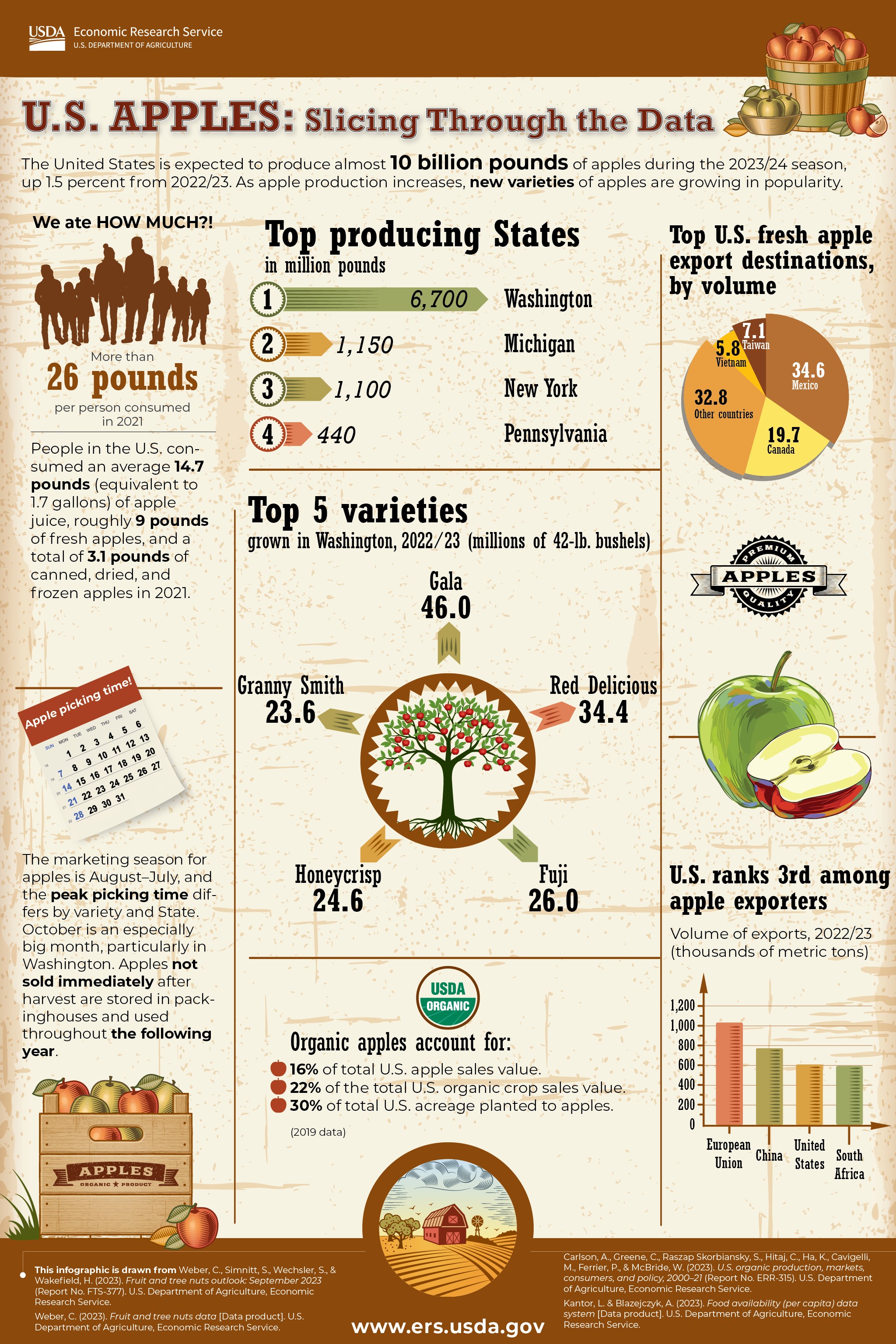
The infographic by the USDA Economic Research Service (ERS) pulls the main apple numbers into one page, from the top growing states to what Americans eat and where exports go. Below we use its figures alongside the newest USDA data, so you get the current picture for the 2025 crop and the 2026 forecast.
How many apples does the US grow each year
The US produces between 10 and 11.5 billion pounds of apples a year. In 2025 utilised production (apples actually sold or used) was 10.7 billion pounds, up 1% on 2024, from 296,900 acres of bearing orchards, according to the NASS Noncitrus Fruits and Nuts 2025 Summary.
The same NASS report puts the average yield at 37,400 pounds an acre and the crop’s value at $2.82 billion, or 26.3 cents a pound averaged across fresh and processing apples. Apples are one of the three biggest noncitrus fruit crops in the country. NASS says grapes, apples and strawberries together made up 77% of all noncitrus fruit production in 2025.
Total production, which also counts apples harvested but not sold, was 11.1 billion pounds in 2025. That is the figure NASS forecasts each summer, and for 2026 it expects a smaller crop of about 10.4 billion pounds (more on that below).
Which state produces the most apples
Washington produces the most apples in the US by a wide margin. It harvested 7.16 billion pounds of utilised apples in 2025, 66.8% of the national total and worth $1.89 billion, according to NASS. New York was second and Michigan third.
NASS publishes estimates for seven main apple states. Here is how they compared in 2025.
| State | Utilised production 2025 (million pounds) | Share of US total | Bearing acres |
|---|---|---|---|
| Washington | 7,163 | 66.8% | 171,000 |
| New York | 1,494 | 13.9% | 46,000 |
| Michigan | 1,064 | 9.9% | 37,000 |
| Pennsylvania | 503 | 4.7% | 18,500 |
| California | 188 | 1.8% | 10,200 |
| Oregon | 158 | 1.5% | 4,600 |
| Virginia | 149 | 1.4% | 9,600 |
Source, NASS Noncitrus Fruits and Nuts 2025 Summary (May 2026). Shares are of the 10,718.5 million pound US total.
Washington’s lead comes from both size and yield. It has more than half of the country’s bearing apple acres and averaged 44,100 pounds an acre in 2025, against 32,500 in New York and 28,800 in Michigan, per NASS. The ERS infographic, published in February 2024, shows Michigan just ahead of New York. That order has since flipped. NASS figures show New York ahead in both 2024 and 2025, helped by what ERS calls New York’s “bumper crop” last season.
Washington’s grip on fresh apples is even tighter. Over the last five seasons it grew between 71% and 80% of all US fresh-market apples, so its harvest largely sets supermarket supply, prices and exports, according to the ERS Fruit and Tree Nuts Outlook for September 2026.
Why the 2026 apple crop is smaller
A spring freeze in the eastern states is the main reason. USDA forecasts the 2026 crop at 10.4 billion pounds, 6% below 2025 and the smallest since 2022, according to the ERS September 2026 outlook, which uses the NASS August crop forecast.
ERS explains that a warm March and early April pushed trees into bud early across the Mid-Atlantic and parts of New York, and a cold snap around 21 April then damaged them. The forecast falls are steep in the affected states.
- Pennsylvania down 58%, to 210 million pounds
- Virginia down 48%, to 77 million pounds, which ERS says would be its smallest apple crop in more than 50 years
- New York down 10%, to 1.35 billion pounds
The West Coast and Michigan are close to last year. Washington is forecast at 7.4 billion pounds, 2% lower than 2025 but 6% above its previous five-year average, and Michigan at 1.05 billion pounds, down 1%, according to ERS.
The most grown apple varieties in the US
Gala is the most grown apple in the US. It leads the variety forecasts for Washington, Michigan, New York and California in 2026/27, according to US Apple Association (USApple) figures reported by ERS.
The varieties that matter most differ by state.
- Washington, Gala, Granny Smith, Red Delicious, Honeycrisp and Cosmic Crisp, 68% of the state’s expected volume
- Michigan, Gala, Honeycrisp, Red Delicious, Fuji and Golden Delicious, 58%
- New York, Gala, Idared, Rome, McIntosh and Empire, 45%
- Pennsylvania, York, Golden Delicious, Gala, Fuji and Red Delicious, 62%
- Virginia, Golden Delicious, York, Rome, Red Delicious and Pink Lady (Cripps Pink), 62%
Source, USApple forecasts for 2026/27 as reported in the ERS Fruit and Tree Nuts Outlook, September 2026. ERS also reports Gala as California’s leading variety (37% of volume) and Granny Smith as Oregon’s (39%).
For a sense of scale, the ERS apple infographic shows Washington’s 2022/23 harvest at 46.0 million 42 pound bushels of Gala, 34.4 million of Red Delicious, 26.0 million of Fuji, 24.6 million of Honeycrisp and 23.6 million of Granny Smith. Newer varieties are gaining ground too. Cosmic Crisp, which was not in that 2022/23 top five, is in Washington’s forecast top five for 2026/27.
When is apple season in the US
The US apple harvest runs from August to October, so early autumn is peak apple season. ERS says the new crop is picked from August through October, with October an especially big month in Washington, per the ERS outlook and the ERS infographic.
You can still buy US apples all year because most of the crop goes into storage. The apple marketing year runs from August to the following July, and apples not sold at harvest are kept in packinghouse storage and sold over the following months, according to ERS. ERS adds that better storage and varieties bred to store well have lengthened the selling season, which is one reason the US now imports fewer counter-seasonal apples from the Southern Hemisphere.
Harvest timing varies by state and year. In 2026, Pennsylvania’s short crop was 90% picked by 20 September, well ahead of its five-year average of 63%, while Virginia was 41% picked against an average of 49%, per ERS.
How many apples Americans eat
About 36 pounds of apples per person were available to eat in the US in 2025, counting fresh apples, juice and processed products, according to the ERS Fruit and Tree Nuts Yearbook tables (farm weight). Fresh apples made up 16.2 pounds of that and apple juice 13.0 pounds.
That total moves mostly with juice. Per person availability was 46.4 pounds in 2021, when juice alone accounted for 23.8 pounds, while fresh apples have stayed between about 16 and 18 pounds a year since 2020, per the same ERS tables.
These are supply figures, not what people actually swallow. ERS’s Loss-Adjusted Food Availability data take off spoilage, peel, cores and plate waste. On that basis Americans ate about 26.7 pounds of apples per person in 2021, made up of 14.7 pounds of apple juice, 8.8 pounds of fresh apples and 3.1 pounds of canned, frozen and dried apples. Those are the figures behind the “more than 26 pounds” in the ERS infographic.
Most of the crop is eaten fresh. In 2025, 7.27 billion pounds of US apples (68%) went to the fresh market and 3.45 billion pounds (32%) to processing, such as juice, sauce, canned and frozen apples, according to NASS. California is the exception, sending 78% of its apples to processing over the last five seasons, while Oregon sends 89% of its crop to the fresh market, per ERS.
Where US apple exports go
The US exports about a quarter of its fresh apples, and Mexico is the biggest buyer. In the 2025/26 marketing year US fresh apple exports totalled 1.87 billion pounds, roughly 25% of fresh production, and reached a record $1.16 billion in value, according to the ERS September 2026 outlook.
| Rank | Destination, 2025/26 | What ERS reports |
|---|---|---|
| 1 | Mexico | 740 million pounds, 39% of volume, up 14% |
| 2 | Canada | 343 million pounds, 18% of volume, up 15% |
| 3 | Taiwan | Third by volume, down 2% |
| 4 | Vietnam | Fourth by volume, down 21% |
| 5 | Dominican Republic | 63 million pounds, nearly unchanged |
| 6 | India | 55.4 million pounds, down 38% |
Source, ERS Fruit and Tree Nuts Outlook, September 2026, based on Census Bureau trade data. The marketing year runs August to July.
Different markets want different apples. Washington State Department of Agriculture shipment data cited by ERS show Fuji makes up more than 70% of Washington apple exports to Taiwan, while more than 80% of shipments to India are the lower priced Red Delicious. Vietnam buys a mix led by Cosmic Crisp (23%), Gala (18%) and Envy (16%).
The US remains a net exporter. Fresh apple imports fell 13% to 162 million pounds in 2025/26, about a third of the volume imported in 2013/14, per ERS. On the world stage, the ERS infographic ranks the US third among apple exporters in 2022/23, behind the European Union and China.
Organic apples
Organic apples are a big and growing part of the US trade. US fresh organic apple exports reached a record 397 million pounds in 2025/26, 21% of all fresh apple export volume, according to ERS.
At home, organic apples accounted for 16% of total US apple sales value and 22% of all US organic crop sales value in 2019, according to the ERS apple infographic, which draws on the ERS report U.S. Organic Production, Markets, Consumers, and Policy, 2000 to 2021.
Apple prices in 2026
Apple prices are rising. The Consumer Price Index for apples was up 5% in August 2026 on a year earlier, and ERS expects higher fresh and processing apple prices through the 2026/27 season because of the smaller crop, the eastern shortfall and higher transport costs, according to the ERS September 2026 outlook.
ERS also reports that stocks of Gala and Red Delicious in storage were about 20% lower than a year earlier at the start of summer 2026, and that shipping point prices for both varieties climbed through the second half of the 2025/26 season, while Granny Smith stayed fairly stable. For growers, NASS puts the 2025 average price across fresh and processing apples at 26.3 cents a pound, down slightly from 26.8 cents in 2024.
Questions about US apple production
Which state produces the most apples?
Washington. It grew 7.16 billion pounds of utilised apples in 2025, 66.8% of the US total, according to NASS. New York (1.49 billion pounds) and Michigan (1.06 billion pounds) were second and third.
How many pounds of apples does the US produce a year?
About 10.7 billion pounds were sold or used in 2025, from total production of 11.1 billion pounds, per NASS. The 2026 crop is forecast at 10.4 billion pounds, according to ERS.
When is apple harvest season in the US?
August to October, with October a peak month in Washington, according to ERS. Stored apples are then sold through to the following July.
What is the most popular apple variety in the US?
By volume grown, Gala. It leads the 2026/27 forecasts in Washington, Michigan, New York and California, according to USApple figures reported by ERS. Red Delicious, Granny Smith, Honeycrisp and Fuji follow it in Washington’s ranking.
How many apples does the average American eat a year?
About 36 pounds of apples and apple products per person were available in 2025, including 16.2 pounds of fresh apples, per the ERS yearbook tables. After waste and inedible parts, ERS estimates actual eating at about 27 pounds per person in 2021, more than half of it as juice.
Does the US export apples?
Yes. About 1 in 4 US fresh apples is exported, 1.87 billion pounds worth $1.16 billion in 2025/26, mostly to Mexico and Canada, according to ERS.
Why are apples more expensive in 2026?
A freeze in April cut the crop in Pennsylvania, Virginia and New York, and transport costs are higher. ERS expects both to push apple prices up during the 2026/27 season.
Sources
- USDA NASS, Noncitrus Fruits and Nuts 2025 Summary (May 2026)
- USDA ERS, Fruit and Tree Nuts Outlook, September 2026 (FTS-386)
- USDA ERS, Fruit and Tree Nuts Yearbook Tables (updated 5 November 2026)
- USDA ERS, Food Availability (Per Capita) Data System
- USDA ERS, U.S. Apples, Slicing Through the Data (Amber Waves infographic, February 2024)