How many types of bananas are there?
There are hundreds of banana varieties, but almost all of them come from just two wild species from Southeast Asia: Musa acuminata and Musa balbisiana [1][2]. Botanists group cultivated bananas by how much of each parent they carry. An AAA banana, such as Cavendish, comes entirely from M. acuminata; AAB and ABB bananas are hybrids with M. balbisiana, and most cooking bananas belong to these groups [1][3].
The line between “bananas” and “plantains” mostly makes sense in Europe and North America, where shops sell one sweet banana and one cooking banana. In Southeast Asia, where most varieties come from, many bananas are eaten both raw and cooked, and some starchy cooking bananas are smaller than dessert ones [1].
In the kitchen, the useful split is simpler. Dessert bananas are sweet and eaten raw when ripe. Cooking bananas, including plantains, are starchier and usually boiled, fried or roasted [1][3]. The EXIM Asian infographic on this page uses that split, with eight dessert bananas and four cooking bananas, and the varieties below follow the same order.
Dessert bananas
Cavendish
Cavendish is the banana in almost every supermarket outside the tropics. It is an AAA group that includes cultivars such as Grande Naine (the Chiquita banana), Williams and Dwarf Cavendish [4][5]. It has smooth yellow skin and pale, creamy flesh, and is sold at every stage from green to yellow with brown spots.
Lady Finger
Lady Finger bananas, also called sugar bananas, fig bananas or date bananas, are small, thin skinned and very sweet. They are an AA cultivar from Malaysia or Indonesia and the most widely grown AA banana in the world [6]. EXIM Asian notes they brown more slowly than Cavendish once cut, which makes them good for fruit salads [7].
Red banana
Red bananas have reddish purple skin and cream to light pink flesh. They are softer and sweeter than Cavendish, and some have a slight raspberry flavour [8]. Some are smaller and plumper than Cavendish, others much larger.
Blue Java
Blue Java, also sold as the ice cream banana, is silvery blue before it ripens and pale yellow when ripe. It is known for its soft, creamy flesh with a flavour often compared to vanilla. It is an ABB hybrid native to Southeast Asia and is hardier and more cold tolerant than most bananas [9].
Manzano
Manzano, also called the apple banana or silk banana, is a short, chubby AAB banana with a slightly acidic, apple-like flavour [10]. It is the same cultivar as the Latundan of the Philippines, one of the most common bananas in Southeast Asia [10].
Pisang Raja
Pisang Raja is an AAB banana grown in Malaysia and Indonesia, where its name translates as “king banana” [11]. It has yellow to orange skin and a sweet, custardy flesh with a balance of sweetness and acidity, and is eaten raw or cooked [7]. EXIM Asian’s article describing it says it is also called Latundan, but that is a different cultivar: the Latundan is known in Malaysia as pisang raja sereh, not Pisang Raja [10][11].
Goldfinger
Goldfinger (FHIA-01) is a modern hybrid bred in Honduras at the Honduran Foundation for Agricultural Research to resist black sigatoka, a leaf disease. It is more resistant to cold, wind and disease than most bananas, and has caught on in Australia more than in North America or Europe [12]. It can be cooked when green and eaten raw when ripe.
Barangan
Barangan is a dessert banana, yellow with small dark spots when ripe, with seedless white flesh and a sweet, mild taste [7].
Cooking bananas and plantains
Cooking bananas are a staple food in West and Central Africa, the Caribbean, Central America and northern South America [3]. Botanists use the word plantain only for true plantains, a particular AAB group, and call the other starchy varieties cooking bananas, although in shops the two names are used loosely [3].
- Plantain. Larger and tougher than a dessert banana, with thick skin. It is green and starchy when unripe, turns yellow, and goes very dark brown when fully ripe, getting sweeter at each stage. It is cooked at every stage [3][7].
- Saba. An ABB banana from the Philippines and one of the most important bananas in Filipino cooking. The fruit is short, thick and distinctly square and angular, with white, starchy flesh. It can be eaten raw but is usually boiled or cooked into dishes such as turon and halo-halo [13].
- Bluggoe and Burro. Bluggoe is a cold hardy ABB banana, about 15 cm long, used mainly for cooking but sweet enough to eat raw when ripe [14]. Burro, sometimes sold as the chunky banana, is stubby and square with a lemony, tangy taste, and turns from dark green to deep yellow as it ripens [7]. Wikipedia lists burro as another name for Bluggoe (also called Orinoco), so the two names on the infographic are at least very closely related and are often used for the same banana [14].
Why supermarkets mostly sell Cavendish
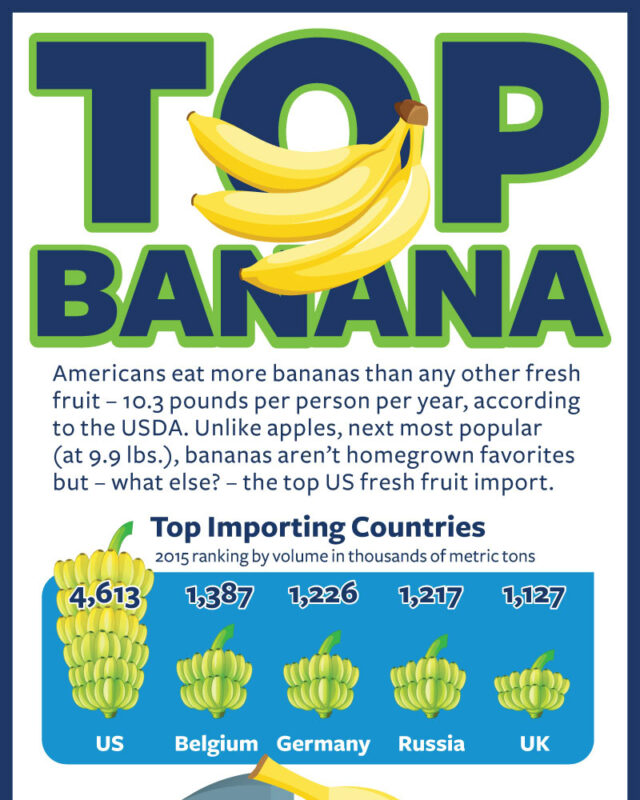
Cavendish bananas account for about 99% of banana exports to developed countries [4]. They were not always the main export banana. Until the 1950s the trade ran on Gros Michel, whose taste is often described as a stronger version of Cavendish [15]. Gros Michel was wiped out on plantations by Panama disease, a soil fungus, and growers switched to Cavendish because it resisted the strain that killed Gros Michel [5][15].
Cavendish is not just an export banana. ProMusa estimates Cavendish types made up 57% of world banana production in 2018, but most of that was grown for domestic markets; exports were about 16% of production [5]. In 2022, world production of bananas and plantains was 179 million tonnes, led by India and China [1].
Because every Cavendish plant is a clone, it has almost no genetic variety. Since the 2010s a new strain of Panama disease, Tropical Race 4, has been spreading through Cavendish plantations, and there is no ready replacement variety [4][16]. That is one reason breeders have worked on hybrids such as Goldfinger.
Which type of banana tastes best?
That is down to taste, but the varieties people pick out most often are the sweeter, creamier dessert bananas. Lady Finger and red bananas are both sweeter than Cavendish, Blue Java has a soft, vanilla-like flesh, and Manzano has a tangy apple flavour [6][8][9][10]. If you want the old-fashioned “banana sweets” flavour, that comes closer to Gros Michel, which has more of the ester used in artificial banana flavouring than Cavendish does [15].
Questions about types of bananas
What is a burro banana?
A burro banana is a short, square cooking banana with a lemony, tangy taste. Its skin goes from dark green to deep yellow with black spots as it ripens [7]. It is usually listed as the same banana as Bluggoe or Orinoco, an ABB variety [14].
Which bananas are best for smoothies?
Any ripe dessert banana works. EXIM Asian lists Burro and Manzano as good for smoothies, puddings and pies [7], and soft, creamy varieties such as Blue Java blend well.
What is the difference between a banana and a plantain?
Plantains are a group of starchy cooking bananas. They are bigger, with thicker skin, and are usually cooked rather than eaten raw. Dessert bananas such as Cavendish are sweet enough to eat raw when ripe [3].
What is the most common type of banana?
Cavendish. It makes up about 99% of banana exports to developed countries and more than half of world banana production [4][5].
What is a group of bananas called?
The whole hanging cluster is a bunch, and each tier within it is a hand. A bunch has around nine hands with up to 20 fruits each [1].
Sources
- Wikipedia, Banana.
- Britannica, Banana.
- Wikipedia, Cooking banana.
- Wikipedia, Cavendish banana.
- ProMusa, Cavendish subgroup, Musapedia.
- Wikipedia, Lady Finger banana.
- EXIM Asian, What are the TOP 10 Varieties of Bananas?, 2022, the article published with this infographic.
- Wikipedia, Red banana.
- Wikipedia, Blue Java banana.
- Wikipedia, Latundan banana.
- ProMusa, Pisang Raja, Musapedia.
- Wikipedia, Goldfinger banana.
- Wikipedia, Saba banana.
- Wikipedia, Bluggoe (Orinoco banana).
- Wikipedia, Gros Michel.
- Wikipedia, Panama disease.
Last reviewed 5 November 2026