How many women are there per 100 men in the EU?
There were 104.2 women for every 100 men in the European Union on 1 January 2025, about 230.0 million women and 220.7 million men, according to Eurostat [2]. Women outnumber men in 23 of the 27 EU countries. Latvia has the most women per 100 men (115.6), while Malta, Slovenia, Sweden and Luxembourg have more men than women [2].
The infographic by Europe Magazine uses Eurostat’s figures for 1 January 2023, when the EU ratio was 104.6 [1]. The ranking has barely changed since then, but the gap between women and men is slowly narrowing in most countries.
Women per 100 men by EU country
These are Eurostat’s population figures for 1 January 2025, with 2023 for comparison, sorted from the most women to the most men [2].
| Country | Women per 100 men (2025) | Women per 100 men (2023) |
|---|---|---|
| Latvia | 115.6 | 116.1 |
| Estonia | 110.8 | 111.0 |
| Lithuania | 110.4 | 113.9 |
| Portugal | 109.1 | 109.5 |
| Bulgaria | 108.0 | 108.0 |
| Hungary | 107.1 | 107.6 |
| Poland | 106.9 | 106.8 |
| France | 106.0 | 106.3 |
| Romania | 105.0 | 106.1 |
| Croatia | 104.8 | 106.8 |
| Slovakia | 104.4 | 104.5 |
| Italy | 104.2 | 104.7 |
| Spain | 103.9 | 104.0 |
| Czechia | 103.7 | 104.0 |
| Greece | 103.6 | 104.5 |
| Cyprus | 103.0 | 104.0 |
| Austria | 102.9 | 103.0 |
| Germany | 102.7 | 103.1 |
| Belgium | 102.4 | 102.6 |
| Ireland | 102.2 | 102.4 |
| Finland | 102.0 | 102.1 |
| Denmark | 101.2 | 101.2 |
| Netherlands | 101.0 | 101.3 |
| Luxembourg | 98.9 | 98.8 |
| Sweden | 98.8 | 98.6 |
| Slovenia | 98.7 | 99.1 |
| Malta | 88.3 | 90.3 |
| EU | 104.2 | 104.6 |
Eurostat revises its population figures when countries publish new census or register data, so a few of the 2023 values in its database now differ slightly from the ones on the infographic. The biggest change is Cyprus, now 104.0 for 2023 rather than 105.0, and Romania, now 106.1 rather than 105.7 [2]. Ratios here are worked out from Eurostat’s counts of women and men.
Why there are more women than men in Europe
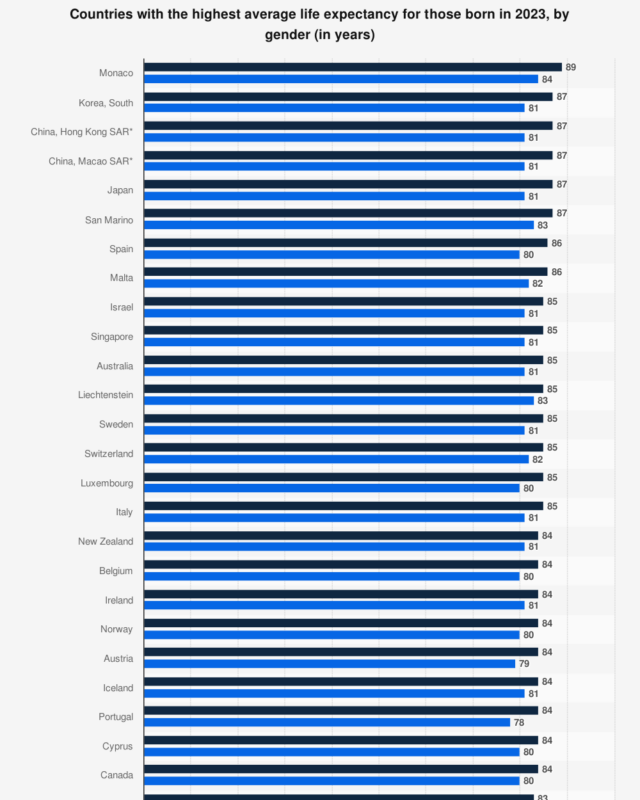
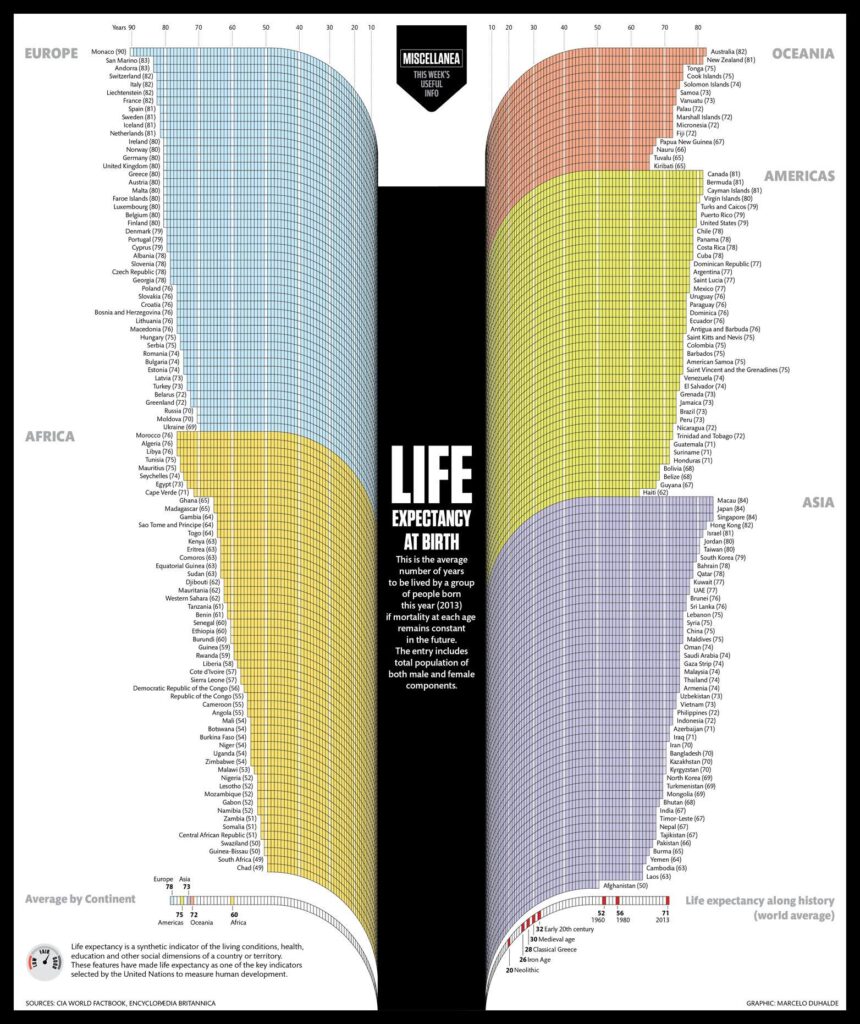
More boys are born than girls, so the ratio starts below 100. In the EU there were 94.9 girls per 100 boys aged under 15 in 2025, and 98.6 women per 100 men of working age (15 to 64) [3]. The balance tips in later life because women live longer. EU life expectancy at birth in 2024 was 84.1 years for women and 78.9 for men, a gap of more than five years [4]. Among people aged 65 and over there were 130.4 women for every 100 men [3].
So the more older people a country has, and the wider its gap in life expectancy, the more women it has relative to men. Migration also matters, because people who move for work are more often young men.
Why the Baltic states have so many more women
Latvia, Lithuania and Estonia have the largest gaps between men’s and women’s life expectancy in the EU. In Latvia, women born in 2024 can expect to live 81.2 years and men 71.4, a gap of almost ten years. Lithuania’s gap is 8.6 years and Estonia’s 8.3 [4]. The explanations usually given are higher rates of smoking, heavy drinking, heart disease and accidents among men. The result is that Latvia has 191.9 women aged 65 and over for every 100 men of that age [3].
All three countries have also lost a large share of their population since the early 2000s, much of it through emigration of working-age people. Latvia’s population fell by 18% and Lithuania’s by 17% between 2003 and 2023, the largest falls in the EU [1].
Why Malta has more men than women
Malta is the clear exception, with 88.3 women per 100 men in 2025. Its population has grown fast, by 36% between 2003 and 2023, much of it from workers arriving from abroad, and they are mostly young men [1]. Among people aged 15 to 64 in Malta, there are only 81.5 women for every 100 men [3]. Twenty years ago Malta had more women than men, at 101.8 per 100 [1].
Luxembourg, Sweden and Slovenia are only just below parity. Luxembourg and Sweden have high immigration and some of the smallest gaps in life expectancy between men and women. In Sweden the gap is only 3.0 years [4].
Questions about women per 100 men in the EU
Are there more men or women in Europe?
There are more women. On 1 January 2025 the EU had about 230.0 million women and 220.7 million men, or 4.2% more women [2]. Among other European countries in Eurostat’s data, Moldova has even more women relative to men (113.0 per 100), while Norway (98.4), Iceland (95.0) and Türkiye (99.9) have slightly more men [2].
Which European country has the most women compared with men?
Latvia, with 115.6 women per 100 men in 2025, followed by Estonia (110.8) and Lithuania (110.4) [2]. Among all countries in Eurostat’s data, Moldova is second at 113.0.
Which country has a shortage of men?
In the EU, Latvia has the largest imbalance, with almost 16 more women than men for every 100 men [2]. The gap is concentrated in older age groups: among Latvians aged 65 and over there are almost two women for every man, because men there die much younger than women [3][4].
Is the gap between women and men in the EU getting smaller?
Yes, slowly. There were 5.4% more women than men in the EU in 2003, 4.6% more in 2023 and 4.2% more in 2025 [1][2]. Since 2023 the biggest falls have been in Lithuania, Croatia and Malta [2].
Sources
- Eurostat, Demography of Europe, 2024 edition (section More women than men, and population change 2003 to 2023).
- Eurostat, Population on 1 January by age and sex (demo_pjan), last updated 25 September 2026.
- Eurostat, Population on 1 January by broad age group and sex (demo_pjanbroad), 2025.
- Eurostat, Life expectancy by age and sex (demo_mlexpec), 2024.
- Reddit r/Infographics, Women per 100 men in the EU, 2023, where the graphic was shared in November 2024.
Last reviewed 9 November 2026