Which countries have the most pension fund assets?
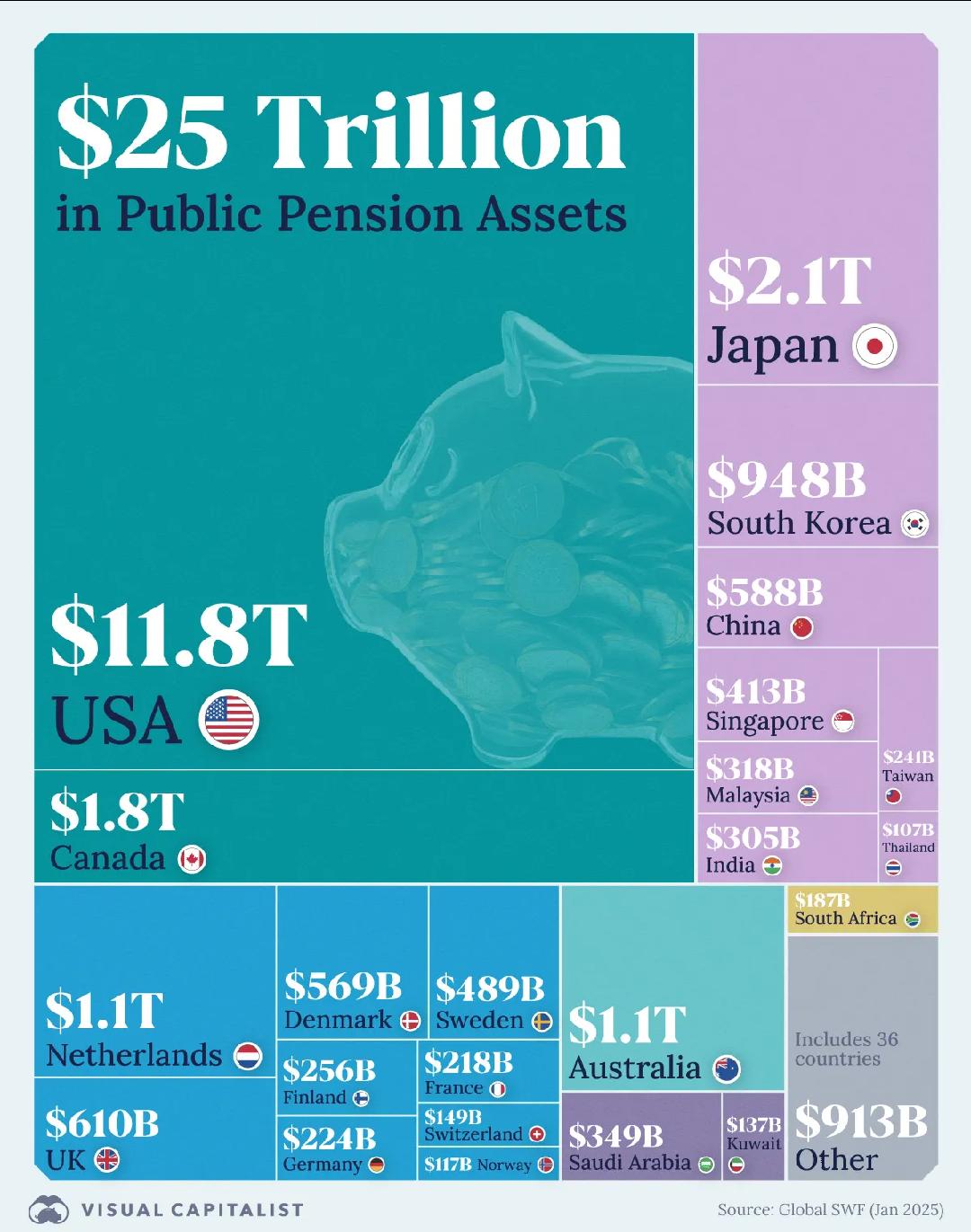
The United States has by far the most pension fund assets of any country. Its public pension funds held $11.8 trillion in January 2025, according to Global SWF, close to half of the $25 trillion held by public pension funds worldwide. Japan ($2.1 trillion) and Canada ($1.8 trillion) come next, followed by the Netherlands and Australia at $1.1 trillion each.
The infographic by Visual Capitalist sizes each country by those public pension assets [1]. Counting private and workplace schemes as well, the totals are much bigger. The Thinking Ahead Institute puts all pension assets in the 22 largest markets at $58.5 trillion at the end of 2024, with the US holding $38.0 trillion of it [2]. This article covers both measures and explains why they differ.
Public pension fund assets by country
Five countries hold more than $1 trillion each in public pension funds, and together they account for about 71% of the world total (our arithmetic from [1]). The table gives Global SWF’s figures as published by Visual Capitalist, in billions of US dollars [1].
| Rank | Country | Region | Public pension assets ($ billion) | Share of world total |
|---|---|---|---|---|
| 1 | United States | North America | $11,760 | 47.0% |
| 2 | Japan | Asia | $2,066 | 8.3% |
| 3 | Canada | North America | $1,804 | 7.2% |
| 4 | Netherlands | Europe | $1,131 | 4.5% |
| 5 | Australia | Oceania | $1,121 | 4.5% |
| 6 | South Korea | Asia | $948 | 3.8% |
| 7 | United Kingdom | Europe | $610 | 2.4% |
| 8 | China | Asia | $588 | 2.4% |
| 9 | Denmark | Europe | $569 | 2.3% |
| 10 | Sweden | Europe | $489 | 2.0% |
| 11 | Singapore | Asia | $413 | 1.7% |
| 12 | Saudi Arabia | Middle East | $349 | 1.4% |
| 13 | Malaysia | Asia | $318 | 1.3% |
| 14 | India | Asia | $305 | 1.2% |
| 15 | Finland | Europe | $256 | 1.0% |
| 16 | Taiwan | Asia | $241 | 1.0% |
| 17 | Germany | Europe | $224 | 0.9% |
| 18 | France | Europe | $218 | 0.9% |
| 19 | South Africa | Africa | $187 | 0.7% |
| 20 | Switzerland | Europe | $149 | 0.6% |
| 21 | Kuwait | Middle East | $137 | 0.5% |
| 22 | Norway | Europe | $117 | 0.5% |
| 23 | Thailand | Asia | $107 | 0.4% |
| 36 other countries | $913 | 3.6% |
The figures add up to $25.02 trillion. Shares are our arithmetic.
By region, North America holds about $13.6 trillion (54%), Asia $5.0 trillion (20%) and Europe $3.8 trillion (15%), with Australia making up most of the rest (our sums from [1]).
What counts as a public pension fund
A public pension fund is one run by or for the state, either for public sector workers or as part of a national pension system. Visual Capitalist describes public plans as schemes that provide retirement and disability benefits and are regulated by public sector law. Most are defined benefit plans, where members pay in compulsory contributions and receive a monthly pension for life, usually worked out from their salary in their highest earning years [1].
That explains some of the surprises in the ranking. The United Kingdom ranks only seventh with $610 billion, because most UK pension money sits in private company schemes and personal pensions rather than public funds. The US figure covers state and local government plans such as CalPERS and CalSTRS and the federal Thrift Savings Plan, not private 401(k) accounts [1].
Total pension assets by country, public and private
If you count every kind of pension, the US share rises to about two thirds. The Thinking Ahead Institute’s Global Pension Assets Study 2025 estimates the following totals at the end of 2024, including private, workplace and personal schemes [2].
| Country | Total pension assets, end 2024 ($ billion) | Pension assets as % of GDP |
|---|---|---|
| United States | $37,992 | 130% |
| Japan | $3,300 | 81% |
| Canada | $3,267 | 148% |
| United Kingdom | $3,139 | 88% |
| Australia | $2,639 | 146% |
| Netherlands | $1,747 | 143% |
| Switzerland | $1,433 | 152% |
These seven markets hold 91% of the $58.5 trillion total across the 22 countries in the study, and the US alone has 64.9% [2]. The US figure includes individual retirement accounts. Outside these 22 markets the institute estimates there is only another $3 trillion to $5 trillion of pension assets [2].
Measured against the size of the economy, Switzerland, Canada, Australia and the Netherlands have the deepest pension systems, each with assets worth more than 140% of GDP [2]. China, France and India are at the other end, under 7%, because their pensions are mostly paid from current taxes and contributions rather than from large invested funds.
The largest pension funds in the world
The two biggest single funds are Norway’s Government Pension Fund Global and Japan’s Government Pension Investment Fund (GPIF). The Thinking Ahead Institute’s 2025 ranking of the world’s 300 largest pension funds puts Norway’s fund first, overtaking GPIF for the first time in over 20 years [3]. Norway’s fund was worth about $2.5 trillion in October 2026, and GPIF held ¥277 trillion ($1.87 trillion) in September 2025 [4][5].
This is why Norway looks small on the infographic, at $117 billion. Global SWF classes the Government Pension Fund Global as a sovereign savings fund, because it invests Norway’s oil and gas revenue for future generations and does not pay pensions directly [6]. So the Visual Capitalist figure leaves it out and counts only Norway’s other public pension funds. Rankings that treat it as a pension fund put Norway at the top.
Altogether the top 300 pension funds held a record $24.4 trillion at the end of 2024, up 7.8% in the year. Sovereign and public sector funds made up 71.2% of that money, and US funds 41.4% [3].
Challenges facing public pensions
The main pressure on public pensions is that people live longer and fewer workers pay in for each retiree. Visual Capitalist cites an Equable Institute estimate that US public pensions were $1.6 trillion short of what they need to pay future benefits in 2023 [1].
Funds have responded by moving money into private equity, property, infrastructure and private debt in search of higher returns, and many countries are shifting new savers into defined contribution schemes [2]. The shift to defined contribution grows more marked every year, and it now holds most pension money in Australia (89%) and the US (69%), against about 5% in Japan [2].
Questions about pension fund assets by country
Which country has the largest pension fund assets?
The United States. It has $11.8 trillion in public pension funds and about $38 trillion in all pension assets, around 65% of the total in the world’s 22 largest pension markets [1][2].
What is the largest pension fund in the world?
Norway’s Government Pension Fund Global, which overtook Japan’s GPIF in the Thinking Ahead Institute’s 2025 ranking [3]. If you count only funds that pay pensions, GPIF is the largest, with about $1.9 trillion [5].
How much money is in pension funds worldwide?
About $58.5 trillion in the 22 biggest markets at the end of 2024, plus an estimated $3 trillion to $5 trillion elsewhere [2]. Public pension funds alone hold about $25 trillion [1].
Which country has the most pension assets compared with its economy?
Switzerland, with pension assets worth about 152% of GDP, just ahead of Canada and Australia [2].
What are the largest public pension funds in the US?
The Federal Retirement Thrift Investment Board, which runs the Thrift Savings Plan for federal employees, and two California funds, CalPERS for public employees and CalSTRS for teachers [1].
Sources
- Visual Capitalist, Countries With the Most Pension Wealth in 2025, Marcus Lu, 20 January 2025, using Global SWF data from January 2025. The original page for the infographic.
- Thinking Ahead Institute and WTW, Global Pension Assets Study 2025, figures to the end of 2024.
- Thinking Ahead Institute and Pensions & Investments, The world’s largest pension funds 2025, September 2025.
- Wikipedia, Government Pension Fund of Norway, value as of October 2026, from Norges Bank Investment Management.
- Wikipedia, Government Pension Investment Fund, assets as of September 2025.
- Global SWF, NBIM (Norway) investor profile.
Last reviewed 13 November 2026