Key figures from the graphic
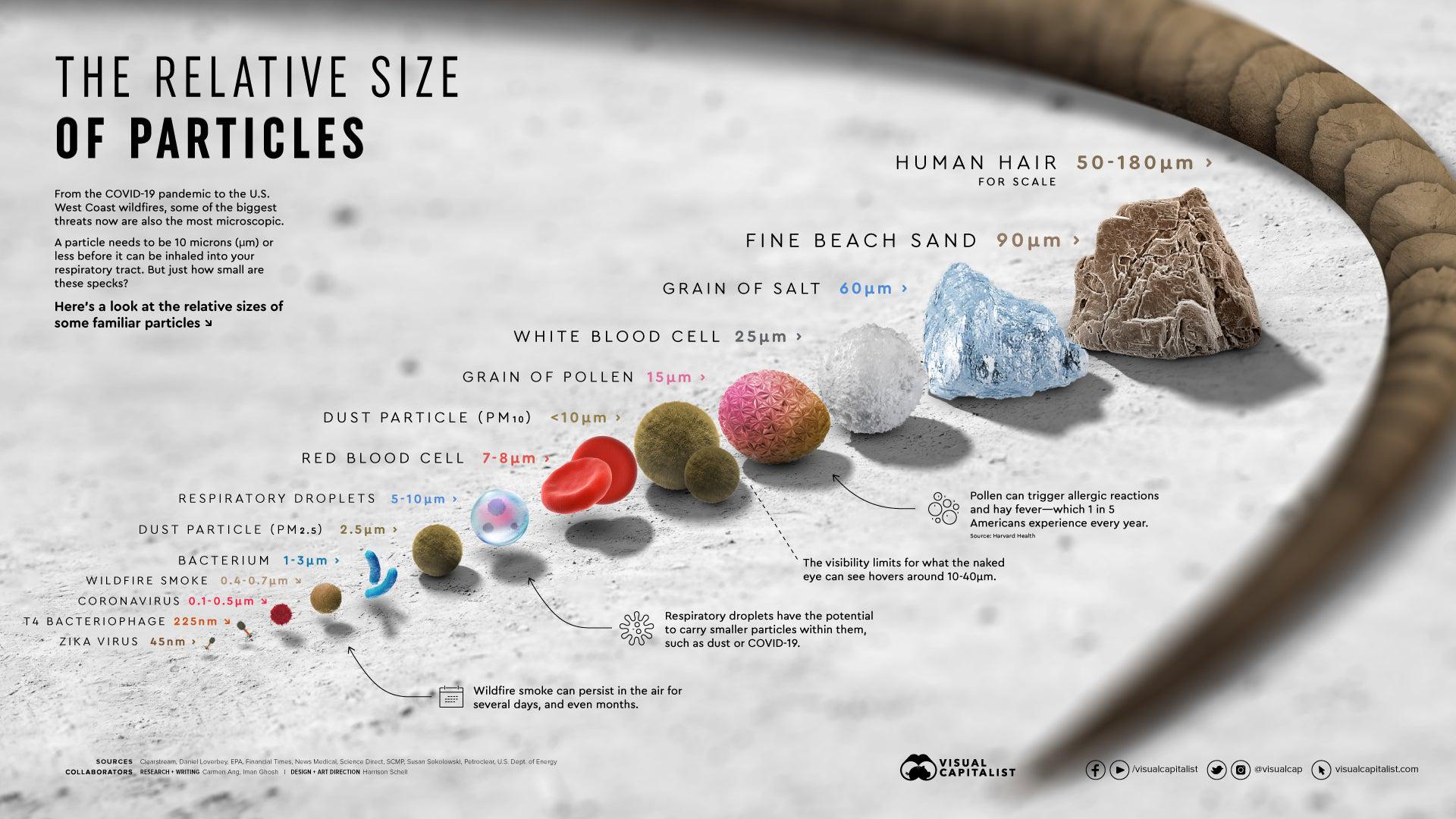
- The graphic compares 14 particles, from the Zika virus at 45 nanometres to fine beach sand at 90 micrometres (µm), with a human hair of 50 to 180 µm for scale.
- The coronavirus is 0.1 to 0.5 µm, smaller than a red blood cell (7 to 8 µm) or a white blood cell (25 µm).
- Wildfire smoke particles are 0.4 to 0.7 µm, smaller than PM2.5 dust (2.5 µm).
- The graphic says a particle needs to be 10 µm or less before it can be inhaled into the respiratory tract, and that the naked eye can see down to about 10 to 40 µm.
All figures are from the graphic, whose sources include the EPA, the U.S. Department of Energy, the Financial Times and Science Direct.
The relative size of particles, in text
Title: The Relative Size of Particles. Intro: “From the COVID-19 pandemic to the U.S. West Coast wildfires, some of the biggest threats now are also the most microscopic. A particle needs to be 10 microns (µm) or less before it can be inhaled into your respiratory tract. But just how small are these specks? Here’s a look at the relative sizes of some familiar particles.”
The particles are drawn as 3D objects in a line from smallest (bottom left) to largest (top right), with a strand of human hair arching across the top. Listed here from smallest to largest; the third column converts nanometres to micrometres (1 µm = 1,000 nm).
| Particle (label on graphic) | Size as printed | Size in micrometres (our conversion) |
|---|---|---|
| Zika virus | 45nm | 0.045 |
| T4 bacteriophage | 225nm | 0.225 |
| Coronavirus | 0.1-0.5µm | 0.1 to 0.5 |
| Wildfire smoke | 0.4-0.7µm | 0.4 to 0.7 |
| Bacterium | 1-3µm | 1 to 3 |
| Dust particle (PM2.5) | 2.5µm | 2.5 |
| Respiratory droplets | 5-10µm | 5 to 10 |
| Red blood cell | 7-8µm | 7 to 8 |
| Dust particle (PM10) | <10µm | under 10 |
| Grain of pollen | 15µm | 15 |
| White blood cell | 25µm | 25 |
| Grain of salt | 60µm | 60 |
| Fine beach sand | 90µm | 90 |
| Human hair (for scale) | 50-180µm | 50 to 180 |
Callouts:
- “Pollen can trigger allergic reactions and hay fever, which 1 in 5 Americans experience every year.” Source: Harvard Health.
- “The visibility limits for what the naked eye can see hovers around 10-40µm.”
- “Respiratory droplets have the potential to carry smaller particles within them, such as dust or COVID-19.”
- “Wildfire smoke can persist in the air for several days, and even months.”
Footer: Sources: Clearstream, Daniel Loverbey, EPA, Financial Times, News Medical, Science Direct, SCMP, Susan Sokolowski, Petroclear, U.S. Dept. of Energy. Research and writing: Carmen Ang, Iman Ghosh. Design and art direction: Harrison Schell. Visual Capitalist logo.
Why 10 and 2.5 micrometres matter
The US Environmental Protection Agency (EPA) groups airborne particle pollution by size. PM10 means inhalable particles with diameters that are generally 10 micrometres and smaller, and PM2.5 means fine inhalable particles of generally 2.5 micrometres and smaller [2]. The EPA says some particles under 10 micrometres can get deep into the lungs and some may even reach the bloodstream, and that PM2.5 poses the greatest risk to health [2]. Sand and large dust, which are larger than 10 micrometres, are not regulated by the EPA [2].
The EPA uses the same comparison as the graphic: the average human hair is about 70 micrometres in diameter, about 30 times larger than the largest fine particle [2]. That sits inside the 50 to 180 µm range on the graphic.
What the original article adds
Visual Capitalist’s article on the graphic, by Carmen Ang, was published on 10 October 2020, during the COVID-19 pandemic and the US West Coast wildfire season [1]. It explains that larger particles such as pollen and sand are usually trapped in the nose and throat before they reach the lungs, while smaller particles slip through more easily [1]. Its table also lists a light dust particle at 1 µm, which is not drawn on the graphic [1].
Notes on this infographic
- PM2.5 and PM10 are size classes, not single sizes. “2.5µm” on the graphic means 2.5 µm and smaller, as Visual Capitalist’s table (≤2.5μm) and the EPA definition show [1][2].
- The drawing is not to scale. The objects are arranged by size, but a 45 nm virus is drawn far larger than its true size relative to the hair.
- The “1 in 5 Americans” hay fever figure is the graphic’s, credited to Harvard Health. We did not check it against the original.
- Visual Capitalist’s article says a particle needs to be “smaller than” 10 microns to be inhaled [1]; the graphic says “10 microns or less”.
- Data date: 2020.
Questions about the relative size of particles
What is the diameter of the COVID-19 virus?
The graphic gives the coronavirus a size of 0.1 to 0.5 µm, which is 100 to 500 nanometres. Visual Capitalist’s table names it as the virus that causes COVID-19, SARS-CoV-2 [1].
What are the different types of particle sizes?
For air pollution, the EPA uses two classes: PM10, inhalable particles generally 10 micrometres and smaller, and PM2.5, fine inhalable particles generally 2.5 micrometres and smaller [2]. On the graphic, pollen, salt and sand are larger than both, while bacteria, smoke and viruses are smaller than PM2.5.
What is the smallest thing the human eye can see?
The graphic says the visibility limit for the naked eye hovers around 10 to 40 µm. For comparison, it gives a grain of pollen as 15 µm, a white blood cell as 25 µm and a grain of salt as 60 µm. Bacteria (1 to 3 µm), wildfire smoke (0.4 to 0.7 µm) and viruses are all well below that limit.
How big are wildfire smoke particles?
The graphic puts wildfire smoke particles at 0.4 to 0.7 µm, smaller than a PM2.5 dust particle (2.5 µm) or a bacterium (1 to 3 µm). It notes that wildfire smoke can persist in the air for several days, and even months. The EPA says PM2.5, fine inhalable particles generally 2.5 micrometres and smaller, poses the greatest risk to health [2].
Sources
- Carmen Ang, Zooming In, Visualizing the Relative Size of Particles, Visual Capitalist, 10 October 2020. The publisher’s post of this graphic.
- U.S. Environmental Protection Agency, Particulate Matter (PM) Basics. One of the sources named on the graphic.
Last reviewed 30 October 2026