The world population is still growing, but more slowly every year. The UN’s World Population Prospects 2024 puts it at 8.2 billion in 2024, growing by about 0.85% or 70 million people a year, down from a peak of over 2% in the 1960s. The UN expects it to peak at around 10.3 billion in the mid-2080s and then fall slightly by 2100.
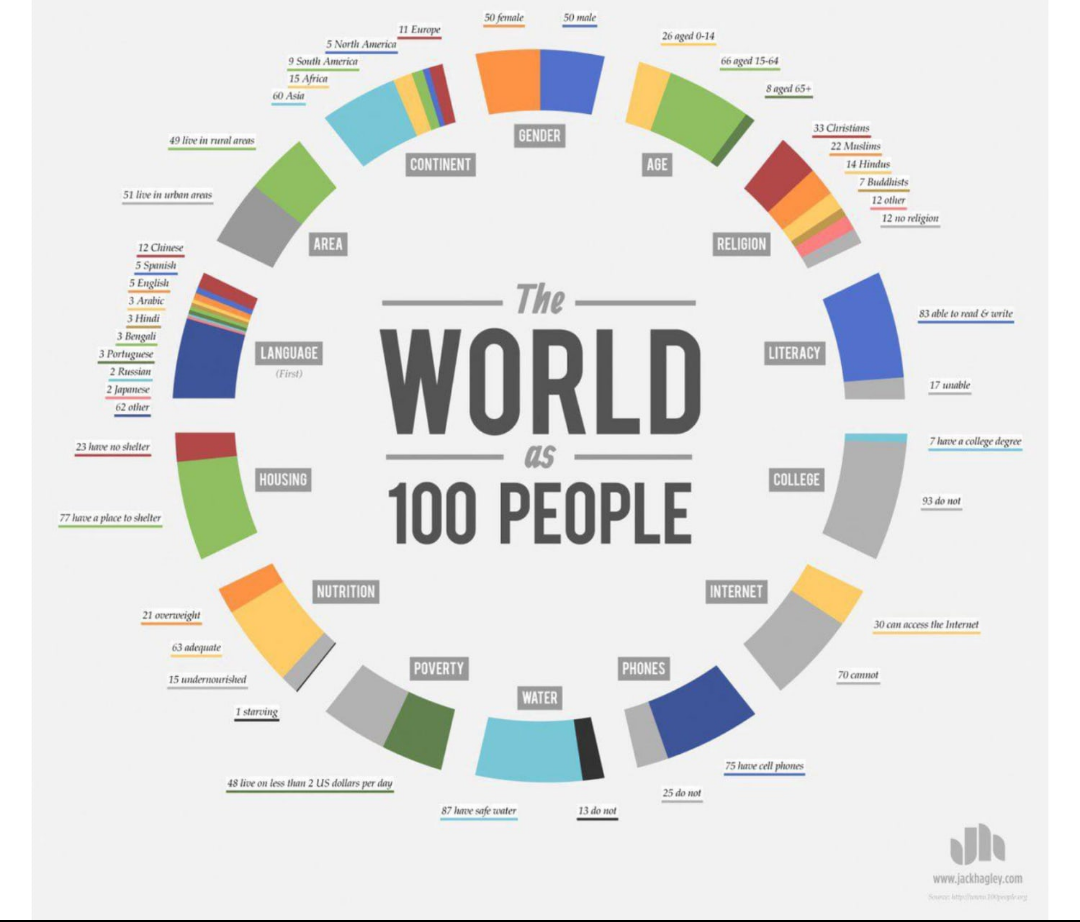
This article covers how fast the population is growing, where the growth is coming from, why it is slowing and when it is expected to stop. Jack Hagley’s infographic, The World as 100 People, shrinks the whole world to 100 people, and that is a handy way to see how the world’s make-up is changing as it grows.
How fast the world population is growing
The world adds roughly 70 million people a year, about the population of the UK, but the rate of growth has been falling for 60 years. Our World in Data, using UN figures, shows growth peaking at about 2.3% a year in 1963 and falling to 0.9% by 2023 [3]. In the UN’s 2024 figures the rate is about 0.85% in 2024 and is projected to fall to around 0.4% by 2050 and below zero just before 2100 [4] (our arithmetic from the UN series).
Growth in numbers has slowed too. The largest yearly increases, more than 90 million people, came around 1989 and 1990 [4]. The world is still adding almost as many people each year as it did in the 1960s only because today’s population is so much larger.
| World population | Year reached |
|---|---|
| 1 billion | about 1805 |
| 2 billion | 1927 |
| 3 billion | 1960 |
| 4 billion | 1975 |
| 5 billion | 1987 |
| 6 billion | 1998 |
| 7 billion | 2010 |
| 8 billion | 2022 |
| 9 billion (projected) | 2037 |
| 10 billion (projected) | 2061 |
The milestones are from Our World in Data, which combines historical estimates with the UN’s 2024 projections [3]. The UN marked 15 November 2022 as the day the world reached 8 billion [5]. It took 123 years to go from 1 to 2 billion, and only 12 years to go from 7 to 8 billion.
Population growth by region
Almost all of the growth from now on will happen in Africa and parts of Asia. Africa had about 1.5 billion people in 2024 and the UN projects 2.5 billion by 2050 and 3.8 billion by 2100, while Europe is already shrinking [4]. If you shrink the world to 100 people, as Hagley’s infographic does, the change looks like this.
| Region | Out of 100 people in 2000 | In 2024 | In 2050 (projected) | In 2100 (projected) |
|---|---|---|---|---|
| Asia | 61 | 59 | 55 | 45 |
| Africa | 14 | 19 | 26 | 38 |
| Europe | 12 | 9 | 7 | 6 |
| Latin America and the Caribbean | 8 | 8 | 8 | 6 |
| Northern America | 5 | 5 | 4 | 5 |
| Oceania | 0.5 | 0.6 | 0.6 | 0.7 |
The shares are our rounding of the UN World Population Prospects 2024 figures for each region [4]. Hagley’s version, which uses the 100 People Foundation’s older statistics, has 60 people in Asia, 15 in Africa and 11 in Europe, which matches the world of the early 2000s rather than today [1]. The foundation’s 2023 update already gives Africa 18 of the 100 and Europe 9 [2]. By 2100 nearly 4 in every 10 people in the world are projected to be African, against fewer than 1 in 10 in 1950.
Why world population growth is slowing
Mainly because families are getting smaller. The UN says women around the world now have one child fewer on average than they did around 1990 [5]. In more than half of all countries the average is below 2.1 births per woman, the level a population needs to keep its size over the long term without migration, and nearly a fifth of countries, including China, Italy, South Korea and Spain, have fewer than 1.4 [5].
The population still grows for a while after fertility falls, because there are so many young adults having children and because people live longer. The UN puts global life expectancy at 73.3 years in 2024, back above its pre-pandemic level [5]. That built-in growth, sometimes called population momentum, is why the world keeps adding people for another 60 years even though the number of young children has already stopped rising. Our World in Data says the number of children under five peaked in 2017 [3].
As the world grows older, the make-up of the 100 changes. The 100 People Foundation’s 2023 figures have 25 children and 10 people aged 65 or over, against 26 children and 8 older people in Hagley’s earlier version [2] [1]. The UN expects people aged 65 or older to outnumber children under 18 by the late 2070s [5].
When will the world population peak?
The UN’s central projection is a peak of around 10.3 billion in the mid-2080s, followed by a slow fall to about 10.2 billion by 2100 [5]. That is about 700 million fewer people in 2100 than the UN expected a decade earlier, mainly because birth rates in China and some other large countries have fallen faster than forecast [5].
Many countries have already passed their peak. The UN counts 63 countries and areas, including China, Germany, Japan and Russia, whose populations peaked before 2024, and expects another 48, including Brazil, Iran and Turkey, to peak between 2025 and 2054 [5]. Projections this far ahead are uncertain, and the UN gives a range of outcomes around its central figure.
Countries with the biggest population changes
India has overtaken China as the world’s most populous country, and the gap will widen. These are the UN’s 2024 figures and central projections for some of the largest countries [4].
| Country | 2024 | 2050 (projected) | 2100 (projected) |
|---|---|---|---|
| India | 1.45 billion | 1.68 billion | 1.51 billion |
| China | 1.42 billion | 1.26 billion | 633 million |
| United States | 345 million | 381 million | 421 million |
| Pakistan | 251 million | 372 million | 511 million |
| Nigeria | 233 million | 359 million | 477 million |
| Ethiopia | 132 million | 225 million | 367 million |
| Japan | 124 million | 105 million | 77 million |
| DR Congo | 109 million | 218 million | 431 million |
The UN expects the populations of nine fast-growing countries, including Angola, the Democratic Republic of the Congo, Niger and Somalia, to double between 2024 and 2054 [5]. China is projected to lose more than half of its people by 2100. For a closer look at the two largest countries, see our China and India population pyramids, and for the US, US population growth by state. Our main world population infographic page covers the total and where people live today.
The world as 100 people, then and now
Seeing the world as 100 people goes back to a 1990 essay by the environmental scientist Donella Meadows, and the 100 People Foundation has kept the statistics going since [2]. Hagley says he used whole people rather than percentages so the numbers would be easy for anyone to follow, and the graphic was widely shared after the astronaut Chris Hadfield posted it [1].
Growth has come with big changes in how people live, and some of Hagley’s figures are now well out of date. His version has 30 people out of 100 able to use the internet and 7 with a college degree. The foundation’s 2023 update puts active internet users at 66 and people with a tertiary or college degree at 39 [2]. Safe drinking water has risen from 87 to 92 people out of 100, literacy from 83 to 87, and undernourishment has fallen from 15 to 11 [1] [2]. The foundation says that in 2006 only 1 person in 100 would have had a college education [2], so treat the degree figure as a broad estimate rather than a precise count.
Questions about world population growth
What is the world population growth rate?
About 0.85% a year in 2024, or roughly 70 million people, according to the UN’s World Population Prospects 2024 [4]. It peaked at about 2.3% in 1963 [3].
Will 1 in 4 people be African by 2050?
Yes, roughly. The UN projects Africa’s population at about 2.5 billion out of 9.7 billion in 2050, which is just over 1 in 4 people [4].
What will the world population be in 2050?
About 9.7 billion in the UN’s central projection, up from 8.2 billion in 2024 [4]. The UN expects the world to pass 9 billion around 2037 [3].
Could there be 12 billion people?
Not on current trends. The UN’s central projection peaks at around 10.3 billion in the mid-2080s [5], and its 2024 projection for 2100 is 700 million lower than the one it made a decade earlier, because birth rates have fallen faster than expected [5].
Which continent is growing fastest?
Africa. Its population grew by more than 80% from 2000 to 2024 and is projected to grow by more than 60% again by 2050, while Europe’s population is projected to fall [4].
Sources
- Jack Hagley, The World as 100 People, using statistics from 100people.org.
- 100 People Foundation, If the World were 100 People (2023 update).
- Our World in Data, Population Growth, using HYDE, Gapminder and UN World Population Prospects 2024.
- United Nations Population Division, World Population Prospects 2024, estimates and medium projection by region and country (via Our World in Data’s population chart).
- UN DESA, UN projects world population to peak within this century, press release, 11 July 2024, and Day of Eight Billion.