What study habits do straight-A students have?
Good students are not usually the ones who study the longest. They study in a planned, steady way and use methods that make the material stick. EssayWriter’s infographic above sums this up as “study smarter not harder” and boils it down to ten habits [1]:
- Keep everything in order. Use a planner or an app for classes, tasks and deadlines.
- Respect deadlines. Stick to your schedule and hand work in on time.
- Be active. Talk to your teachers, ask questions and ask for help early.
- Make it comfortable. Find a safe, comfortable place to study, at home, outdoors or in the library.
- Make it fun. Use flashcards, games and a colour-coded system for notes.
- Make it social. Study groups do not suit everyone, but they can help.
- Make it varied. Mix in subjects that interest you so you have something to turn to when you need a change.
- Pay attention to detail. Do not race for marks; take the time to understand topics you are unsure of.
- Create a roadmap. Split big goals into smaller to-do lists and follow the plan.
- Keep it balanced. Take breaks, rest and keep a life outside study.
Most of these are about organisation and attitude rather than technique. They matter because the techniques that work best, covered below, depend on starting early and studying little and often.
The most effective way to study
In 2013, a team of psychologists led by John Dunlosky reviewed the evidence for ten popular study techniques and rated how useful each one is across different ages, subjects and types of test [3]. Two came out on top:
- Practice testing. Testing yourself, rather than just reading, forces you to pull information out of memory, and that strengthens it. Flashcards, past papers, answering questions at the end of a chapter or writing out what you remember on a blank page all count [3].
- Distributed practice. Spreading your study over several sessions, days or weeks beats cramming the same total time into one sitting [3]. This is why a roadmap and a planner help: you cannot space your revision without planning it.
Three more techniques were rated moderately useful: asking yourself why a fact is true (elaborative interrogation), explaining to yourself how new information fits with what you know (self-explanation), and mixing different types of problem in one session rather than doing them in blocks (interleaved practice) [3].
Study habits that don’t work as well as they feel
The same review rated summarising, highlighting, the keyword memory trick, picturing text as images, and rereading as low utility [3]. Rereading and highlighting are what most students do, because they feel productive and the material starts to look familiar. Familiarity is not the same as being able to recall it in an exam. If you reread your notes “again and again”, as the infographic suggests for some learners [1], try closing the book and testing yourself instead [3].
The infographic also names four habits to avoid [1]:
- Being all over the place. Spreading yourself across too many interests at once leaves no time to go deep on anything.
- Overdoing it. In EssayWriter’s words, “overstudying is just as bad as not studying at all”. Rest, sleep and eat properly.
- Constant distraction. Turn off or mute your phone and social media and pick a quiet place.
- Studying only to remember. Learning things by heart without understanding them makes learning less effective. Work through exercises, look things up and ask for help.
Do learning styles matter?
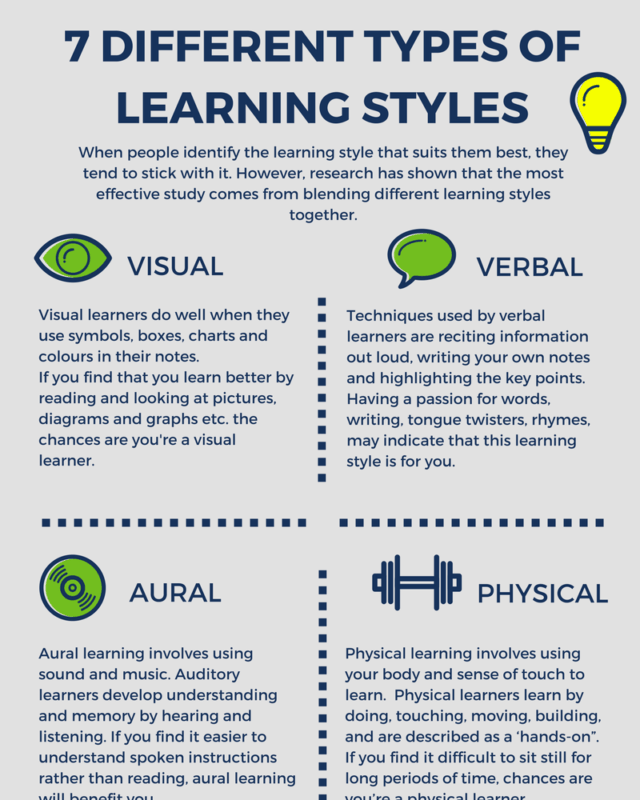
A lot of study advice, including this infographic, sorts students into types: visual learners who learn by seeing, auditory learners who learn by listening, tactile learners who learn by doing, and reading and writing learners who learn through text [1]. It then suggests strategies for each, such as podcasts for auditory learners and charts for visual learners.
People do have preferences, but the evidence that matching study to them improves results is weak. A major review by Harold Pashler and colleagues found “virtually no evidence” that teaching people in their preferred style helps them learn more, and concluded there was no adequate evidence base for using learning-style assessments in education [2]. The practical lesson is to use the method that suits the material, and to use several. Many of the strategies on the infographic are useful whatever your style: flashcards and question-and-answer revision are practice testing, studying in short blocks spaces your learning out, and turning a diagram into words or words into a diagram makes you process the material rather than just reread it [1][3].
How to build a study routine that works
- Put every deadline and exam date in one planner, then work backwards to plan short, regular sessions for each subject.
- Start each session by testing yourself on the last one before moving on to new material.
- Mix topics and question types within a session once you know the basics.
- Study somewhere quiet with your phone out of reach.
- Ask your teacher about anything you do not understand as soon as you notice it.
- Keep breaks, sleep and time off in the plan, so you can keep the routine up for a whole term rather than a week.
Questions about study tips
What is the best study method?
Practice testing and spacing your study over time have the strongest evidence. A 2013 review of ten techniques rated both as high utility for learners of all ages [3].
How do straight-A students study?
They plan ahead, meet deadlines, ask for help early, study regularly in short sessions and test themselves rather than just rereading [1][3].
What are the four types of learners?
The commonly used model names visual, auditory, kinaesthetic (tactile), and reading and writing learners [1]. Research has not found that teaching people in their preferred style improves their results [2].
Is highlighting a good way to study?
Not on its own. Highlighting and rereading were rated low utility in the 2013 Dunlosky review; testing yourself works much better [3].
How can I stop getting distracted when studying?
Put your phone in another room or mute it, turn off social media notifications, work in a quiet place and give each session a single clear task [1].
Sources
- EssayWriter, How To Become a Straight-A Student (Infographic), George Lynch, 2020, updated 2021, the original article for this infographic.
- Pashler H, McDaniel M, Rohrer D, Bjork R, Learning Styles: Concepts and Evidence, Psychological Science in the Public Interest, 2008.
- Dunlosky J and others, Improving Students’ Learning With Effective Learning Techniques, Psychological Science in the Public Interest, 2013.
Last reviewed 2 November 2026