Antibiotics are used on UK farms to treat bacterial disease in livestock, and the amount sold for farm animals has more than halved since 2014. Sales came to 15.9 milligrams per kilogram of livestock in 2025, 56% below the 2014 level, according to the UK-VARSS 2025 report from the Veterinary Medicines Directorate (VMD). Pigs use the most for their size.
How much antibiotic is used in UK livestock?
Veterinary antibiotic sales for food-producing animals in the UK were 15.9 mg/kg in 2025. That was 2% more than in 2024 and 20.2 mg/kg less than in 2014, when the figure was 36.0 mg/kg. Most of the drop happened between 2014 and 2017. Since 2022 sales have stayed between 15.6 and 15.9 mg/kg.
The VMD’s highlights summary of the report is the infographic on this page. It covers sales, use by species and resistance testing for 2014 to 2025.
| Year | Sales for food-producing animals (mg/kg) | Sales for all animals (tonnes) |
|---|---|---|
| 2014 | 36.0 | 452 |
| 2015 | 32.5 | 411 |
| 2016 | 22.9 | 299 |
| 2017 | 19.3 | 256 |
| 2018 | 17.9 | 238 |
| 2019 | 18.7 | 243 |
| 2020 | 18.7 | 242 |
| 2021 | 17.4 | 228 |
| 2022 | 15.7 | 205 |
| 2023 | 15.9 | 200 |
| 2024 | 15.6 | 194 |
| 2025 | 15.9 | 195 |
The mg/kg figure is the weight of antibiotic sold divided by the estimated weight of the farm animal population, so years with more or fewer animals can be compared. The VMD now uses this EU measure and has recalculated the earlier years with it. Older reports used a unit called mg/PCU, and on that basis 2025 sales were 27.7 mg/PCU. The tonnes column includes pets and horses as well as farm animals.
Sales are an estimate of use. Drug companies have had to report their UK sales of veterinary antibiotics to the VMD by law since 2005. Some medicines sold in one year are used in a later year or not at all. Products brought in from abroad under the Special Import Scheme are not in the sales figures, and the sectors with good records reported 10.6 tonnes of those in 2025.
VMD chief executive Abi Seager said in the announcement of the report on 17 November 2026, “Thanks to the hard work of farmers and vets, sales for animals have more than halved over the past decade.”
Which farm animals are given the most antibiotics?
Pigs use the most antibiotic of the UK livestock sectors that publish usage data. Pig farms used 44.8 mg/kg in 2025, which was 57.3 tonnes across 9.8 million pigs. Turkeys came next at 18.1 mg/kg and farmed salmon at 12.4 mg/kg. These usage figures come from the industries’ own records and cover at least 83% of each of the main sectors.
| Sector | Use in 2025 | Change since 2024 | Change since records began |
|---|---|---|---|
| Pigs | 44.8 mg/kg | down 11% | down 72% (since 2015) |
| Turkeys | 18.1 mg/kg | down 8% | down 83% (since 2014) |
| Farmed salmon | 12.4 mg/kg | up 52% | down 23% (since 2017) |
| Farmed trout | 6.9 mg/kg | up 36% | down 64% (since 2017) |
| Broiler chickens | 3.8 mg/kg | down 20% | down 81% (since 2014) |
| Ducks | 0.34 mg/kg | up 42% | down 95% (since 2014) |
| Laying hens | 0.254% bird days | down 9% | down 62% (since 2016) |
| Gamebirds | 11.4 tonnes | up 3% | down 43% (since 2016) |
The units differ because the sectors measure use in different ways. Laying hens are measured in bird days, the average number of days each hen is treated in every 100 days, and the gamebird sector has no agreed population measure yet, so it reports tonnes. Florfenicol made up 75% of what the salmon farms used and oxytetracycline the other 25%.
Cattle and sheep are the biggest gap. No beef data were available for 2025. Records from the industry’s Medicine Hub cover 49% of the dairy herd, which used 6.8 mg/kg, and about 11% of finished lambs, which used 4.3 mg/kg. The VMD calls ruminant usage data one of the most pressing gaps in the report.
Which antibiotics are used on farms?
Tetracyclines and penicillins make up over half of the antibiotics sold for farm animals. In 2025 tetracyclines were 33% of sales, penicillins 21%, aminoglycosides 13%, macrolides 10% and trimethoprim-sulfonamides 9%. Tetracycline sales rose by 10% in 2025, mainly because of a premix product for pigs and poultry, and the VMD says the rise did not show up in the sectors’ use data.
The antibiotics regulators watch most closely are the highest priority critically important antibiotics (HP-CIAs). These are classes that matter most in human medicine and carry the highest risk of resistance passing from animals to people. The World Health Organization’s list includes third and fourth generation cephalosporins, colistin and fluoroquinolones. Sales of HP-CIAs for farm animals were 0.07 mg/kg in 2025, which is 0.4% of all antibiotic sales for food-producing animals.
| HP-CIA sales for food-producing animals | 2014 (mg/kg) | 2024 (mg/kg) | 2025 (mg/kg) | Change since 2014 |
|---|---|---|---|---|
| All HP-CIAs | 0.38 | 0.06 | 0.07 | down 82% |
| Fluoroquinolones | 0.20 | 0.05 | 0.06 | down 71% |
| 3rd and 4th generation cephalosporins | 0.11 | 0.01 | 0.01 | down 93% |
| Colistin | 0.07 | 0.00 | 0.00 | down 100% |
No colistin was sold for use in animals in the UK for the fifth year running.
Do farmers give antibiotics to chickens?
Yes, when a vet prescribes them to treat illness in a flock, but UK chicken farms now use very little. Broiler chickens, the birds reared for meat, received 3.8 mg/kg in 2025, the lowest figure since records began in 2014 and well below the sector’s own target of 10.4 mg/kg. The British Poultry Council’s data covered 83% of the industry, about 956 million broilers.
Across all meat poultry, including turkeys and ducks, use was 11.2 tonnes in 2025, 18% less than in 2024 and 82% less than in 2014. The meat poultry sector has never used third or fourth generation cephalosporins and has not used colistin since 2016. Laying hens kept for eggs were treated on 0.254% of bird days, a quarter of a day in every 100 for the average hen.
Chicken meat on sale should not carry antibiotic residues above the legal limit. Each medicine has a withdrawal period, which the GOV.UK guidance on prescribing under the cascade describes as the time that must pass between the last dose and the animal being slaughtered for food, or its milk or eggs being used. The VMD’s residues surveillance for 2025 found antibiotic residues above the reference point in 10 samples by our count, mostly calf kidneys, plus one sample each of cattle kidney, cow’s milk, eggs and sheep kidney. None came from pigs, chickens or turkeys.
Is antibiotic resistance in farm animals going down?
Resistance in bacteria from UK pigs and poultry is much lower than in 2014, but the improvement has stalled in the last two years. The VMD tests E. coli from the guts of healthy pigs, broilers and turkeys at slaughter. In 2024 to 2025, 34% of those E. coli were fully susceptible to every antibiotic tested, against 17.2% in 2014 to 2015. The figure was 35% the year before, after a fall driven mainly by more resistance in broilers in 2024.
Multi-drug resistant E. coli, meaning resistance to three or more antibiotic classes, is 58% lower than in 2014 to 2015 according to the highlights, though it rose slightly in 2025. Other findings from the 2025 testing were mixed.
- Salmonella from pigs showed the clearest improvement, with 57% of isolates fully susceptible and no resistance found to HP-CIAs or to antibiotics kept for human use.
- Pigs carrying ESBL or AmpC-producing E. coli, which resist important cephalosporins, rose from 23% of samples in 2023 to 32% in 2025. More than a third of those isolates also resisted fluoroquinolones.
- Carbapenemase-producing E. coli were found in 0.3% of pig samples and colistin-resistant E. coli in 0.8%.
- Vancomycin-resistant Enterococcus faecium was found in pigs for the first time.
Testing of samples sent in by vets and farmers from sick animals in England and Wales gives a second view. In 2025, 18% of E. coli from livestock had limited treatment options, meaning resistance to four or more antibiotics. That is 68% lower than in 2014. Resistance was higher in young animals, with newborn calves and lambs showing the highest levels.
What the rules say about antibiotics on UK farms
In Great Britain a vet can only prescribe an antibiotic for animals when it is not used routinely, not used to make up for poor hygiene or poor farm management, and not used to promote growth or increase yield. These conditions are in the Veterinary Medicines Regulations, and the VMD set out how it reads them in its clarification of the 2024 changes. Giving antibiotics to prevent disease before any signs appear is allowed only in exceptional cases. If a vet prescribes preventive treatment for a whole group, they have to record why and review how the farm is managed afterwards.
The rules will tighten on 1 March 2028. Under the UK-EU Sanitary and Phytosanitary Agreement, Great Britain will apply EU rules on antimicrobial stewardship from that date, according to the VMD’s guidance for farmers and vets published on 20 November 2026.
- Preventive antibiotics will only be allowed for an individual animal, and medicated feed containing an antibiotic cannot be prescribed for prevention.
- Treating a group when some animals are ill and others are at high risk will only be allowed when the risk of spread is high and there is no other suitable option, such as separating sick animals or vaccination.
- Antimicrobials reserved for treating people will be banned in all animals, including pets.
Farming has its own voluntary targets too. The Responsible Use of Medicines in Agriculture Alliance (RUMA) Targets Task Force sets them for each livestock sector. Its latest report, published alongside UK-VARSS, covers the first year of its third set of targets.
Antibiotic use in dogs and cats
Dogs and cats get more antibiotic for their weight than most farm animal sectors. The VMD estimates the UK has 11.1 million dogs and 10.5 million cats. From sales data, it puts 2025 use at 42 mg/kg for dogs (7.6 tonnes) and 30 mg/kg for cats (1.3 tonnes).
The VMD prefers a different measure for pets because cats often get long-acting injections. On average each dog received antibiotics on 2.03 days in 2025 and each cat on 2.05 days. Dog use has fallen 58% since 2014 and cat use 22%. HP-CIAs made up 7% of antibiotic sales for dogs and 32% for cats, and 95% of the cat figure was one injectable cephalosporin, cefovecin.
The companion animal group of RUMA set the first national targets for pets in 2025. It aims to cut antibiotic use in dogs and cats by 30% over five years from 2024 and HP-CIA use in cats by 50%. The 2025 report also has the first verified resistance data for dogs and cats, from 26 private veterinary laboratories. Resistance to amoxicillin with clavulanate was high in most of the bacteria tested.
Why antibiotic use in animals matters for people
Some bacteria can pass between animals and people, and the VMD’s monitoring of healthy animals at slaughter focuses on those, including Salmonella and E. coli, which are common causes of food poisoning.
The World Health Organization’s fact sheet on antimicrobial resistance, updated in July 2026, says bacterial resistance was associated with more than 4.7 million deaths worldwide in 2021. About 1 in 6 laboratory-confirmed bacterial infections worldwide resisted antibiotics in 2023. In England, the UK Health Security Agency reported 21,129 antibiotic-resistant bloodstream infections in 2025, an average of 406 a week. Antibiotic use in the NHS fell by 10.7% between 2019 and 2025.
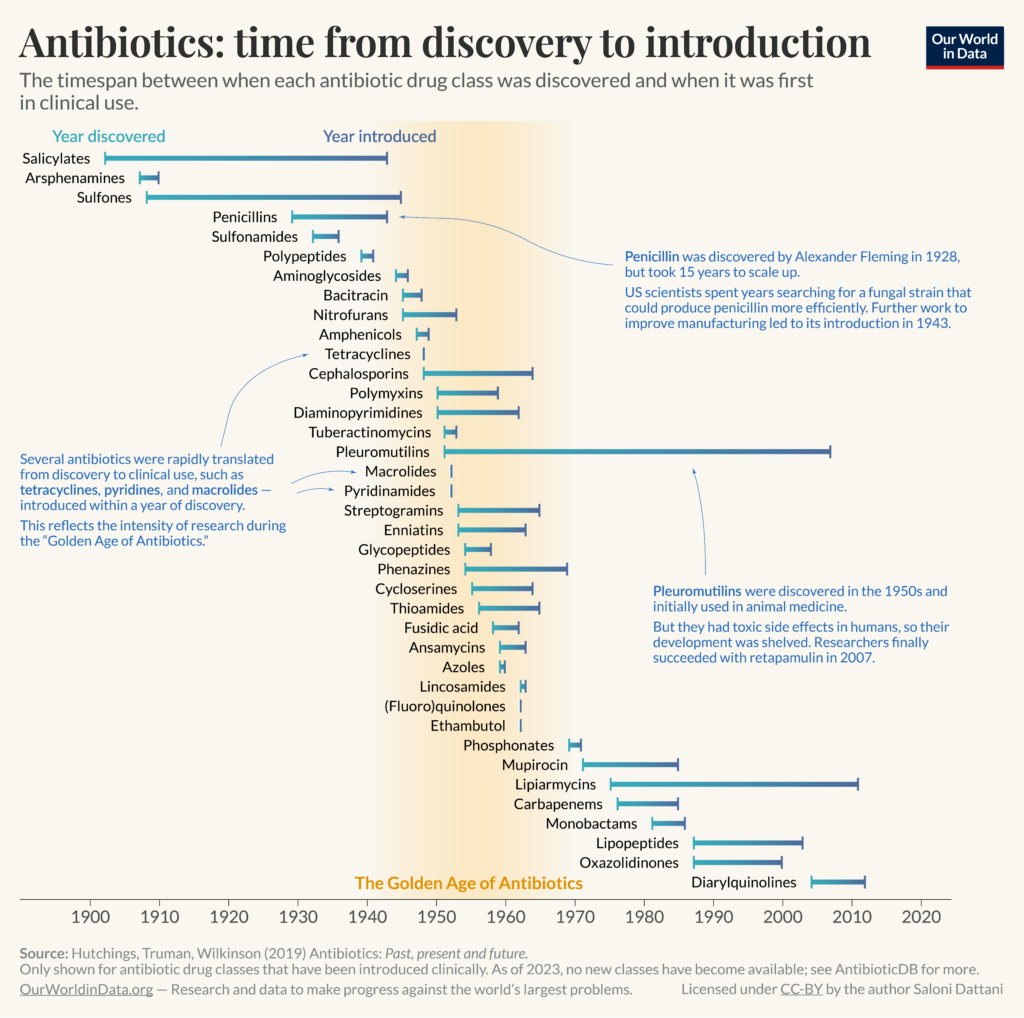
UK-VARSS 2025 covers the second year of the UK’s national action plan on antimicrobial resistance, which runs from 2024 to 2029. Our timeline of antibiotic discovery shows when each class of antibiotic was found.
Questions about antibiotics in livestock
Are antibiotics in chicken illegal?
UK vets can legally prescribe antibiotics to treat sick chickens, but using them to make birds grow faster is not allowed. After treatment the birds cannot go for slaughter until the medicine’s withdrawal period has passed, so that residues in the meat stay below the legal limit.
Are cows treated with antibiotics?
Cattle are given antibiotics when a vet prescribes them. In the 49% of the UK dairy sector that reports data, antibiotic use was 6.8 mg/kg in 2025 and 77% of it was given by injection. Penicillins were the most used class. Sales of antibiotic tubes used in the udder at the end of lactation (dry cow therapy) worked out at 0.45 courses per dairy cow, 28% fewer than in 2014.
What is an antibiotic residue?
It is a trace of an antibiotic, or what it breaks down into, left in meat, milk or eggs after an animal has been treated. Many substances have a legal maximum residue limit, and the VMD tests animals and animal products for residues of veterinary medicines every year.
Which farm animals use the most antibiotics in the UK?
Pigs, at 44.8 mg/kg in 2025, followed by turkeys at 18.1 mg/kg and farmed salmon at 12.4 mg/kg. Broiler chickens used 3.8 mg/kg. There are no complete figures for beef cattle or sheep.
When do the new UK rules on farm antibiotics start?
The changes agreed under the UK-EU Sanitary and Phytosanitary Agreement apply in Great Britain from 1 March 2028. Until then the current Veterinary Medicines Regulations apply.
Sources
- Veterinary Medicines Directorate, Veterinary Antimicrobial Resistance and Sales Surveillance 2025, published 17 November 2026, including the UK-VARSS 2025 Highlights (the infographic on this page) and the full UK-VARSS 2025 report
- Veterinary Medicines Directorate, Stable sales support long-term decline in animal antibiotic use, 17 November 2026
- Veterinary Medicines Directorate, Residues of veterinary medicines in food, 2025, results to 31 December 2025
- Veterinary Medicines Directorate, Antimicrobial resistance clarification of new elements applied from the VMR, May 2024
- Veterinary Medicines Directorate, Antimicrobial stewardship changes, preparing your business, 20 November 2026
- Veterinary Medicines Directorate, The cascade, prescribing unauthorised medicines
- UK Health Security Agency, Over 400 antibiotic-resistant infections each week in 2025, 12 November 2026
- World Health Organization, Antimicrobial resistance fact sheet, 16 July 2026
The residue sample count is our sum of the VMD’s 2025 results table, and the VMD is not responsible for it. Contains public sector information published by the Veterinary Medicines Directorate and licensed under the Open Government Licence v3.0. Pages 1 to 6 of the UK-VARSS 2025 Highlights are shown together as one image. The VMD logo and the blank space above the cover banner were removed, and nothing else was changed. Its use here does not imply any endorsement by the VMD.