How dress types are named
Dress names describe one of four things: the overall shape (silhouette), the neckline or straps, the length, or the occasion and origin. Knowing which is which makes shopping much easier, because one dress can be all four at once. A long navy wrap dress, for example, is a wrap by its closure, a maxi by its length and could be a day dress or an evening dress depending on the fabric.
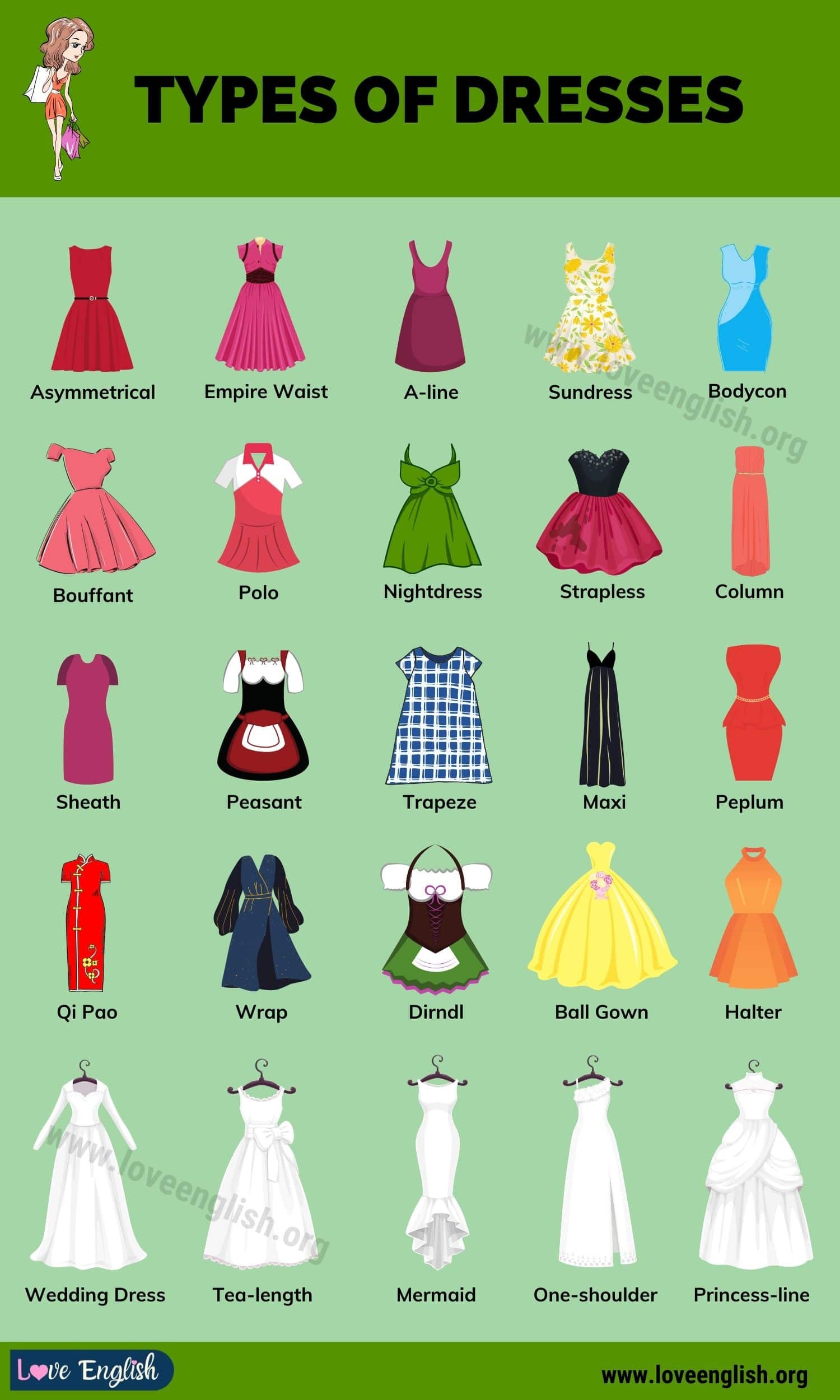
The Love English chart above names 25 common styles [1]. Below they are grouped the way designers and shops use them, with what each style looks like and who it tends to suit.
Dress types by silhouette
The silhouette is the shape a dress makes on the body. It is the most useful way to think about fit.
- A-line. Fitted at the top and gradually wider towards the hem, like a capital A [2]. It skims the hips, so it suits almost every figure and is the safest choice if you are unsure.
- Empire waist. A fitted bodice ending just below the bust, giving a high waist, over a long, loose skirt that skims the body [3]. The style dates from the late 18th century and is named after the First French Empire [3]. It draws attention to the bust and away from the waist and is popular for maternity wear.
- Sheath. A fitted, straight dress shaped at the waist, usually knee length and often with short sleeves [4]. It is a classic office and cocktail dress.
- Shift. Often confused with the sheath, a shift falls straight from the shoulders without shaping at the waist. It was popular in the 1920s and again in the 1960s [5].
- Column. Long, straight and narrow from top to bottom, with no flare at the hem.
- Bodycon. Short for body-conscious: tight, stretchy and fitted all over.
- Trapeze. Narrow at the shoulders and widening sharply to the hem, a looser, more dramatic version of the A-line.
- Princess line. Cut in long vertical panels with no seam at the waist; the fit comes from the long seams rather than darts [6]. It gives a long, slim line and is a common wedding dress shape.
- Mermaid. Fitted through the body and hips to the knee, then flaring out to the hem. A dramatic evening and bridal style.
- Ball gown. A fitted bodice over a very full, floor-length skirt, made for balls and formal evening events [7]. The bouffant is a shorter or less formal cousin with a very full, puffed skirt.
- Peplum. A fitted dress with a short flared ruffle or overskirt at the waist, which adds shape at the hips.
Dress types by neckline and straps
- Halter. A strap runs from the front of the dress around the back of the neck, leaving the shoulders and upper back bare [8]. It shows off the shoulders and is popular for summer.
- Strapless. Stays up without shoulder straps, held by a fitted bodice or built-in boning. Common for evening and wedding dresses.
- One-shoulder. A single strap across one shoulder, leaving the other bare.
- Asymmetrical. Uneven by design, at the neckline, the hem or both.
- Wrap. One side wraps across the other and ties at the side or back, which forms a V-shaped neckline [9]. Because the tie sets the waist, the wrap dress adjusts to the wearer and flatters many shapes.
Dress types by length
- Mini: well above the knee.
- Knee length: the usual length for sheath, shift and A-line dresses for work.
- Tea length: ends around mid-calf. It is a popular choice for daytime and vintage-style weddings.
- Midi: between the knee and the ankle.
- Maxi: floor or ankle length, usually loose and casual in summer or more formal in evening fabrics.
Dress types by occasion
- Sundress. A casual warm-weather dress in a light fabric, usually cotton, typically sleeveless with thin straps and a loose fit [10]. The word dates from the early 1940s, and sundresses became fashionable in the 1950s [10].
- Polo dress. A dress-length version of the polo shirt, with a collar and short buttoned placket [11]. A sporty, casual day dress.
- Peasant dress. Based on folk dress, with a loose blouse, often with puffed or gathered sleeves, and a full skirt.
- Nightdress. Loose nightwear, usually in cotton, silk, satin or nylon.
- Wedding dress. The dress worn by the bride. In Western weddings it is usually white, a tradition popularised after Queen Victoria wore a white dress to marry Prince Albert. In Chinese and Indian weddings brides often wear red, for good fortune [12]. The chart’s five white gowns show the most common bridal shapes: classic, tea length, mermaid, one-shoulder and princess line [1].
Traditional dresses
Two national dresses appear on the chart. The qipao, also called the cheongsam, is a figure-fitting Chinese dress with a standing collar, an asymmetric opening and two side slits. It developed in the 1910s and 1920s from Manchu clothing, influenced by Western tailoring, and was popular in China from the 1920s to the 1960s [13]. The dirndl comes from the German-speaking Alps and is worn in parts of Austria, Germany, Italy, Liechtenstein and Switzerland. A modern dirndl has a close-fitting bodice with a low neckline, a blouse underneath, a wide high-waisted skirt and an apron [14].
How to choose a dress style for your shape
There are no rules, but a few principles help. If you want to define your waist, look at wrap, A-line, fit-and-flare and peplum styles. If you would rather not draw attention to the waist, an empire line, shift or trapeze dress falls away from it. Sheath, bodycon and mermaid dresses follow the body closely, so they show your natural shape. And if you are shorter, knee-length or shorter hems and a defined waist usually avoid swamping you, while long column and maxi shapes add length.
Questions about types of dresses
How many types of dresses are there?
There is no fixed number, because shapes, necklines, lengths and occasions combine in endless ways. Most guides list between 20 and 50 named styles; the Love English chart names 25 [1].
What is the difference between a sheath dress and a shift dress?
A sheath is shaped at the waist and follows the body; a shift hangs straight from the shoulders with no waist shaping [4][5].
What is an empire waist dress?
A dress with the waistline just under the bust and a long, loose skirt below it [3].
What is the most flattering dress style?
The A-line and the wrap dress are usually named, because the A-line skims the hips and the wrap’s tie lets you set the waist where it suits you [2][9].
What are the main types of wedding dress?
Ball gown, A-line, mermaid, sheath or column, princess line and tea length are the common bridal shapes, with strapless, one-shoulder, halter and long-sleeved necklines on top.
Sources
- Love English (loveenglish.org), Types of Dresses, the infographic.
- Wikipedia, A-line (clothing).
- Wikipedia, Empire silhouette.
- Wikipedia, Sheath dress.
- Wikipedia, Shift dress.
- Wikipedia, Princess line.
- Wikipedia, Ball gown.
- Wikipedia, Halterneck.
- Wikipedia, Wrap dress.
- Wikipedia, Sundress.
- Wikipedia, Polo shirt.
- Wikipedia, Wedding dress.
- Wikipedia, Qipao.
- Wikipedia, Dirndl.
Last reviewed 2 November 2026