What is the Great Language Race?
The Great Language Race is a family tree of the world’s languages by Kolya Fabrika, drawn as a race from 5000 BC to today. Each language family branches out over time, and the languages that are still spoken finish the race with their number of speakers. English and Mandarin Chinese come out in front, with more than a billion speakers each, while languages such as Gothic and Akkadian died out along the way.
Kolya Fabrika posted the chart to the r/dataisbeautiful community on Reddit on 1 January 2025 as a global language evolution chart [1]. It shows a selection of 139 living languages and language groups, plus dozens of extinct ones. The rest of this article looks at what the race shows about how languages are related, how they spread and why so many of them have died out.
What is a language family?
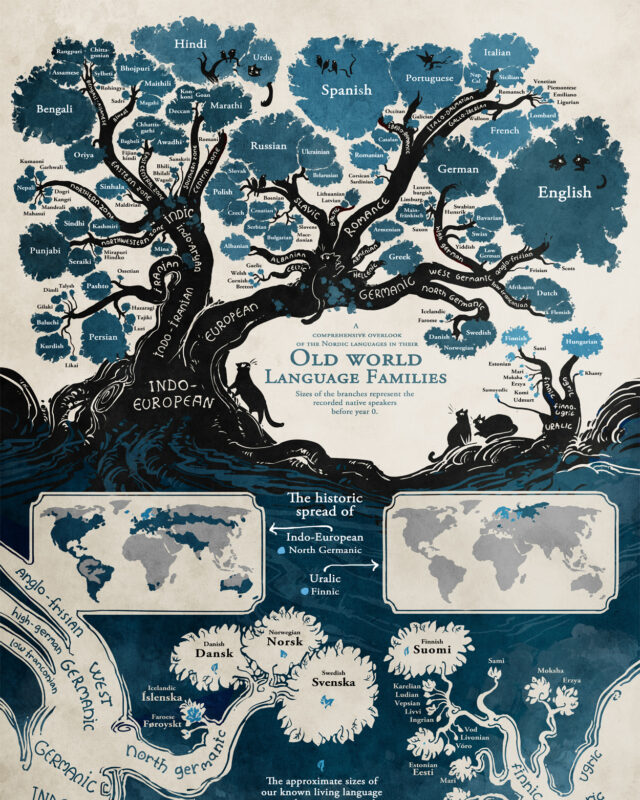
A language family is a group of languages that all come from one common ancestor language. English, German and Dutch are Germanic languages, which all developed from an older language called Proto-Germanic. The Germanic languages are in turn one branch of the much bigger Indo-European family, alongside the Romance, Slavic, Celtic and Indo-Iranian languages [2].
Ethnologue counts 7,170 living languages [4]. Linguists don’t agree on how many families they fall into, because the evidence for some groupings is thin. Ethnologue puts the number at 142 language families, while the linguist Lyle Campbell identified 406 independent families, including isolates such as Basque that have no known relatives [2].
The largest language families
Which family is largest depends on whether you count languages or speakers. By number of languages, two families from Africa and the Pacific lead [2].
| Language family | Number of languages (Ethnologue) | Where it is spoken |
|---|---|---|
| Niger-Congo | 1,552 | Africa south of the Sahara |
| Austronesian | 1,256 | South East Asia, the Pacific and Madagascar |
| Trans-New Guinea | 481 | New Guinea |
| Sino-Tibetan | 458 | China, the Himalayas and Myanmar |
| Indo-European | 454 | Europe, Iran, South Asia and worldwide |
| Australian | 384 | Australia |
| Afroasiatic | 382 | North Africa, the Horn of Africa and the Middle East |
| Nilo-Saharan | 210 | Central and East Africa |
By number of speakers, Indo-European is far ahead. Wikipedia’s list of language families puts it at about 3.2 billion current speakers, against about 1.4 billion for Sino-Tibetan and about 500 million each for Afroasiatic and Atlantic-Congo, the main branch of Niger-Congo [3]. That is why the Indo-European branches take up so much of the Great Language Race. Most of the world’s biggest languages, English, Hindi, Spanish, French, Bengali, Portuguese and Russian among them, belong to it [5].
Which languages have the most speakers?
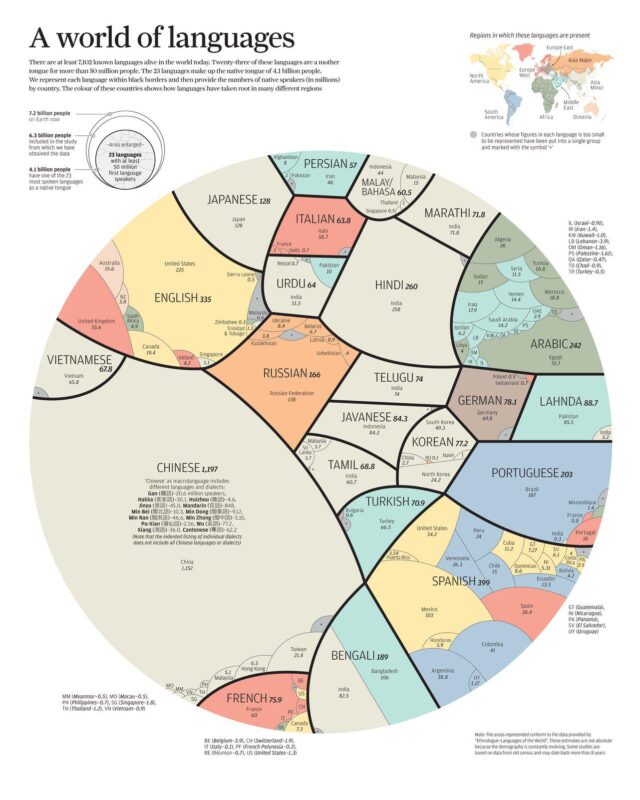
The finishing order on the Great Language Race is close to Ethnologue’s latest counts for the biggest languages, though some figures on the chart are well out. The chart doesn’t give a source or date for its numbers.
| Language | Family | First language speakers (millions) | Total speakers (millions) |
|---|---|---|---|
| English | Indo-European | 372 | 1,493 |
| Mandarin Chinese | Sino-Tibetan | 988 | 1,183 |
| Hindi | Indo-European | 347 | 611 |
| Spanish | Indo-European | 487 | 561 |
| Modern Standard Arabic | Afroasiatic | 0 | 335 |
| French | Indo-European | 75 | 334 |
| Bengali | Indo-European | 234 | 274 |
| Portuguese | Indo-European | 252 | 269 |
| Indonesian | Austronesian | 78 | 255 |
| Urdu | Indo-European | 78 | 246 |
| Russian | Indo-European | 133 | 210 |
| Standard German | Indo-European | 76 | 133 |
| Japanese | Japonic | 124 | 126 |
Source, Ethnologue 2026, via Wikipedia [5]. Modern Standard Arabic has no first language speakers in Ethnologue’s count because people learn it at school on top of a spoken Arabic dialect such as Egyptian Arabic (118 million speakers) [5].
English wins on total speakers, but only because of second language speakers. It has about 1.1 billion people who speak it as a second language, against 372 million native speakers. Mandarin has by far the most native speakers, at 988 million [5].
A few of the chart’s numbers need correcting. It gives Hausa, a major language of West Africa, only 2 million speakers, when Ethnologue counts 58 million first language and 94 million total speakers. Swahili is shown at 150 million against Ethnologue’s 95 million total, and Russian at 260 million against 210 million [5]. The chart also gives Coptic 2 million speakers, but Coptic has no native speakers today. It died out as a spoken language in the late 19th or early 20th century and is now used as the liturgical language of the Coptic Orthodox and Coptic Catholic churches [11]. In the Germanic branch, the English names next to four labels are swapped. The native names are right, so the 24 million figure belongs to Dutch (Nederlands), 10 million to Swedish (Svenska), 6.5 million to Flemish (Vlaams) and 5.3 million to Norwegian (Norsk).
How languages split and spread
Languages split when groups of speakers move apart and stop talking to each other often. Over centuries, each group’s speech changes in its own way until the two can no longer understand each other. Latin is the clearest example. After the Western Roman Empire broke up, the spoken Latin of different regions drifted into Spanish, Portuguese, French, Italian, Romanian, Catalan and the other Romance languages.
The biggest language families spread with migrations, farming and empires. Linguists still argue about where the ancestor of the Indo-European languages was first spoken. The leading theory, the steppe theory, places it on the Pontic-Caspian steppe north of the Black Sea and Caspian Sea, with its earliest form emerging around 4400 to 4000 BC. The main alternative, the Anatolian hypothesis, places it in what is now Turkey around 8000 BC and ties its spread to the spread of farming [6]. Kolya Fabrika’s chart marks some of the events historians link with big language changes, including the Bronze Age collapse around 1200 BC, the expansion of the Roman Empire, the migration period in Europe around AD 500, the Viking expansion and the Mongol conquests.
Languages that lost the race
Many languages that were once widely spoken have died out. Akkadian, written in cuneiform, was the common language of the Middle East for centuries. By the end it was used only by scholars and priests, and the last known Akkadian cuneiform document dates from the 1st century AD [7]. Gothic, Hittite, Etruscan, Sumerian and Phoenician have all gone the same way.
Some languages died much more recently, including two in the British Isles. Norn, a Norse language spoken in Orkney, Shetland and Caithness, is thought to have died out around 1850 with the death of Walter Sutherland, one of its last speakers [8]. Manx, the Celtic language of the Isle of Man, lost its last native speaker, Ned Maddrell, on 27 December 1974. Manx has since been revived, helped by good records of the language, and there is now a Manx-medium primary school on the island [9].
The race is still going. Ethnologue says 3,226 languages, roughly 44% of all living languages, are now endangered, often with fewer than 1,000 users left. At the other end, the 20 largest languages are the native language of more than 3.7 billion people [4][10].
Questions about the great language race
Who made the Great Language Race?
Kolya Fabrika, who posted it on Reddit’s r/dataisbeautiful on 1 January 2025 [1].
How many languages are there in the world?
Ethnologue counts 7,170 living languages, spoken in 242 countries [4]. The number changes as languages die out and as researchers learn more about them.
What are the 7 major language families?
There isn’t one agreed list of seven. By number of languages, Ethnologue’s seven largest families are Niger-Congo, Austronesian, Trans-New Guinea, Sino-Tibetan, Indo-European, Australian and Afroasiatic [2]. By number of speakers, Indo-European is the largest by a wide margin [3].
Which language has the most native speakers?
Mandarin Chinese, with 988 million first language speakers. English has the most speakers in total, at about 1.49 billion, because so many people learn it as a second language [5].
Which language family does English belong to?
English is a Germanic language in the Indo-European family, in the same branch as German, Dutch and the Scandinavian languages [5].
Sources
- Kolya Fabrika, Global Language Evolution Chart, r/dataisbeautiful, 1 January 2025. This is the original post for the infographic.
- Wikipedia, Language family (Ethnologue 27 family sizes).
- Wikipedia, List of language families (Glottolog language and speaker counts).
- Ethnologue, How many languages are there in the world?
- Wikipedia, List of languages by total number of speakers (Ethnologue 2026 figures).
- Wikipedia, Proto-Indo-European homeland.
- Wikipedia, Akkadian language.
- Wikipedia, Norn language.
- Wikipedia, Manx language.
- Ethnologue, How many languages are endangered?
- Wikipedia, Coptic language.
Last reviewed 11 November 2026