Most played game genres by generation
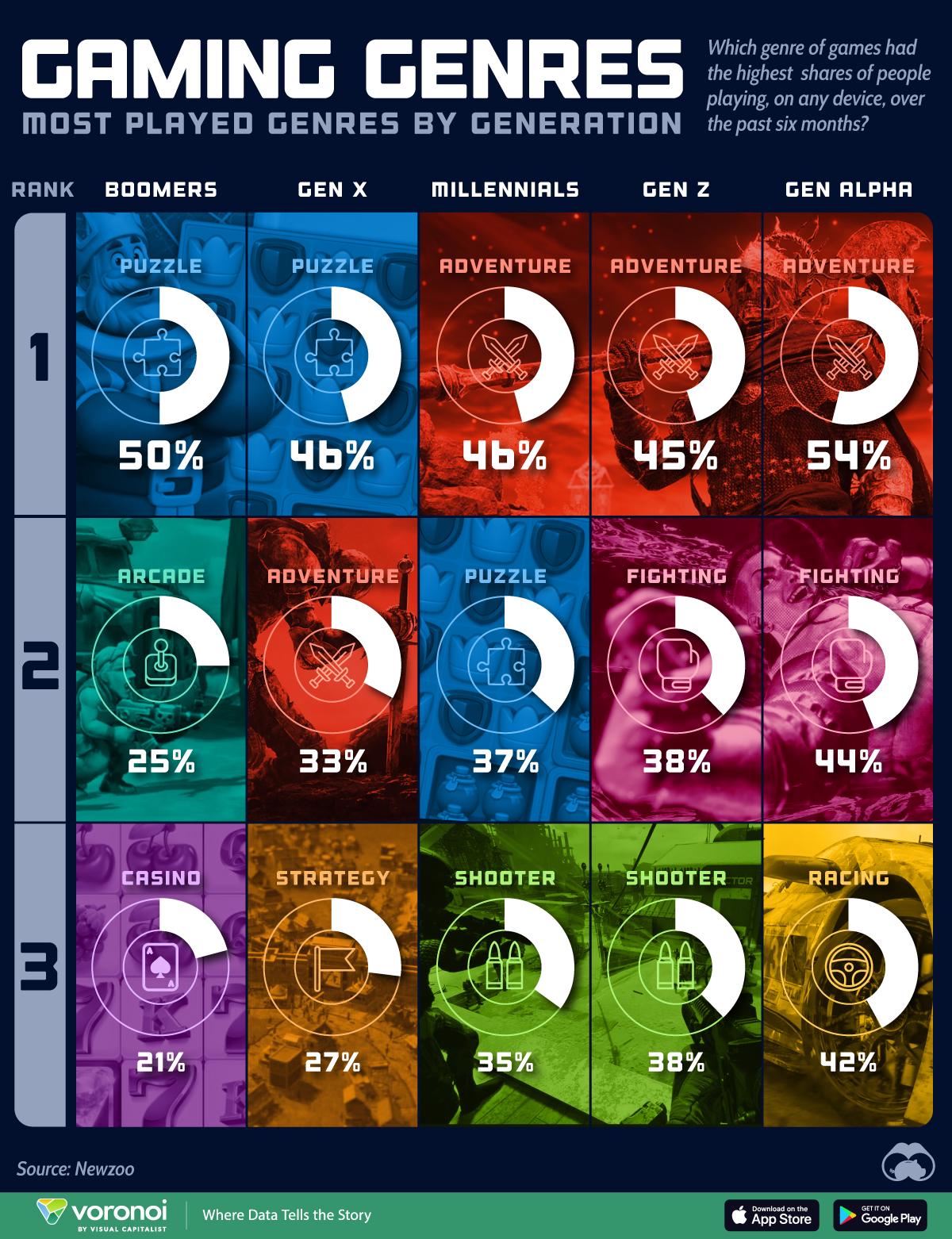
The clearest pattern in game demographics is age. Newzoo’s Global Gamer Study 2024, which surveyed more than 73,000 people in 36 markets, asked which genres people had played on any device in the past six months [1]. Puzzle games came first for the two oldest generations, and adventure games came first for everyone younger.
| Generation (birth years used) | Most played genre | Second | Third |
|---|---|---|---|
| Baby Boomers (1945 to 1964) | Puzzle, 50% | Arcade, 25% | Casino, 21% |
| Gen X (1965 to 1980) | Puzzle, 46% | Adventure, 33% | Strategy, 27% |
| Millennials (1981 to 1994) | Adventure, 46% | Puzzle, 37% | Shooter, 35% |
| Gen Z (1995 to 2009) | Adventure, 45% | Fighting, 38% | Shooter, 38% |
| Gen Alpha (2010 and later) | Adventure, 54% | Fighting, 44% | Racing, 42% |
The percentages are the share of each generation who played that genre at least once in six months, as reported by Visual Capitalist’s Voronoi, which made the infographic [1]. They measure reach, not hours or spending, and they don’t add up to 100 because most people play more than one genre. Only the top three for each generation were published, so you can’t tell from this data how many Boomers play adventure games, for example.
What older players play
Puzzle games are the genre that holds on to players as they get older. Half of Baby Boomers and 46% of Gen X had played one in the past six months, well ahead of anything else in those age groups [1]. These are mostly mobile and casual games: match-3 games such as Candy Crush, word games, card games like solitaire, and daily brain teasers. They are quick to pick up, need no controller and can be played in short sessions, which fits how most older adults play.
The rest of the Boomer top three points the same way. Arcade games (25%) and casino games such as slots and poker (21%) are also short-session, mostly mobile genres [1]. Gen X is the bridge between the two groups: puzzle games still lead, but adventure (33%) and strategy (27%) come next, reflecting a generation that grew up with home consoles and PC games in the 1980s and 1990s [1].
The US industry body, the Entertainment Software Association (ESA), found the same thing in its 2025 survey. Asked what they played regularly, 73% of players in the Boomer and Silent generations and 71% of Gen X players named puzzle games, the top genre for both groups, with skill and chance games such as card and casino games second [2]. ESA also found older players are much more likely to play to keep their mind sharp: 65% of Boomer and Silent players gave that as a reason, against 21% of Gen Z [2].
What younger players play
From Millennials down, adventure is the most played genre, and the share rises with each younger group, from 46% of Millennials to 54% of Gen Alpha [1]. Newzoo’s adventure category is broad. Voronoi’s examples include story-led games such as Skyrim, The Last of Us and Baldur’s Gate 3, and it says Minecraft, Fortnite and Call of Duty were among the most played games for Gen Z [1].
Competitive genres come next for younger players. Shooters are in the top three for both Millennials (35%) and Gen Z (38%), and fighting games are second for Gen Z (38%) and Gen Alpha (44%) [1]. Racing games make the top three only for Gen Alpha, at 42% [1]. Younger players also play more genres overall: the third-placed genre reaches 42% of Gen Alpha but only 21% of Boomers [1].
The ESA’s US figures use different genre groups but tell a similar story. Shooters were the top genre for Gen Z players at 58%, ahead of action games at 56%, while Gen Alpha players most often named arcade and other casual games (67%), puzzle games (66%) and action games (62%) [2]. Millennials sit in between, with puzzle games first (60%) and action games second (54%) [2].
How many people play games, by age
Gaming is not just a young person’s hobby. The ESA estimates that 205.1 million Americans aged 5 to 90 play video games, and 64% of the population plays for at least an hour a week [2]. The average player is 36 years old, and 28% of players are 50 or older [2].
| US generation (ages in 2025) | Share who play 1+ hour a week | Players |
|---|---|---|
| Gen Alpha (5 to 12) | 83% | 27.4 million |
| Gen Z (13 to 28) | 78% | 59.2 million |
| Millennials (29 to 44) | 68% | 47.9 million |
| Gen X (45 to 60) | 52% | 35.4 million |
| Boomers (61 to 79) | 49% | 31.5 million |
| Silent Generation (80 to 90) | 36% | 3.7 million |
Source: ESA Essential Facts 2025 [2]. So the share who play falls with age, but slowly, and there are almost as many weekly players among Boomers as among Gen X. The genre they play is what changes most.
Game demographics by gender
Overall, players are close to evenly split. In the ESA’s 2025 survey 47% of US players were female and 52% male [2]. The split by genre is very different. Quantic Foundry, a games research firm, looked at the favourite games named by more than 270,000 mostly core gamers and found the share of women ranged from about 2% for sports games to 69% for match-3 and family or farm simulation games [3]. Tactical shooters (4.3%) and first-person shooters (7.2%) were also among the most male genres [3].
Those figures are from 2017 and from a self-selected sample that leans towards keen players, so treat the exact numbers with care. The broad pattern matches the age data though. Puzzle and casual mobile genres have the oldest and most female audiences, while shooters, sports and competitive games skew young and male.
Why genre tastes change with age
The surveys don’t measure causes directly, but a few things help explain the differences.
- Time and device. Puzzle, casino and arcade games are mostly played on phones in short sessions, which fits a busy adult day. Adventure, shooter and fighting games usually mean a console or PC and longer sessions.
- Reasons for playing. ESA found Gen Z and Millennials mostly play to have fun or relax, while older players are far more likely to play to keep their mind sharp [2].
- Playing with others. 79% of Gen Alpha and Gen Z players play with friends, according to ESA [2]. Online adventure, shooter and fighting games are built around that.
- What people grew up with. People probably keep playing the kinds of game they learned on, which would explain why Gen X, the first console generation, sits between the puzzle-led older groups and the adventure-led younger ones.
Questions about game demographics by genre
What is the most popular video game genre?
It depends on who you ask. Across Newzoo’s 2024 survey, adventure games were the most played genre for Millennials, Gen Z and Gen Alpha, and puzzle games for Gen X and Boomers [1]. In the ESA’s US survey, puzzle games were the top genre for every adult generation except Gen Z, where shooters came first [2].
What demographic plays video games the most?
Children and teenagers. In the US, 83% of Gen Alpha (ages 5 to 12) and 78% of Gen Z (13 to 28) play at least an hour a week, against 49% of Boomers [2]. Gen Z is the largest group of players, at 59.2 million [2].
What is the most popular game genre for Gen Z?
Adventure games, played by 45% of Gen Z in the past six months, followed by fighting and shooter games at 38% each, in Newzoo’s global survey [1]. In the US, ESA found shooters were the genre Gen Z played most regularly (58%) [2].
What games do older people play most?
Puzzle games. Half of Baby Boomers had played one in the past six months in Newzoo’s survey [1], and 73% of US Boomer and Silent Generation players named puzzle games as a genre they play regularly [2].
Which game genres have the most female players?
Match-3 puzzle games and family or farm simulation games, where Quantic Foundry found about 69% of players were women. Sports games and tactical shooters had the fewest, at about 2% and 4% [3].
Sources
- Visual Capitalist, Most Popular Gaming Genres By Generation, Voronoi, July 2024, using Newzoo’s Global Gamer Study 2024. The creator’s post with this chart.
- Entertainment Software Association, Essential Facts About the U.S. Video Game Industry, 2025.
- Nick Yee, Quantic Foundry, Beyond 50/50, Breaking Down the Percentage of Female Gamers by Genre, 2017.
Last reviewed 9 November 2026