Merry Christmas in the most common languages
If you only need the greeting in one of the big European or Asian languages, these are the standard forms given by Wiktionary’s translation list [2]. Accents matter in writing, so they are included here even where a poster or card leaves them out.
| Language | Merry Christmas | Notes |
|---|---|---|
| Spanish | Feliz Navidad | Navidad comes from the Latin for nativity [4] |
| French | Joyeux Noël | Noël comes from the Latin natalis, “birthday” [5] |
| German | Frohe Weihnachten | Fröhliche Weihnachten is also used [2] |
| Italian | Buon Natale | |
| Portuguese | Feliz Natal | The same in Brazil and Portugal |
| Dutch | Vrolijk Kerstfeest | Prettig kerstfeest is also common [2] |
| Polish | Wesołych Świąt | In full, Wesołych Świąt Bożego Narodzenia |
| Swedish | God Jul | Danish uses Glædelig Jul, Norwegian God Jul |
| Finnish | Hyvää joulua | |
| Greek | Kalá Christoúgenna | Written Καλά Χριστούγεννα |
| Russian | S Rozhdestvom | Written С Рождеством |
| Ukrainian | Z Rizdvom | Written З Різдвом |
| Japanese | Merii Kurisumasu | Written メリークリスマス, a loan from English |
| Korean | Meri Keuriseumaseu | Jeulgeoun seongtanjeol is also used |
| Mandarin Chinese | Shèngdàn kuàilè | Written 圣诞快乐 |
| Arabic | Eid Milad Majid | Milad Majid on its own is also used |
| Hindi | Shubh Krismas or Shubh Bada Din | Bada din means “big day” |
| Tagalog (Filipino) | Maligayang Pasko | |
| Hawaiian | Mele Kalikimaka | A Hawaiian rendering of the English |
| Welsh | Nadolig Llawen | |
| Irish | Nollaig Shona | |
| Scottish Gaelic | Nollaig Chridheil |
Why the greeting sounds so different from one language to the next
Most of the world’s Christmas greetings come from one of a handful of roots, which is why groups of languages sound alike.
The Romance languages and many of their neighbours name the day after the birth of Christ. French Noël comes, through Old French, from the Latin natalis [dies Domini], “the birthday of the Lord” [5]. Italian Natale, Portuguese and Catalan Natal and Nadal, and Welsh Nadolig share that root, while Spanish Navidad comes from the Latin nativitas, “nativity” [4]. Arabic Milad and Hebrew Molad also mean “birth” [8].
The Scandinavian languages kept the old midwinter word. Swedish, Danish and Norwegian jul comes from Old Norse jól, the same word as English Yule [6]. German Weihnachten is different again: it comes from the Middle High German phrase for “in the holy nights” [7].
Some languages simply borrowed the English. Japanese merii kurisumasu, Korean meri keuriseumaseu, Hawaiian Mele Kalikimaka and Māori Meri Kirihimete are all adaptations of “Merry Christmas” [2]. Others wish a “happy” or “joyful” feast rather than a “merry” one, which is closer to the British “Happy Christmas” than the American “Merry Christmas”.
Christmas and New Year greetings together
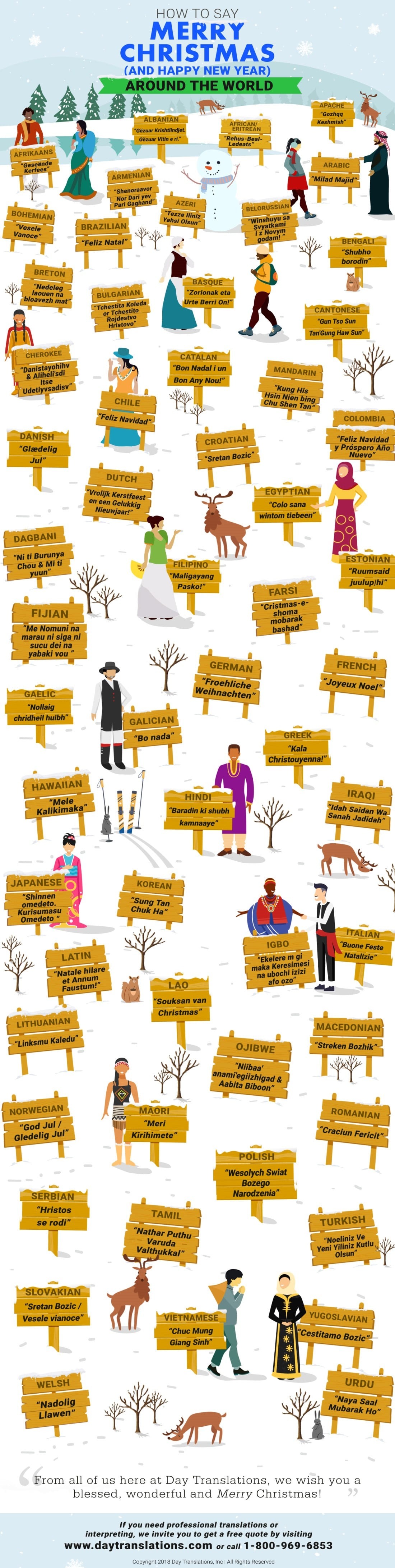
In many countries the two greetings are said together, and the Day Translations poster above gives a combined Christmas and New Year wish for many of its 58 languages [1]. Common pairings are:
- Spanish: Feliz Navidad y Próspero Año Nuevo
- Dutch: Vrolijk Kerstfeest en een Gelukkig Nieuwjaar
- Catalan: Bon Nadal i un Bon Any Nou
- Basque: Zorionak eta Urte Berri On
- Breton: Nedeleg laouen na bloavezh mat
- Albanian: Gëzuar Krishtlindjet. Gëzuar Vitin e Ri
- Latin: Natale hilare et Annum Faustum
Watch for greetings that are only about the New Year. The Urdu sign on the poster, Naya Saal Mubarak Ho, means Happy New Year. The Christmas greeting in Urdu is Krismas Mubarak [2][3]. In the same way, the Japanese sign pairs the New Year wish Shinnen omedeto with Kurisumasu omedeto.
Greetings in less widely taught languages
The poster’s real value is the spread of smaller and indigenous languages that most phrase lists leave out. A few that are hard to find elsewhere:
- Apache: Gozhqq Keshmish
- Cherokee: Danistayohihv & Aliheli’sdi Itse Udetiyvsadisv
- Ojibwe: Niibaa’ anami’egiizhigad & Aabita Biboon
- Dagbani (Ghana): Ni ti Burunya Chou
- Igbo (Nigeria): Ekelere m gi maka Keresimesi na ubochi izizi afo ozo
- Fijian: Me Nomuni na marau ni siga ni sucu dei na yabaki vou
- Tigrinya (Eritrea and Ethiopia): Rehus-Beal-Ledeats, which WhyChristmas gives as Ruhus Beal Lidet [8]
- Breton (Brittany): Nedeleg laouen
The Cherokee and Dagbani forms match those on WhyChristmas.com’s long list [8]. We could not check the Apache and Ojibwe greetings against a second source, so treat them as the poster gives them.
Spelling corrections worth knowing
Greeting posters, cards and phrase lists often drop accents or carry small slips, and this one is no exception. If you are writing a card, these are the standard forms:
- Afrikaans is Geseënde Kersfees (with an s), not Kerfees [2].
- Galician is Bo Nadal, not Bo nada [2].
- Slovak is Veselé Vianoce. Sretan Božić is Croatian, Bosnian and Serbian in Latin script [2][8].
- Polish is Wesołych Świąt and Romanian Crăciun Fericit, with their accents [2][8].
- The “Gaelic” greeting Nollaig Chridheil is Scottish Gaelic. In Irish it is Nollaig Shona [2].
- For Tamil, Wiktionary gives kiṟistumas nalvāḻttukkaḷ [2]. We could not verify the phrase on the poster.
For anything formal, such as a printed card or a message to a business contact, check the greeting with a native speaker. Many languages have both a religious and a neutral form, and the right choice depends on who you are writing to.
Questions about Merry Christmas in different languages
How do you say Merry Christmas in Spanish?
Feliz Navidad. To add Happy New Year, say Feliz Navidad y Próspero Año Nuevo [2].
How do you say Merry Christmas in French?
Joyeux Noël. Noël comes from the Latin for the Lord’s birthday [5].
How do you say Merry Christmas in German?
Frohe Weihnachten, or Fröhliche Weihnachten. Weihnachten means “the holy nights” [2][7].
How do the Irish say Merry Christmas?
Nollaig Shona in Irish, or Nollaig Shona Dhuit to one person. In Scottish Gaelic it is Nollaig Chridheil [2][8].
How do you say Merry Christmas in Japanese?
Merii Kurisumasu (メリークリスマス), borrowed from English. In text messages it is often shortened to meri kuri [2].
Is it Merry Christmas or Happy Christmas?
Both are correct. Wiktionary marks Happy Christmas as British and Irish usage [2], and you will hear both in the UK. Merry Christmas is the usual form in the US.
Sources
- Day Translations, How to Say Merry Christmas in 100 Different Languages, the original poster (2018).
- Wiktionary, merry Christmas, translations.
- Wiktionary, Happy New Year, translations.
- Wiktionary, Navidad, Spanish etymology.
- Wiktionary, Noël, etymology.
- Wiktionary, jul, etymology.
- Wiktionary, Weihnachten, etymology.
- WhyChristmas.com, Merry Christmas in different languages, updated 5 December 2025.
Last reviewed 2 November 2026