What are the 7 learning styles?
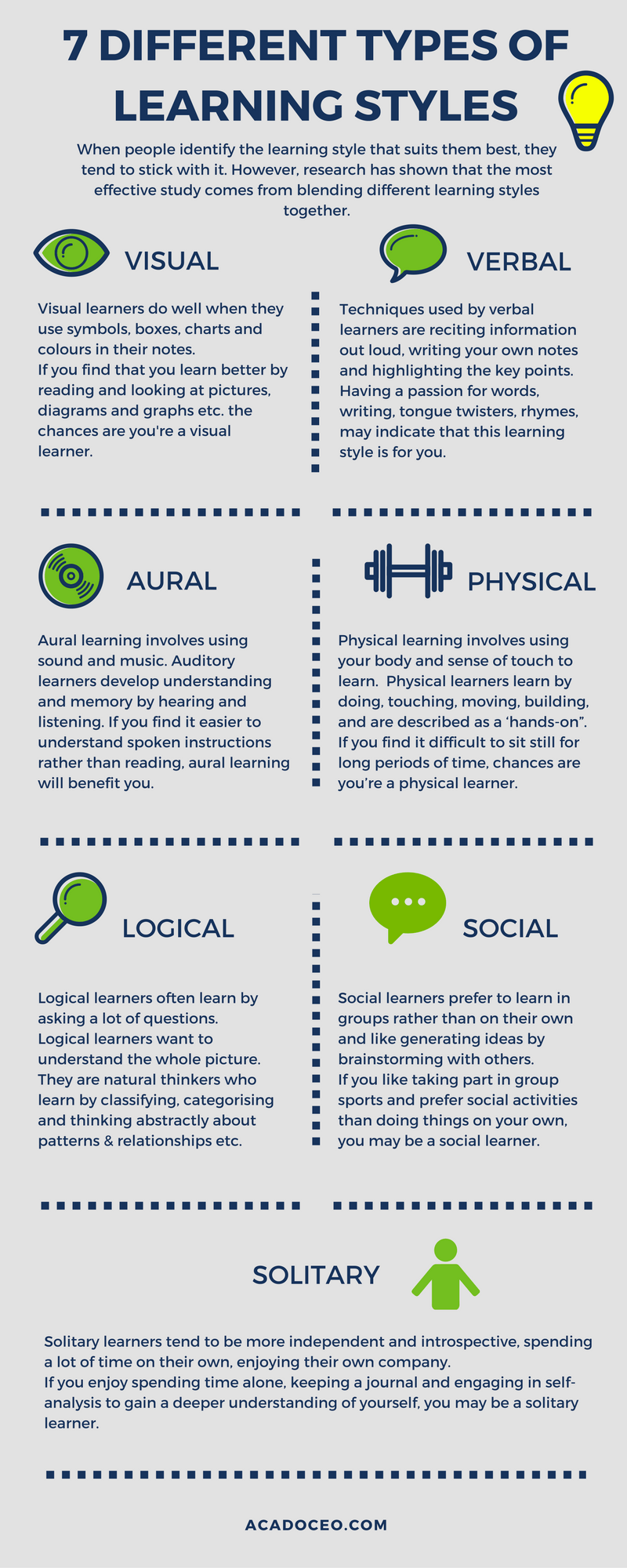
The seven learning styles in this popular model are visual (pictures and diagrams), verbal (words in speech and writing), aural (sound and music), physical (hands-on doing), logical (reasoning and systems), social (learning in groups) and solitary (learning alone). Acadoceo’s infographic above sums each one up with a short “if you…” test, and it makes a point that is easy to miss: research shows the most effective study comes from blending styles rather than sticking to one [4].
That second point matters more than which style you think you are. As the sections below explain, there is good evidence that people have learning preferences and very little evidence that teaching to a preferred style helps them learn more [1][2].
The seven learning styles explained
- Visual learners prefer pictures, diagrams, graphs and colour. They tend to use symbols, boxes and charts in their notes [4].
- Verbal learners like words, both spoken and written. Reciting information out loud, writing your own notes and highlighting key points are typical techniques, and a love of writing, rhymes or tongue twisters is a hint [4].
- Aural (auditory) learners take things in by listening. If spoken instructions are easier for you than written ones, this is your preference [4].
- Physical (kinaesthetic) learners learn by doing, touching, moving and building, and often find it hard to sit still for long periods [4].
- Logical learners ask a lot of questions and want to see the whole picture. They classify, categorise and look for patterns and relationships [4].
- Social learners prefer working in groups and generating ideas through brainstorming with others [4].
- Solitary learners are more independent and introspective. They like studying alone, keeping a journal and reflecting on what they have learned [4].
Where the learning styles idea came from
There is no single learning styles theory. A 2004 review led by Frank Coffield identified 71 different models and examined 13 of the most influential in detail [3]. The best known is Neil Fleming’s VARK model, which has four styles: visual, aural, reading and writing, and kinaesthetic. It built on an earlier three-part model of visual, auditory and kinaesthetic learning by Walter Burke Barbe and colleagues [3]. The seven-style model keeps the visual, aural and physical styles and adds verbal, logical, social and solitary, which overlap with Howard Gardner’s ideas about different kinds of intelligence.
Do learning styles actually work?
This is where the idea runs into trouble. In 2008 a panel led by Harold Pashler reviewed the evidence for the Association for Psychological Science. It found plenty of evidence that children and adults will say how they prefer to receive information, but virtually no evidence that matching teaching to those preferences improves learning. Of the few studies designed to test the idea properly, several contradicted it. The panel concluded there is no adequate evidence base for using learning styles assessments in general education [1].
The Education Endowment Foundation, which reviews evidence for schools in England, rates learning styles as having unclear impact based on insufficient evidence. It says learners are very unlikely to have a single learning style, that restricting pupils to activities matched to a reported preference may damage their progress, and that labelling students as one kind of learner can undermine their belief that effort will pay off [2].
Two further findings explain why. Teachers cannot assess their students’ learning styles accurately, and in one study 70% of nearly 400 students did not use study habits that matched their own stated preference [3]. In other words, even people who have been told their style often learn another way.
Why the idea is still popular
Learning styles feel true because preferences are real. Most people can say whether they would rather watch a video, read an article or try something for themselves. The problem is the leap from “I prefer pictures” to “I learn best only from pictures”. What matters more is the material: geography is learned through maps, music through listening, and a practical skill through practice, whatever a learner’s preference. Matching the method to the subject beats matching it to the person.
How to use learning styles in your own study
The useful part of the seven styles is as a menu of study methods, not a label. Mixing them is the approach the infographic itself recommends [4], and it lines up with well-tested techniques:
- Turn notes into a diagram or mind map, then explain it out loud. That combines visual and verbal processing.
- Test yourself rather than rereading. Writing answers from memory works for every “style”.
- Study alone to learn the material, then discuss it in a group to check your understanding.
- Where a topic has a practical side, do it: build the circuit, cook the recipe, solve the problem.
If one method feels more enjoyable, use it to keep yourself going, but do not avoid the others.
Questions about learning styles
What are the 7 different learning styles?
Visual, verbal, aural, physical, logical, social and solitary. Other models list different styles; VARK, for example, has four [3][4].
What are the four learning styles?
Usually this means Neil Fleming’s VARK model: visual, aural, reading and writing, and kinaesthetic [3].
Is the learning styles theory a myth?
The idea that people learn better when taught in their preferred style is not supported by evidence. Reviews by the Association for Psychological Science and the Education Endowment Foundation found no good evidence for it, though people do have real preferences [1][2].
How do I know my learning style?
Questionnaires such as the VARK inventory ask how you prefer to take in information [3]. Treat the result as a preference, not a rule: mixing methods is the safer approach [1][4].
What is the most common learning style?
Visual is often claimed to be the most common, but because people rarely have a single style and stated preferences do not match how they actually study, there is no reliable answer [2][3].
Sources
- Pashler, McDaniel, Rohrer and Bjork, Learning Styles, Concepts and Evidence, Psychological Science in the Public Interest, 2008 (PubMed).
- Education Endowment Foundation, Teaching and Learning Toolkit, Learning styles.
- Wikipedia, Learning styles.
- Acadoceo, How To Use Different Types of Learning Styles To Improve Study (Internet Archive copy, 2020), the original infographic.
Last reviewed 2 November 2026