What does Ethereum mean?
Ethereum is an open, public blockchain launched in July 2015 by the programmer Vitalik Buterin and a small group of co-founders [3]. Bitcoin lets people send and receive digital money without a bank. Ethereum builds on the same idea but adds open-source programs called smart contracts, which let anyone create their own digital assets and decentralised applications (dapps) that run around the clock and are open to anyone with an internet connection [3].
That is why the Jaxx beginner’s guide above describes Ethereum as a “world computer”, with the line: “What Bitcoin does for payments, Ethereum does for anything that can be programmed.” Instead of one company’s servers, the applications run on thousands of computers around the world, and no single person or company is in charge of the network [3].
What is ether (ETH)?
Ether, usually written ETH, is Ethereum’s own cryptocurrency. People often say “Ethereum” when they mean the coin, but strictly Ethereum is the network and ether is the currency it runs on [3].
Ether has two jobs. First, every action on the network, whether sending money, buying a digital collectible or running an app, costs a small fee called gas, paid in ETH. The fee stops spam and stops broken or malicious programs from running forever, the same point the infographic makes [3][1]. Second, ETH secures the network. Validators lock up, or “stake”, their ETH for the right to process transactions and earn rewards; if they act dishonestly they can lose some of it [3][5]. Since the London upgrade in August 2021, part of every fee is burned, permanently removing that ETH from the supply [3][2].
How Ethereum works
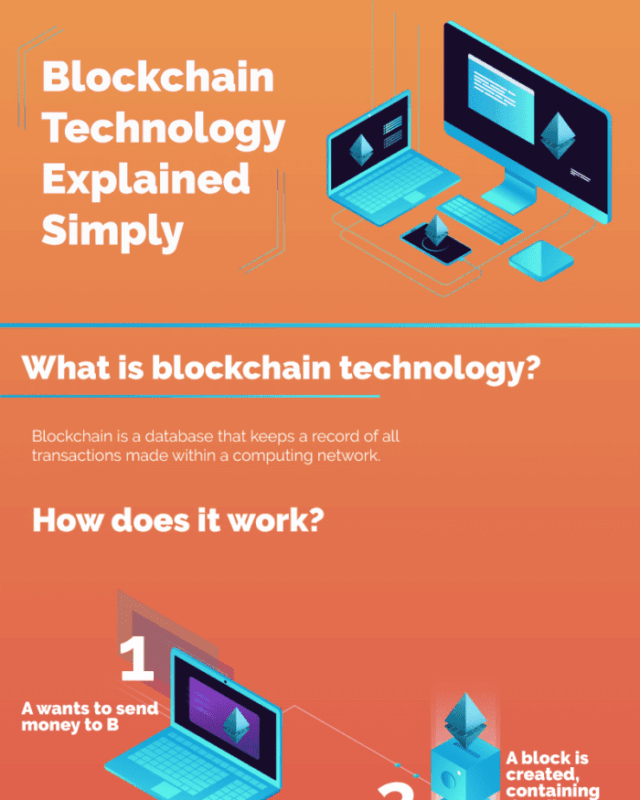
Like Bitcoin, Ethereum keeps a shared record of every transaction, the blockchain, copied across a network of independent computers. The infographic explains why that matters: most systems rely on a central authority to make final decisions, while a blockchain lets the whole network agree on what is true without one [1].
The difference is what the record can hold. Bitcoin’s blockchain mainly records payments. Ethereum’s also stores and runs smart contracts: small programs that carry out their rules automatically when conditions are met, such as releasing a payment once two parties sign, or swapping one token for another [3].
New blocks are now added by validators under a system called proof of stake. To run your own validator you need at least 32 ETH, and since the Pectra upgrade in May 2025 a single validator can hold up to 2,048 ETH. Smaller holders can join staking pools instead [5].
What is Ethereum used for?
Ethereum.org describes the network as home to thousands of cryptocurrencies and applications [3]. The main uses today are:
- Decentralised finance (DeFi): lending, borrowing and trading without a bank or broker in the middle.
- Stablecoins: tokens designed to hold a steady value, often pegged to the US dollar.
- NFTs: tokens that prove ownership of a specific digital item, such as art or a game asset.
- Other tokens and dapps, including gaming and decentralised social media [3].
The infographic, made in early 2016, predicted this kind of use: taking out the company in the middle of services like eBay or Uber and so cutting fees. The projects it names, such as Maker, Augur and uPort, and its planned Mist user interface, were early ideas of that time, so treat that part of the graphic as history [1].
A short history of Ethereum
- 27 November 2013: Vitalik Buterin publishes the Ethereum whitepaper [2].
- 22 July 2014: the ether crowdsale opens. It ran for 42 days and raised 31,591 BTC, worth about $18.4 million at the time, from around 9,000 participants, according to the infographic [1][2].
- 30 July 2015: Frontier, the first live version of Ethereum, launches [2].
- 14 March 2016: Homestead, the first planned upgrade [2].
- 2016: an exploit drains 3.6 million ETH, about $60 million, from a project called The DAO, leading to a split of the chain [3].
- 1 December 2020: the Beacon Chain starts the move to proof of stake [5].
- 15 September 2022: The Merge replaces mining with staking and cuts Ethereum’s energy use by about 99.95% [2][4].
- 12 April 2023: the Shanghai upgrade lets stakers withdraw their ETH [5].
- 2024 and 2025: the Dencun (March 2024), Pectra (May 2025) and Fusaka (December 2025) upgrades follow [2].
The infographic’s timeline ends at Homestead and lists “Metropolis” and “Serenity” as still to come. Metropolis arrived in two parts, Byzantium in October 2017 and Constantinople in February 2019, and the proof of stake plans once called Serenity became the Beacon Chain and The Merge [2].
Ethereum vs Bitcoin
Both are public blockchains with their own currency, but they are built for different things. Bitcoin is designed mainly as digital money. Ethereum is a platform for programmable applications, with ether as the fuel that pays for them [3]. They also secure their networks differently: Bitcoin still relies on proof of work mining, while Ethereum has used proof of stake since The Merge [4]. Because part of every Ethereum fee is burned, ETH can become scarcer over time when the network is busy [3].
This page explains the technology and is not investment advice. Cryptocurrency prices are volatile and you can lose money.
Questions about the meaning of Ethereum
What is Ethereum in simple terms?
A global, shared computer network that no one company controls. People use it to send its currency, ether, and to run programs called smart contracts that power apps, tokens and digital collectibles [3].
Is Ethereum the same as ether?
No. Ethereum is the network; ether (ETH) is the cryptocurrency used on it to pay fees and to stake [3].
What was the Ethereum Merge?
The upgrade on 15 September 2022 that switched Ethereum from proof of work mining to proof of stake. It cut the network’s energy use by about 99.95% [2][4].
What is an Ethereum wallet?
An app or device that holds the keys to your Ethereum account. It lets you send and receive ETH and connect to dapps. Whoever controls the keys controls the funds, so keep recovery phrases private and offline.
Who created Ethereum?
Vitalik Buterin, who wrote the whitepaper in 2013, together with a small team of co-founders. The network launched in July 2015 [2][3].
Sources
- Jaxx (Kryptokit), A Beginner’s Guide to Ethereum, the infographic on this page (2016).
- ethereum.org, The history of Ethereum.
- ethereum.org, What is Ethereum?
- ethereum.org, The Merge.
- ethereum.org, Ethereum staking.
Last reviewed 2 November 2026