How many languages are spoken in the world?
Ethnologue, the reference catalogue of the world’s languages, counts 7,170 languages in use today [2]. The number keeps changing as linguists document more languages and as others fall out of use: roughly 44% are now endangered, often with fewer than 1,000 users left [2]. At the other extreme, a handful of very large languages cover most of humanity. Ethnologue says the 20 largest languages are the native tongue of more than 3.7 billion people, about half the world’s population, even though they make up just 0.3% of its languages [2].
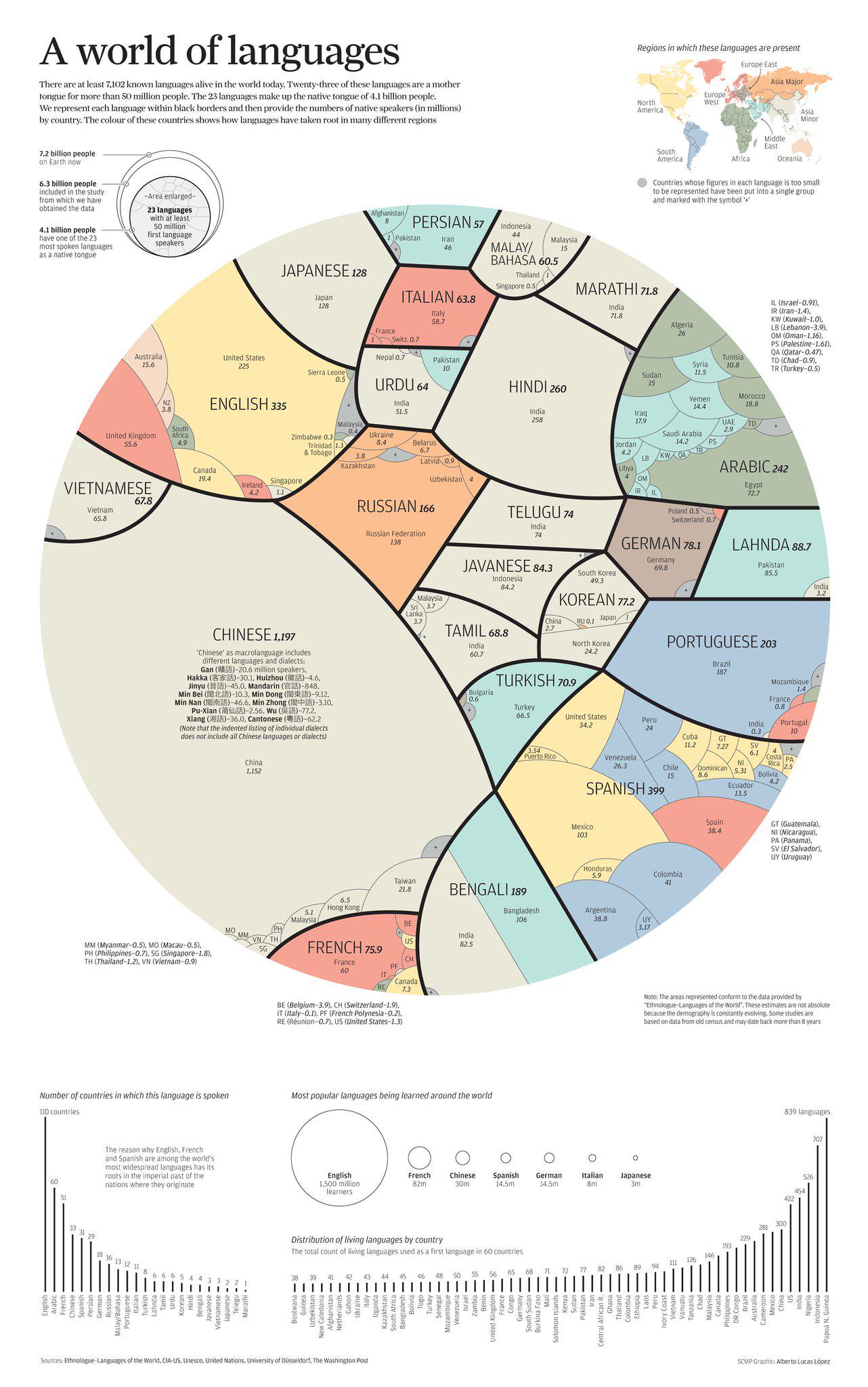
Alberto Lucas López’s world languages map for the South China Morning Post, shown above, makes the same point visually. Drawing mainly on Ethnologue data, it sizes each language by its native speakers and shows that 23 languages, each the mother tongue of more than 50 million people, together covered 4.1 billion people when it was published in 2015 [1].
The most spoken languages by native speakers
By native (first-language) speakers, Chinese is far ahead of every other language, followed by Spanish, English and Hindi. Ethnologue’s current ranking has the same top four in the same order, with Mandarin first [3]. These were the map’s figures in millions [1]:
| Rank | Language | Native speakers (millions) | Where most speakers live |
|---|---|---|---|
| 1 | Chinese (all varieties) | 1,197 | China, Taiwan, Hong Kong, Malaysia |
| 2 | Spanish | 399 | Mexico, Colombia, Argentina, Spain, United States |
| 3 | English | 335 | United States, United Kingdom, Canada, Australia |
| 4 | Hindi | 260 | India |
| 5 | Arabic | 242 | Egypt, Algeria, Morocco, Iraq |
| 6 | Portuguese | 203 | Brazil, Portugal |
| 7 | Bengali | 189 | Bangladesh, India |
| 8 | Russian | 166 | Russia, Ukraine |
| 9 | Japanese | 128 | Japan |
| 10 | Lahnda (Western Punjabi) | 88.7 | Pakistan |
The rest of the 23 were Javanese, German, Korean, French, Telugu, Marathi, Turkish, Tamil, Vietnamese, Urdu, Italian, Malay and Persian, each with between about 57 and 84 million native speakers [1]. India alone is home to six of them: Hindi, Bengali, Telugu, Marathi, Tamil and Urdu.
Is Chinese one language?
Not quite. “Chinese” is a macrolanguage: Ethnologue groups nineteen languages under it, linked by a shared writing system and literature [3]. The map’s own note splits its 1,197 million into Mandarin (848 million), Wu (77.2 million), Cantonese (62.2 million), Min Nan, Jinyu, Xiang, Hakka and others [1]. Many of these are not mutually understandable when spoken, which is why the linguist Victor Mair has argued that counting them as a single language overstates its size [4]. Even on its own, though, Mandarin is the largest native language in the world [3].
Which language has the most speakers overall?
Count second-language speakers too and English comes out on top, with Mandarin second, Hindi third and Spanish fourth [3]. English’s lead comes from people learning it: the SCMP map put English learners at 1.5 billion, far ahead of French (82 million), Chinese (30 million), Spanish and German (14.5 million each) [1]. Ethnologue puts this down first to the reach of the British Empire and later to the spread of American culture [3].
Which language is spoken in the most countries?
English again. The 2015 map counted English in 110 countries, ahead of Arabic (60), French (51), Chinese (33) and Spanish (31), and noted that the spread of English, French and Spanish has its roots in the imperial past of the countries where they began [1]. Ethnologue’s newer figures, using different methods, put English in 188 countries against Mandarin’s 108 [3]. Mandarin is concentrated in a few Asian countries with huge populations, while English is spread thinly across many, particularly in Africa [3].
Which countries have the most languages?
Language diversity and population size are very different things. Papua New Guinea, a country with a fraction of the population of the largest nations, had 839 living languages on the map, the most of any country, followed by Indonesia (707), Nigeria (526), India (454), the United States (422) and China (300) [1]. Most of those languages are small and local, spoken in a few villages or valleys. Ethnologue says Asia and Africa have the largest number of languages [2].
How language maps show the world
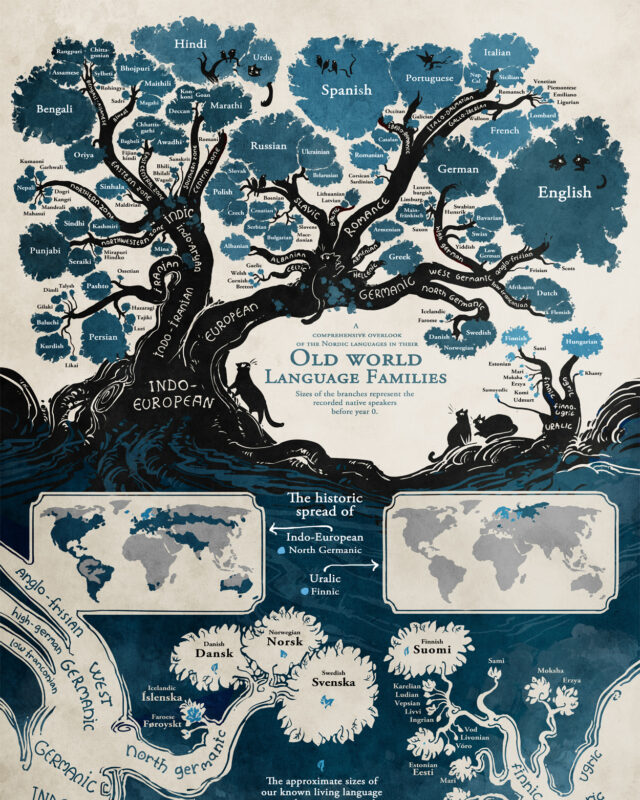
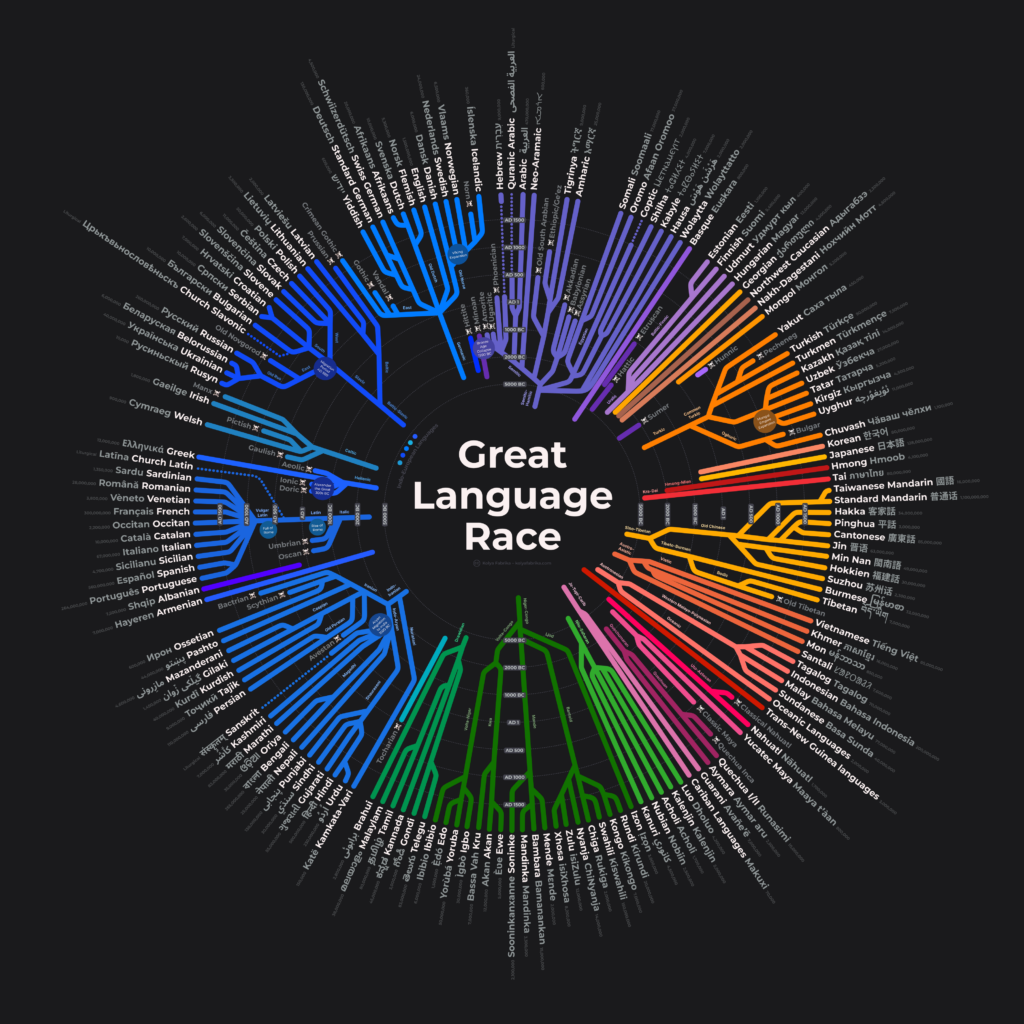
A world languages map can be drawn in several ways, and each answers a different question. A map by country shows official or majority languages, but hides the minority languages spoken within borders. A map by language family groups languages by shared ancestry, such as Indo-European across Europe and South Asia or Niger-Congo across much of Africa. A proportional map like López’s ignores geography and sizes each language by its speakers, which shows at a glance how much of the world speaks a few big languages and how small each of the other 7,000 is.
Questions about world languages
How many languages are there in the world?
Ethnologue counts 7,170 languages in use today, about 44% of them endangered [2].
What is the most spoken language in the world?
Mandarin Chinese has the most native speakers. English has the most speakers overall once second-language speakers are counted [3].
Which language is spoken in the most countries?
English, in 188 countries on Ethnologue’s count, against 108 for Mandarin [3].
Which country has the most languages?
Papua New Guinea, with 839 living languages on the SCMP map, followed by Indonesia and Nigeria [1].
What are the top 5 languages in the world by native speakers?
Chinese (Mandarin), Spanish, English, Hindi and Arabic, in that order on the SCMP map [1]. Ethnologue’s current ranking has the same top four [3].
Sources
- South China Morning Post, In graphics, a world of languages and how many speak them, Alberto Lucas López, 27 May 2015, the original map.
- Ethnologue, How many languages are there in the world?
- Ethnologue, What is the most spoken language?
- Language Log (Victor Mair), Extravagant claims for the number of “Chinese” speakers.
Last reviewed 2 November 2026