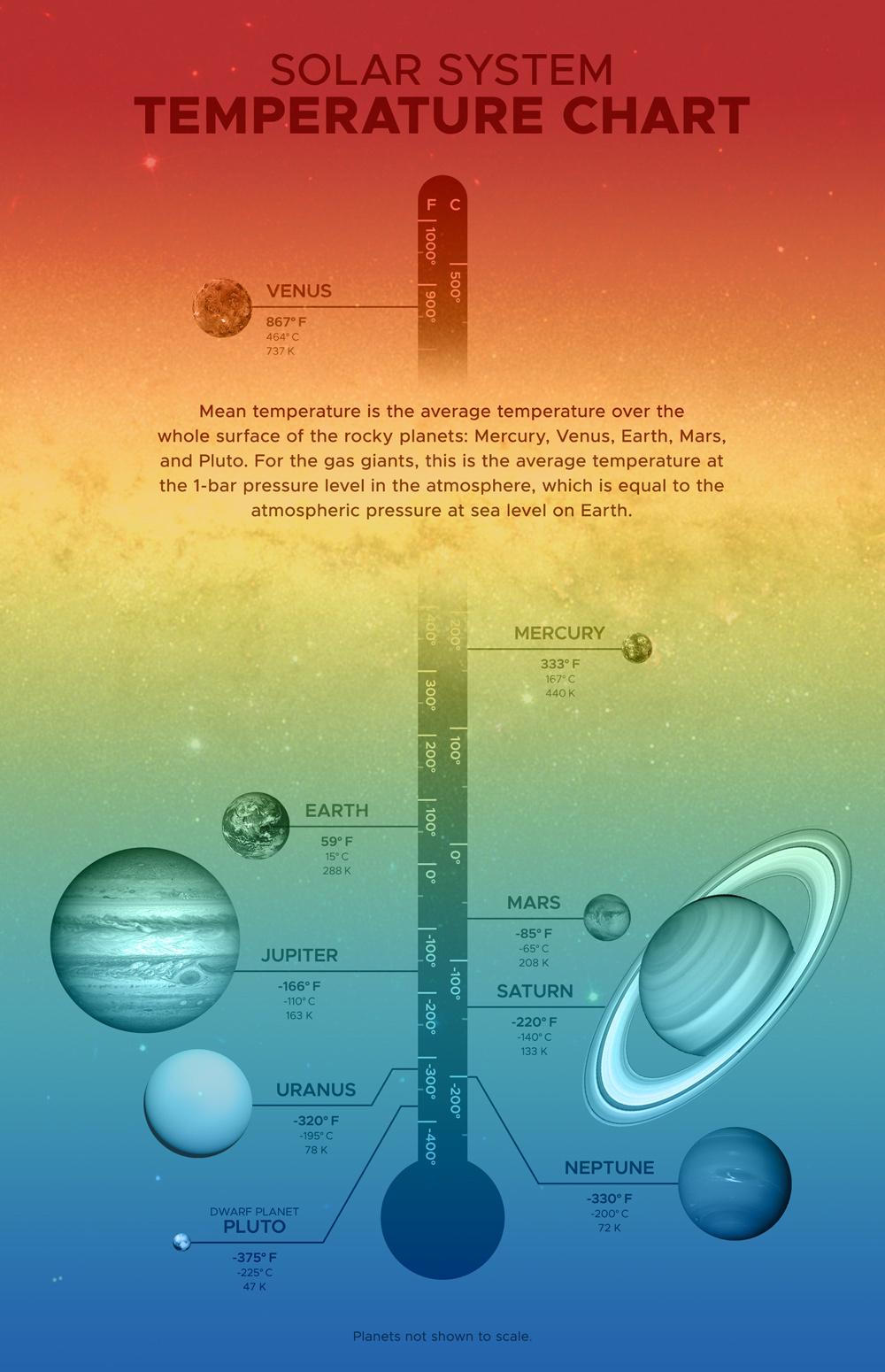
Planet temperatures mostly fall the further a planet is from the Sun, with one big exception. NASA puts the mean temperature of Venus at 867°F (464°C), hotter than Mercury at 333°F (167°C), even though Mercury is closer to the Sun. Earth averages 59°F (15°C), Mars minus 85°F (minus 65°C), and the outer planets get colder all the way to Neptune at minus 330°F (minus 200°C).
Temperature of each planet
The mean temperature of each planet ranges from 867°F (464°C) on Venus to minus 330°F (minus 200°C) on Neptune, according to NASA’s Solar System Temperatures chart, which is based on the NASA Planetary Fact Sheet. The average distances below come from NASA’s own fact pages for each planet.
| Planet | Average distance from the Sun | Mean temperature (°F) | Mean temperature (°C) |
|---|---|---|---|
| Mercury | 0.4 AU | 333°F | 167°C |
| Venus | 0.72 AU | 867°F | 464°C |
| Earth | 1 AU | 59°F | 15°C |
| Mars | 1.5 AU | -85°F | -65°C |
| Jupiter | 5.2 AU | -166°F | -110°C |
| Saturn | 9.5 AU | -220°F | -140°C |
| Uranus | About 19 AU | -320°F | -195°C |
| Neptune | 30 AU | -330°F | -200°C |
| Pluto (dwarf planet) | 39 AU | -375°F | -225°C |
One astronomical unit (AU) is the average distance from the Sun to Earth, about 93 million miles (150 million kilometres), as NASA’s Earth facts page explains. A mean temperature is an average over a whole planet, day and night, so the real conditions at any one spot can be far hotter or colder, as the sections below show.
NASA measures the rocky planets and Pluto at the surface. Jupiter, Saturn, Uranus and Neptune have no solid surface to stand on, so NASA takes their temperatures at the level in the atmosphere where the pressure equals sea level on Earth (1 bar). The NASA infographic shows these mean temperatures on a single thermometer from Venus at the top to Pluto at the bottom, in Fahrenheit, Celsius and kelvin.
What is the hottest planet in the solar system
Venus is the hottest planet in the solar system. NASA’s Venus facts page gives its surface temperature as about 872°F (467°C), which is hot enough to melt lead, and the mean in NASA’s temperature chart is 867°F (464°C).
The reason is its atmosphere. Venus is wrapped in a thick atmosphere that traps heat in what NASA calls a runaway greenhouse effect, so the heat that reaches the surface can’t escape again. Venus also has almost no seasons to bring any relief, because its axis is tilted by only about 3 degrees, compared with about 23 degrees for Earth, according to the same NASA page.
Conditions are far milder higher up. About 30 miles (50 kilometres) above the surface of Venus, NASA says temperatures range from 86°F to 158°F (30°C to 70°C), a range NASA says could suit hardy microbes of the kind that live in extreme places on Earth.
Why Mercury is not the hottest planet
Mercury is not the hottest planet because it has almost no atmosphere to hold on to its heat. NASA’s Mercury facts page says daytime temperatures on the surface can reach 800°F (430°C), but at night they can fall to minus 290°F (minus 180°C).
That gives Mercury the biggest swing between day and night of any planet. NASA’s temperature chart page adds that Mercury rotates slowly, so its night side can be more than 1,000°F colder than its day side. Its average of 333°F (167°C) is well below the average on Venus, even though Venus is almost twice as far from the Sun, at 0.72 AU against Mercury’s 0.4 AU. NASA says Mercury may even have water ice inside deep craters at its poles, in places that are always in shadow.
What is the coldest planet in the solar system
Neptune has the coldest average temperature of the eight planets, but Uranus holds the record for the coldest temperature measured. NASA’s temperature chart gives Neptune a mean of minus 330°F (minus 200°C) and Uranus minus 320°F (minus 195°C), so on average the two are only about 5°C apart.
The coldest single reading belongs to Uranus. NASA’s Uranus facts page says its atmosphere has a minimum temperature of 49 kelvin (minus 224.2°C), which makes it even colder than Neptune in places, even though Uranus is closer to the Sun at about 19 AU against Neptune’s 30 AU. Deep inside, Uranus is very different, and NASA says it heats up to about 9,000°F (4,982°C) near the core.
Some moons are colder still. Neptune’s largest moon, Triton, has surface temperatures of around minus 391°F (minus 235°C), according to NASA’s Neptune facts page.
Temperature on Mars
Mars has a mean temperature of minus 85°F (minus 65°C) in NASA’s chart, but it swings a long way either side of that. NASA’s Mars facts page says the temperature can be as high as 70°F (20°C) or as low as about minus 225°F (minus 153°C).
Its thin atmosphere is the reason. Mars is 1.5 AU from the Sun and its air is too thin to hold much heat, so warmth escapes fast. NASA describes standing on the Martian equator at noon as feeling like spring at your feet, at about 75°F (24°C), and winter at your head, at about 32°F (0°C).
Temperature on Jupiter, Saturn and the gas giants
Jupiter has a mean temperature of minus 166°F (minus 110°C) and Saturn minus 220°F (minus 140°C), according to NASA’s Solar System Temperatures page. Both figures are taken at the 1 bar pressure level in their atmospheres rather than at a surface.
These are cloud level temperatures, not the whole story. Pressure and temperature rise steeply with depth inside the giant planets. NASA’s Jupiter facts page says the pressure and temperature deep in the atmosphere compress Jupiter’s hydrogen gas into a liquid, and the conditions there would crush, melt and vaporise any spacecraft trying to fly in. NASA’s Saturn facts page says the same of Saturn.
How hot is Earth compared with other planets
Earth’s mean temperature is 59°F (15°C), the only planetary average in the solar system that sits between the freezing and boiling points of water. That is why, as NASA’s Earth facts page puts it, most of our planet is covered in liquid water, since the temperature lets it stay liquid for long periods.
Earth is much hotter on the inside. NASA says the solid iron and nickel inner core reaches as high as 9,800°F (5,400°C). Our Moon, with no atmosphere to spread the heat, swings from about 260°F (127°C) in full sunlight to about minus 280°F (minus 173°C) in darkness, according to NASA’s Moon facts page.
How cold is Pluto
Pluto is colder than any planet. NASA’s temperature chart gives it a mean of minus 375°F (minus 225°C), and NASA’s Pluto facts page puts its average a little lower, at minus 387°F (minus 232°C), with temperatures as cold as minus 375°F to minus 400°F (minus 226°C to minus 240°C).
The two NASA pages round the numbers differently, but both put Pluto at the bottom of the scale. Pluto averages 39 AU from the Sun, and its oval orbit takes it anywhere from 30 AU to 49.3 AU away over each 248-year orbit. At those temperatures, NASA says, water is essentially as hard as rock.
Why planets further from the Sun are colder
Planets further from the Sun are colder because they receive less sunlight, but a planet’s atmosphere decides how much of that heat it keeps. NASA’s Solar System Temperatures page says that in general surface temperatures fall with distance from the Sun, and Venus is the exception because its dense atmosphere acts as a greenhouse.
The examples above show the pattern. A thick atmosphere like that of Venus traps heat and evens out day and night. A thin one like that of Mars, or almost none at all like Mercury and the Moon, lets heat escape, so temperatures swing hard between sunlight and shadow. For scale, NASA’s Sun facts page gives the visible surface of the Sun, the photosphere, at about 10,000°F (5,500°C), its outer atmosphere, the corona, at up to 3.5 million °F (2 million °C), and its core at about 27 million °F (15 million °C).
Questions about planet temperatures
Which planet is the hottest and which is the coldest?
Venus is the hottest planet, with a mean temperature of 867°F (464°C) in NASA’s chart. Neptune has the coldest average, at minus 330°F (minus 200°C), while Uranus has recorded the coldest single temperature of any planet, 49 kelvin (minus 224.2°C), according to NASA.
What are the top 3 hottest planets?
By mean temperature in NASA’s chart, the three hottest planets are Venus at 867°F (464°C), Mercury at 333°F (167°C) and Earth at 59°F (15°C). Every other planet averages below freezing.
Is Venus hotter than Mercury?
Yes. Venus averages 867°F (464°C) and Mercury 333°F (167°C), according to NASA, even though Mercury is closer to the Sun. Venus’s thick atmosphere traps heat, while Mercury has almost none, so its night side drops to minus 290°F (minus 180°C).
How hot is Pluto?
Pluto is not hot at all. NASA gives its average temperature as minus 387°F (minus 232°C) on its Pluto facts page and minus 375°F (minus 225°C) in its temperature chart, colder than any of the eight planets.
Why is Uranus colder than Neptune?
Uranus can be colder than Neptune in places even though it is closer to the Sun. NASA’s Uranus facts page records a minimum atmospheric temperature of 49 kelvin (minus 224.2°C), colder than Neptune in places. On average, though, NASA’s chart still puts Neptune slightly colder.
How are temperatures measured on gas giants?
Gas giants have no solid surface, so NASA quotes their temperature at the height in the atmosphere where the pressure is 1 bar, the same as air pressure at sea level on Earth.
Sources
- NASA, Solar System Temperatures (infographic, published 15 February 2022, data from the NASA Planetary Fact Sheet)
- NASA Science, Mercury facts
- NASA Science, Venus facts
- NASA Science, Earth facts
- NASA Science, Moon facts
- NASA Science, Mars facts
- NASA Science, Jupiter facts
- NASA Science, Saturn facts
- NASA Science, Uranus facts
- NASA Science, Neptune facts
- NASA Science, Pluto facts
- NASA Science, Sun facts
The infographic is a NASA work made available under NASA’s images and media usage guidelines. Its use here does not imply any endorsement by NASA.