Space debris is every human-made object in orbit that no longer does a job, from dead satellites and spent rocket stages down to tiny fragments of break-ups. ESA’s Space Debris Office counts about 47,330 objects tracked in Earth orbit and estimates 1.5 million pieces between 1 cm and 10 cm, plus 230 million smaller fragments. Each travels at several kilometres a second, so even a tiny piece can wreck a working satellite.
What is space debris
Space debris is any non-functional, human-made object in Earth orbit or falling back through the atmosphere. ESA’s Zero Debris page uses the international definition “All non-functional, human-made objects, including no longer functioning spacecraft or fragments of them, in orbit or reentering Earth’s atmosphere.”
That covers a wide range of things. ESA’s space environment statistics sort it into satellites that have stopped working, rocket bodies (the upper stages left in orbit after a launch), objects released on purpose during a mission such as lens covers and fairings, and fragments from break-ups and collisions. A growing share can’t yet be traced to any launch at all, and ESA lists these as unidentified. Space junk is simply the everyday name for the same thing.
How much space debris is there
There are about 47,330 objects tracked and catalogued in Earth orbit, and millions more too small to track. ESA’s space environment statistics, last updated on 17 November 2026, give these figures.
| Measure | ESA figure (November 2026) |
|---|---|
| Rocket launches since 1957 (excluding failures) | About 7,420 |
| Satellites placed in Earth orbit | About 28,840 |
| Satellites still in space | About 19,770 |
| Satellites still working | About 15,800 |
| Objects regularly tracked and catalogued | About 47,330 |
| Break-ups, explosions, collisions and other fragmentation events | More than 660 |
| Total mass of all objects in Earth orbit | More than 17,600 tonnes |
| Estimated objects larger than 10 cm | 68,450 (including about 11,300 active payloads) |
| Estimated objects from 1 cm to 10 cm | 1.5 million |
| Estimated objects from 1 mm to 1 cm | 230 million |
The last three rows are estimates. Surveillance networks can only follow objects above a certain size, so ESA works out the rest with its MASTER statistical model, using the February 2026 reference population. Most of the tracked objects, about 28,080, are in low Earth orbit below 2,000 km, the busiest part of space.
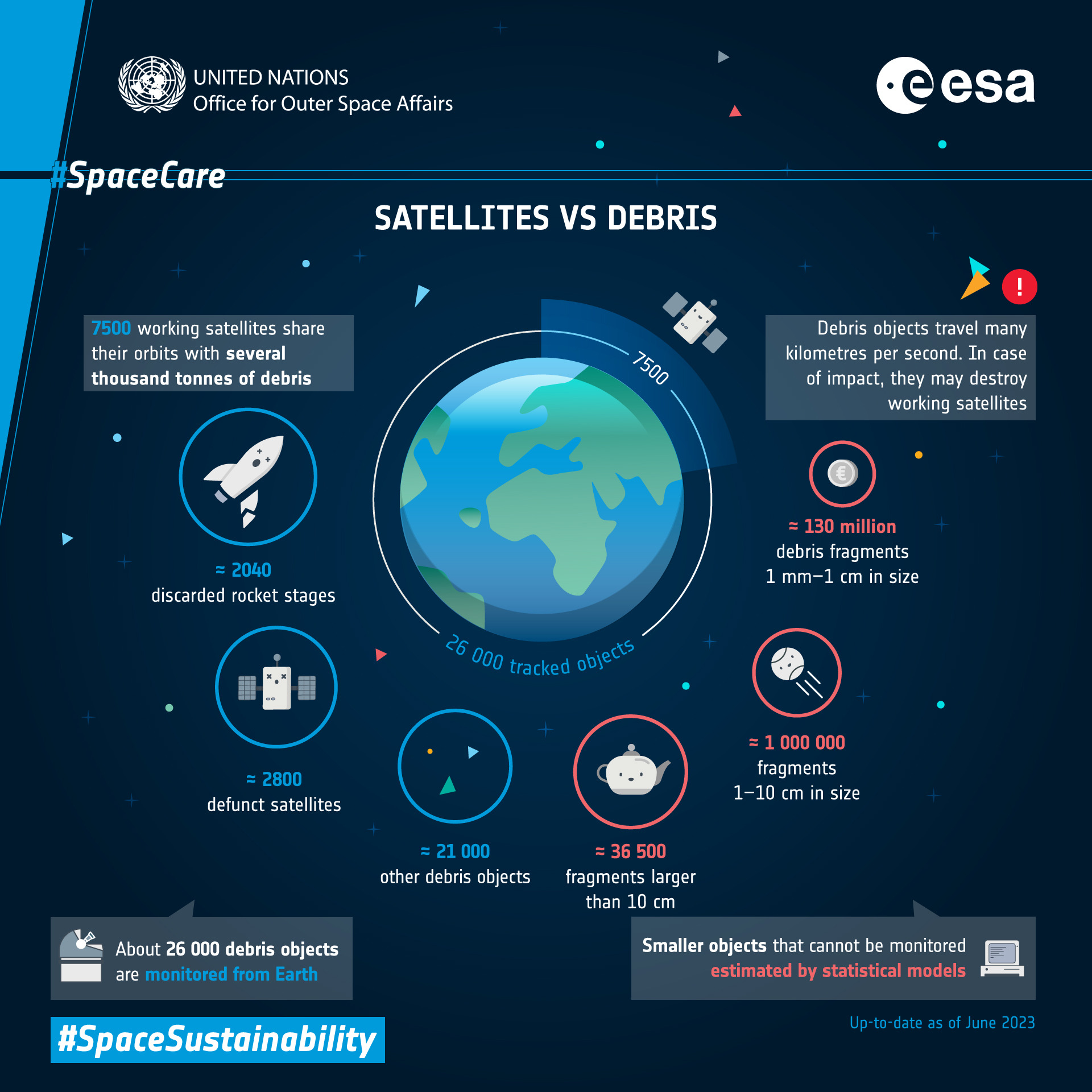
The infographic by ESA and the United Nations Office for Outer Space Affairs (UNOOSA) shows the same split as it stood in June 2023, with 7,500 working satellites, about 26,000 tracked objects, around 36,500 fragments larger than 10 cm, about 1 million from 1 cm to 10 cm and about 130 million from 1 mm to 1 cm. ESA’s current estimates are higher for every size of fragment, and the number of working satellites has roughly doubled since then.
How many satellites are in orbit
About 19,770 satellites are in space, and about 15,800 of them still work, according to ESA’s space environment statistics. The other 4,000 or so are dead satellites that now count as debris.
The rise has been fast. ESA’s 2026 Space Environment Report says more than 300 launches in 2025 put over 4,000 new payloads into orbit, around ten a day, with large constellations and rideshare missions carrying many satellites on each launch. In June 2023 the ESA and UNOOSA infographic counted 7,500 working satellites. ESA’s Zero Debris page, written in November 2023, already noted that more satellites had been launched in the previous two years than in the six decades of spaceflight before.
Why space debris is dangerous
Space debris is dangerous because it moves so fast that even a small piece hits with enormous energy. ESA’s Zero Debris page says a 1 cm particle travelling at 10 km/s, and there are about a million of them in orbit, releases the same energy as a small car crashing at 40 km/h.
A strike like that can disable a satellite or break it apart, which creates more debris. ESA’s Satellites vs Debris page says any impact threatens at least to impair a working spacecraft and at worst to destroy it altogether. Most fragments are too small to track from the ground, so satellites get no warning of them. ESA’s statistics record four confirmed collisions between catalogued objects so far, along with several anomalies that look like satellites struck by small debris or micrometeoroids.
How satellites avoid space debris
Satellites avoid the larger, tracked pieces of debris by firing their thrusters to move out of the way, a collision avoidance manoeuvre. ESA’s The cost of avoiding collision page says each ESA mission makes on average three to four of these manoeuvres a year.
Each one has a cost. Teams spend hours monitoring the sky, calculating the risk and planning the move, the satellite burns extra fuel, and science data is lost while instruments are switched off. The International Space Station does the same. On 30 April 2025, NASA’s space station blog reported that the thrusters of a docked Progress cargo ship fired for 3 minutes 33 seconds to raise the station’s orbit away from a fragment of a Chinese Long March rocket launched in 2005. Without the manoeuvre, NASA estimated the fragment could have passed within about 0.4 miles of the station.
How long space debris stays in orbit
How long space debris stays in orbit depends almost entirely on its height. ESA’s Falling to Earth takes a long time page explains that the thin upper atmosphere slowly drags objects down, which can take less than 25 years for satellites at low altitudes and thousands of years for those tens of thousands of kilometres out.
In that companion ESA and UNOOSA graphic, objects below about 500 km usually come down within 25 years, at 800 km it takes 100 to 150 years, and at 1,200 km about 2,000 years. Satellites in geostationary orbit, about 36,000 km up, are barely touched by the atmosphere and could stay there indefinitely, so they should be moved up to a higher “graveyard” orbit at the end of their lives. As ESA puts it, had the dinosaurs launched a satellite into the furthest geostationary orbit, it would still be up there today.
Plenty of objects do come back. ESA’s 2026 Space Environment Report says more than three intact satellites or rocket bodies reentered the atmosphere every day on average in 2025, and that controlled reentries of rocket bodies outnumbered uncontrolled ones for the second year running.
What is the Kessler syndrome
The Kessler syndrome is a runaway chain reaction in which collisions create fragments that cause further collisions, until some orbits become unusable. ESA’s 2026 Space Environment Report calls this self-sustaining cycle the greatest long-term threat in space.
ESA says that even if no new satellites were launched, the debris population would keep growing, because fragmentation events create debris faster than it naturally falls back to Earth. In its 2026 report, ESA’s projections of objects and collisions in low Earth orbit rose so steeply that it cut its forecast horizon from 200 years to 100 years, and the numbers were still higher than a year earlier. ESA now says active debris removal, physically taking dead objects out of orbit, is needed to stop the growth.
Is space debris getting worse
Yes. ESA’s measure of the problem got about ten times worse in a single year. ESA’s 2026 Space Environment Report says its Space Environment Health Index, which compares current behaviour in orbit with a sustainable benchmark set in 2014, jumped from about 4 to 50 in 2025.
A score above 1 means more strain on the orbital environment than is sustainable, so a score of 50 means 50 times that. ESA blames the continued growth in constellations and the fact that not enough satellites leave crowded orbits at the end of their lives. The same report added a new measure in 2026, the risk to people on the ground from reentering fragments. It is still low compared with everyday risks, but it has risen with the extra traffic.
What is being done about space debris
Agencies are tightening the rules on how long dead satellites can stay in orbit and testing ways to remove debris. ESA’s Zero Debris approach aims to significantly limit the debris created by all its future missions in Earth and lunar orbits by 2030.
The long-standing guideline says a satellite or rocket body in low Earth orbit should come down within 25 years of the end of its mission. ESA’s Zero Debris recommendations cut that to under five years, and the 2026 Space Environment Report credits the move from 25 to 5 years with shorter orbital lifetimes. ESA also wants disposal planned and checked before launch, with at least a 90% chance of success, and is developing active removal with its ClearSpace-1 mission and a standard removal interface, tested with its CAT demonstration mission, so failed satellites can be collected more easily. The infographic is part of a joint ESA and UNOOSA series on space debris, which urges operators to dispose of satellites responsibly at the end of their lives, either up to a graveyard orbit or down to burn up in the atmosphere.
Questions about space debris
How much space junk is there?
ESA counts about 47,330 tracked objects in Earth orbit and estimates 68,450 objects larger than 10 cm, 1.5 million from 1 cm to 10 cm and 230 million from 1 mm to 1 cm. Together they weigh more than 17,600 tonnes.
What is the 25 year rule in space?
The 25 year rule is the long-standing international guideline that a satellite or rocket body in low Earth orbit should leave orbit within 25 years of the end of its mission. ESA’s Zero Debris recommendations reduce this to under five years.
How does the ISS not get destroyed by debris?
The International Space Station moves out of the way of tracked debris. When a piece is predicted to pass too close, NASA and its partners fire the thrusters of a docked spacecraft to raise the station’s orbit, as they did on 30 April 2025 to avoid a rocket fragment.
Does space debris fall to Earth?
Yes, eventually, if it is low enough. ESA says more than three intact satellites or rocket bodies reentered every day on average in 2025. Most burn up, but some fragments survive, which is why ESA now tracks the casualty risk on the ground.
Who cleans up space debris?
Nobody cleans it up at scale yet. ESA is developing active debris removal through its ClearSpace-1 mission and says removal must become part of the solution soon, alongside better disposal at the end of each mission.
Sources
- ESA and UNOOSA, Satellites vs Debris (infographic, up to date as of June 2023, licensed CC BY-SA 3.0 IGO)
- ESA Space Debris Office, Space Environment Statistics (last updated 17 November 2026)
- ESA, ESA Space Environment Report 2026 (14 September 2026)
- ESA, ESA’s Zero Debris approach
- ESA and UNOOSA, Falling to Earth takes a long time
- ESA and UNOOSA, The cost of avoiding collision
- NASA, Station Maneuvers to Avoid Orbital Debris (30 April 2025)
The infographic “Satellites vs Debris” is by ESA and UNOOSA (credit ESA/UNOOSA) and is shared under the Creative Commons CC BY-SA 3.0 IGO licence, unchanged. Its use here does not imply any endorsement by ESA or the United Nations.