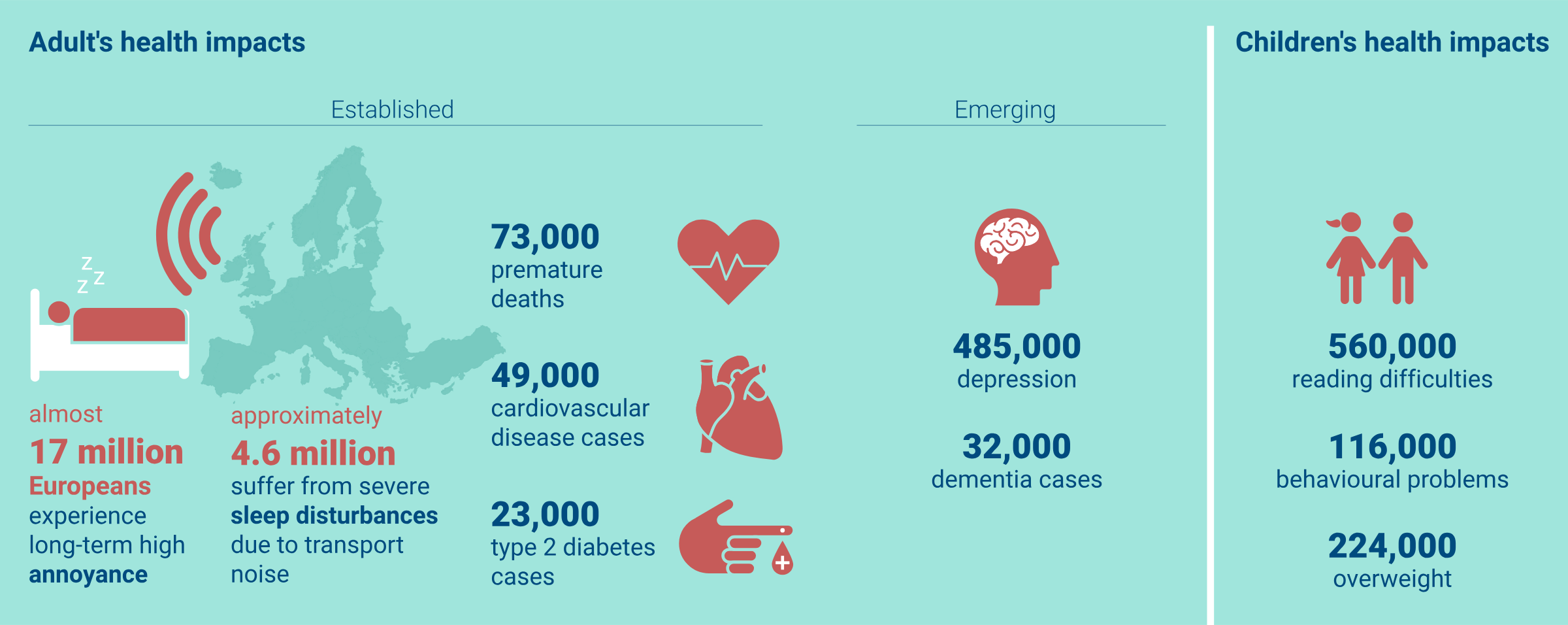
Noise pollution harms far more than your hearing. Long-term exposure to traffic, rail and aircraft noise disturbs sleep and keeps the body’s stress response switched on, which raises the risk of heart disease, type 2 diabetes, depression and early death. The European Environment Agency (EEA) links transport noise in Europe to 73,000 premature deaths, 49,000 new cases of cardiovascular disease and 23,000 new cases of type 2 diabetes in 2021.
How noise pollution affects your health
Noise affects health mainly through stress and broken sleep, not through damage to the ear. The EEA briefing Transport noise, vulnerability and inequalities (October 2026) explains that chronic exposure disrupts sleep and activates the body’s stress response, which can trigger oxidative stress, inflammation and hormonal changes. Over years, those processes contribute to cardiovascular disease, diabetes, mental health conditions, dementia and premature death.
That is why the noise that matters most for health is not the occasional loud bang but the steady background hum of a busy road outside a bedroom window. You can get used to it in the sense that you stop noticing it, but the body still reacts. The EEA’s noise expert Eulalia Peris describes it as keeping the body in a constant state of “fight or flight”, even when people don’t consciously realise it.
The EEA infographic above sets out the scale of the established and emerging effects for adults and children in Europe. The sections below go through each one.
How many people are exposed to harmful noise
More than one in five people in Europe live with transport noise at levels that harm health. According to the EEA report Environmental noise in Europe 2025, about 112 million people across the EEA member countries (excluding Türkiye) are exposed to long-term road, rail and aircraft noise above the reporting thresholds of the EU Environmental Noise Directive. Measured against the stricter World Health Organization (WHO) recommendations, the figure rises to about 150 million people, more than 30% of the population.
Road traffic is by far the biggest source. The same report counts about 92 million people exposed to harmful road noise over the day, evening and night, and 58 million at night. Railway noise affects 18 million people (13 million at night) and aircraft noise about 2.6 million (fewer than 1 million at night). Rail and aircraft noise affect fewer people overall, but they can dominate life near a busy line or airport.
Annoyance and sleep disturbance
The most common effects of noise are long-term annoyance and poor sleep. The EEA estimates that nearly 17 million people in Europe are highly annoyed by transport noise and about 4.6 million suffer severe sleep disturbance because of it.
Annoyance sounds minor, but here it means a lasting sense of irritation and stress at home, which is one of the routes by which noise feeds into wider health problems. Sleep disturbance matters for the same reason. The EEA briefing lists insomnia and sleeping too little or too much among the factors that may make people more susceptible to the heart and metabolic effects of noise.
Heart disease, diabetes and premature deaths
Long-term transport noise raises the risk of cardiovascular disease and type 2 diabetes, and contributes to early death. In 2021, the EEA links it to about 73,000 premature deaths, 49,000 new cases of cardiovascular disease and 23,000 new cases of type 2 diabetes across Europe, according to Environmental noise in Europe 2025.
The report puts those figures in proportion. They are about 1.2% of all premature deaths, 0.6% of all new cardiovascular disease cases and 1.2% of all type 2 diabetes cases in that year. Road traffic accounts for most of them, and people in towns and cities are worst affected.
People who already have heart disease appear to be most at risk. The EEA’s October 2026 briefing says the strongest and most consistent evidence of greater susceptibility is among people with coronary heart disease or a previous heart attack, who showed stronger links between transport noise and cardiovascular outcomes than the general population.
Noise and mental health
Noise is linked to depression and dementia, although the evidence is newer than for heart disease. Using recent meta-analyses, the EEA’s 2025 report estimates that transport noise contributed to about 485,000 cases of depressive disorders and 32,000 cases of dementia in Europe in 2021. The EEA treats these as emerging effects, which is why the infographic shows them separately from the established ones.
The same report lists anxiety, suicide and aggression among the mental health outcomes that research has linked to transportation noise, alongside tinnitus and some respiratory conditions. These links are still being studied, so they are not yet counted in the headline totals.
How noise affects children
Children are hit hard because the exposure happens while they are learning and developing. The EEA estimates that about 15 million children in Europe live in areas with harmful noise levels. Among children aged 6 to 17, transport noise contributed to about 564,500 cases of reading impairment, 115,700 cases of behavioural problems and 223,600 cases of being overweight, according to Table 3.3 of Environmental noise in Europe 2025.
Roughly 84% of those cases come from road traffic noise, 15% from rail and about 1% from aircraft. The EEA briefing adds that around 60,000 schools and 15,000 hospitals and health centres in Europe sit in areas with transport noise at or above 55 dB over the day, evening and night.
How loud is too loud
For long-term traffic noise at home, health effects start at levels many people would call quite normal. The EU’s Environmental Noise Directive uses 55 dB averaged over the day, evening and night (written Lden) and 50 dB at night (Lnight) as its reporting thresholds. The WHO’s Environmental noise guidelines for the European Region recommend lower levels, as summarised in Table 1.3 of the EEA report.
| Noise source | WHO recommended level, day-evening-night (Lden) | WHO recommended level, night (Lnight) |
|---|---|---|
| Road traffic | 53 dB | 45 dB |
| Railways | 54 dB | 44 dB |
| Aircraft | 45 dB | 40 dB |
Even these may be too high. The EEA says many studies find health effects from as low as 45 dB Lden, so its own estimates, which count only people above the directive’s thresholds, are likely to understate the real harm.
Who is most affected by noise
Everyone exposed is at risk, but some groups are more vulnerable or more exposed. The EEA briefing names people with existing heart disease, children and older adults as the groups of most concern. Older adults are more likely to have the chronic conditions that noise makes worse, although the evidence that noise affects them more strongly is less consistent.
Exposure is also unequal. Across 250 EU urban centres, the EEA found that areas with more residents born outside the EU tended to have a larger share of land exposed to road noise of 65 dB or more, a positive correlation in 19 of the 21 countries analysed. The EEA stresses that these are area-level patterns, not causal effects, and that local factors such as housing markets and where major roads run shape who lives with the most noise.
The cost of noise pollution
Noise pollution costs Europe more than EUR 100 billion a year. The EEA’s 2025 report estimates that transport noise causes the loss of about 1.5 million healthy life years each year, with an economic cost of EUR 104.6 billion, about 0.61% of the region’s GDP. Road noise alone accounts for EUR 85.9 billion of that.
Measured by disease burden, transport noise ranks among the top three environmental health threats in Europe, behind air pollution and temperature-related factors. The EEA says it has a bigger health impact than better-known risks such as second-hand smoke or lead exposure.
How noise pollution can be reduced
The most effective fixes cut noise at the source, such as quieter roads, tyres and vehicles and lower urban speed limits. The EEA report says source measures benefit the most people and work better than local fixes like noise barriers, and that no single measure is enough on its own.
- Lower speed limits. When Zurich cut limits from 50 km/h to 30 km/h, average noise fell by 1.6 dB in the day and 1.7 dB at night, and annoyance and sleep disturbance fell by more than the decibel drop alone would suggest. Applied across Europe, the EEA estimates this could cut the number of people highly annoyed by road noise by 7% and those with high sleep disturbance by 12%.
- Quieter roads, tyres and vehicles. An EU-commissioned study cited by the EEA estimated that quieter road surfaces and tyres, lower vehicle sound limits and more electric vehicles could reduce the health burden of road noise by 18% to 24% by 2030.
- Smoother rail and quieter aircraft. The same study found smoother, quieter trains and tracks could cut the rail noise burden by 37% to 52%, and a night curfew at all airports could cut the aircraft noise burden by 30% to 60%, though at a high cost.
- Quiet green space. Access to quiet green areas helps reduce stress and annoyance, yet across 233 cities only 34% of people can reach one within 400 metres of home.
Progress is slow. The EU’s zero pollution action plan aims to cut the number of people chronically disturbed by transport noise by 30% by 2030 compared with 2017, but the EEA estimates the number of people highly annoyed fell by only 3% between 2017 and 2022. On current trends it says the target is unlikely to be met without new measures.
Closer to home, the EEA report notes that countries commonly use low-noise asphalt, building insulation and noise barriers, and recommends building design that shields noise-sensitive rooms from transport corridors. For your own sleep, the night-time level reaching the bedroom is what counts most.
Questions about noise pollution and health
How does noise pollution affect human health?
Long-term noise keeps the body’s stress response active and disturbs sleep. Over time this raises the risk of heart disease, stroke, type 2 diabetes, depression and premature death. In children it is linked to reading difficulties, behavioural problems and being overweight.
How many deaths are caused by noise pollution?
The EEA links long-term transport noise to about 73,000 premature deaths a year in Europe, based on 2021 data. That is about 1.2% of all premature deaths in the region.
Is it unhealthy to sleep with noise?
Regular noise at night can harm health even if it doesn’t wake you. The WHO recommends keeping night-time road traffic noise below 45 dB, and the EEA estimates about 4.6 million people in Europe suffer severe sleep disturbance from transport noise.
Can loud noise cause anxiety and depression?
Research links transport noise to anxiety and depression, though the evidence is still emerging. The EEA estimates noise contributed to about 485,000 cases of depressive disorders in Europe in 2021.
What is a safe noise level at home?
For road traffic, the WHO recommends average levels below 53 dB over the day, evening and night and below 45 dB at night. The EEA notes that some health effects appear from about 45 dB Lden.
What is the main source of noise pollution?
Road traffic. In Europe it exposes about 92 million people to harmful levels, against 18 million for railways and 2.6 million for aircraft, according to the EEA.
Sources
- European Environment Agency, Estimated health impacts of transport noise in Europe (infographic, published 26 October 2026, data EEA 2025, licensed CC BY 4.0)
- European Environment Agency, Environmental noise in Europe 2025 (EEA Report 05/2025, corrected March 2026)
- European Environment Agency, Transport noise, vulnerability and inequalities, who is most affected? (briefing, 26 October 2026)
- European Environment Agency, Interview, assessing the health and environmental impacts of noise (16 June 2025)
- World Health Organization Regional Office for Europe, Environmental noise guidelines for the European Region (2018)
The infographic “Estimated health impacts of transport noise in Europe” is by the European Environment Agency (EEA) and is shared under the Creative Commons CC BY 4.0 licence, unchanged (rendered from the EEA’s own SVG file). Its use here does not imply any endorsement by the EEA.