Common octopus numbers off South West England have risen sharply since spring 2025, and the bloom was still going in 2026. UK vessels landed about 3,840 tonnes of octopus into UK ports between January and September 2026, against an average of about 220 tonnes a year from 2021 to 2024, based on Marine Management Organisation (MMO) landings data. Most of it comes ashore in Cornwall and Devon.
What is the octopus bloom?
The octopus bloom is a sudden, large rise in the number of common octopus (Octopus vulgaris) in the English Channel off Cornwall and Devon. The MMO says the increase started in spring 2025 and that elevated numbers continued into 2026. It links the rise to environmental conditions, including warmer seas.
The common octopus is native to UK waters but is usually rare this far north. A report led by the Marine Biological Association (MBA), with Plymouth Marine Laboratory and the University of Plymouth, found only four major blooms in the past 125 years. They were in 1899 to 1900, 1932 to 1933, 1950 to 1951 and the current one since 2025. The researchers describe this bloom as the largest for at least 75 years.
A second species, the curled or horned octopus (Eledone cirrhosa), also lives in UK waters. MMO landings data records both, along with landings listed only as “octopus”.
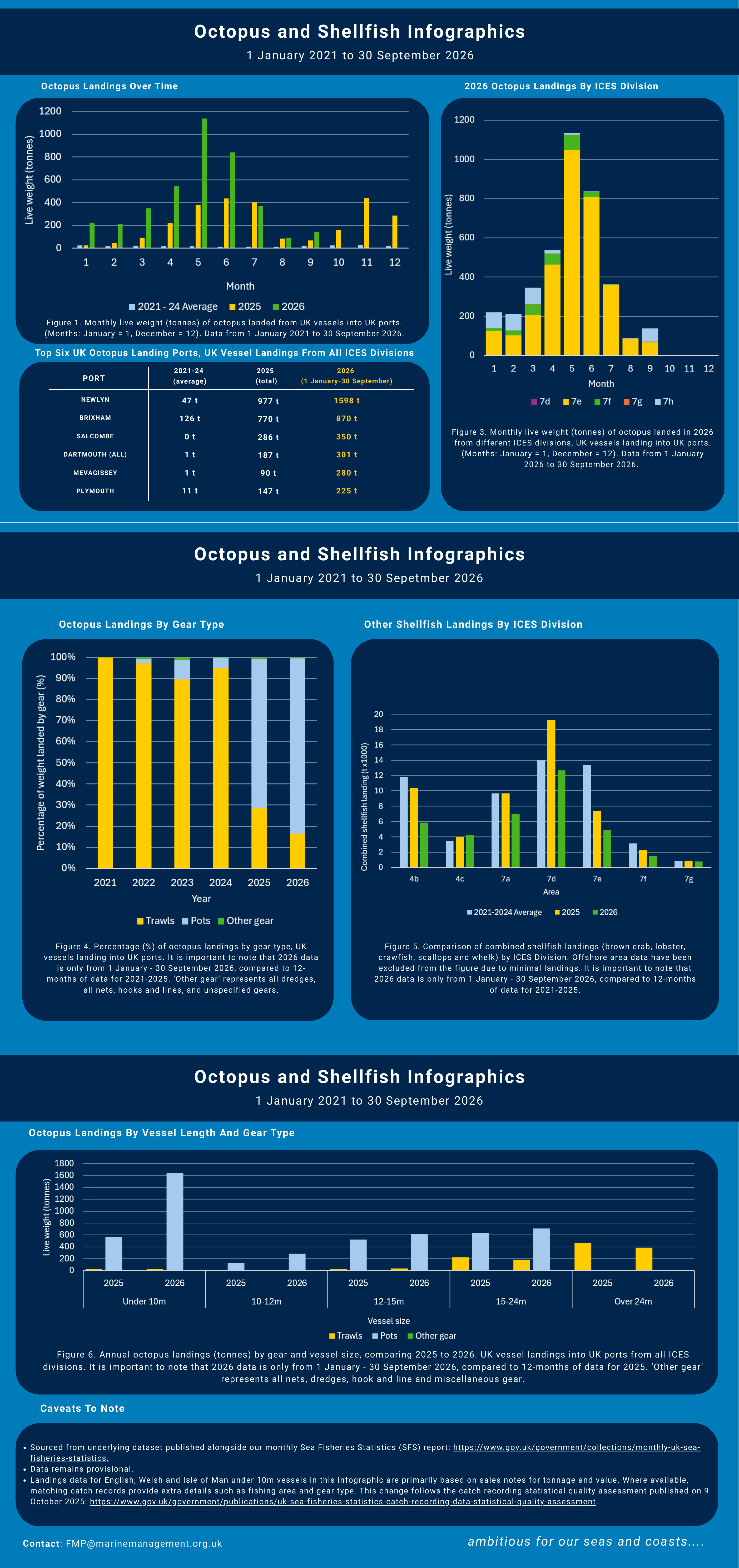
The infographic on this page is the MMO’s monthly octopus and shellfish data summary, covering 1 January 2021 to 30 September 2026. It is published on GOV.UK and updated each month after the MMO’s monthly sea fisheries statistics.
How much octopus is being landed in the UK?
UK boats landed more octopus in the first nine months of 2026 than in the whole of 2025, and 2025 was already more than ten times a normal year. The figures below are our sums of the MMO’s published landings datasets for UK vessels landing into UK ports. The 2026 figures are provisional.
| Year | Octopus landed (tonnes) | First sale value |
|---|---|---|
| 2021 | 254 | £0.56 million |
| 2022 | 265 | £0.76 million |
| 2023 | 233 | £0.62 million |
| 2024 | 138 | £0.46 million |
| 2025 | 2,587 | £15.3 million |
| 2026 (January to September) | 3,840 | £20.4 million |
Sources are the MMO’s UK sea fisheries annual statistics 2025 dataset for 2021 to 2025 and its 2026 provisional landings dataset for 2026. Vessels from Jersey, Guernsey and the Isle of Man are left out. In October 2026 Defra said UK octopus landings had risen by nearly 1,500% since 2021, from an annual average of around 220 tonnes to over 3,700 tonnes.
The infographic’s monthly chart shows how the catch peaks. In May 2026 alone, UK boats landed about 1,140 tonnes, more than five times the usual total for a whole year before the bloom (our calculation). Landings dropped to under 150 tonnes a month in August and September 2026. In 2025 they rose again in October and November after a similar summer dip.
Prices held up as volumes grew. The average first sale price in 2025 was about £5.91 a kilo, against £3.37 a kilo in 2024 (our calculation from the same MMO data). In the first nine months of 2026 it was about £5.31 a kilo.
Where is octopus being landed?
Newlyn in Cornwall and Brixham in Devon take most of the catch. The MMO infographic lists the top six ports for octopus landed by UK vessels.
| Port | 2021 to 2024 (yearly average) | 2025 | 2026 (to 30 September) |
|---|---|---|---|
| Newlyn | 47 t | 977 t | 1,598 t |
| Brixham | 126 t | 770 t | 870 t |
| Salcombe | 0 t | 286 t | 350 t |
| Dartmouth (all) | 1 t | 187 t | 301 t |
| Mevagissey | 1 t | 90 t | 280 t |
| Plymouth | 11 t | 147 t | 225 t |
Every one of these ports had passed its 2025 total by the end of September 2026. Newlyn’s landings in those nine months were 34 times its average year before the bloom (our calculation). Salcombe, Dartmouth and Mevagissey landed almost no octopus before 2025.
Almost all of the 2026 catch came from ICES division 7e, the western English Channel, which runs along the south coast of Devon and Cornwall. Smaller amounts came from division 7h, south-west of Cornwall, and from the Bristol Channel (7f).
Why are there so many octopus off Cornwall and Devon?
Warm water is the most consistent factor. The MBA-led report found that unusually warm sea temperatures in the bloom year, and in the year before it, were present in all of the recorded UK blooms.
The same team found that steady easterly winds may have carried young octopus larvae across from the Channel Islands and northern France. Their ocean current modelling suggests larvae from Guernsey, which has had its own octopus bloom since 2024, probably added to the numbers off the UK.
Octopus also bred in UK waters in 2025, which the researchers say was previously very rare, and fishers reported juveniles in their catches. The report says blooms like this one could become a more regular part of UK seas if the warm conditions continue.
How has octopus fishing changed?
Octopus used to be a small bycatch for trawlers and is now a targeted pot fishery for small inshore boats. Between 2017 and 2024, trawlers landed 97% of UK octopus by weight, according to an MMO feasibility study finished just before the bloom was recognised. The best year in that period was 2019, with 325 tonnes.
Pots took about 70% of UK octopus landings in 2025 and 83% in the first nine months of 2026 (our sums of MMO data, matching the infographic’s gear chart). Boats of 10 metres and under using pots landed about 1,640 tonnes in those nine months, the largest group by far. The infographic’s vessel chart shows boats over 24 metres catching octopus only by trawling.
The common octopus is a non-quota species in England. The MMO’s species ID card sets a minimum landing weight of 750g for common octopus, with no closed season and no catch limit. The curled octopus has no minimum weight.
Selling the catch has been one of the open questions. The MMO feasibility study put the UK market for octopus through restaurants and fishmongers at around 1 tonne a day, with export buyers thought able to take 4 to 5 tonnes a day or more.
How does the octopus bloom affect crab, lobster and scallops?
Octopus eat crabs, lobsters and scallops, and fishers in the South West say they have lost much of their usual catch. The MBA-led report says catch rates for brown crab, lobster and scallops fell by 30% to 50% in 2025. The MMO feasibility study notes that octopus take crabs and lobsters from pots and eat dogfish eggs.
Landings in the western English Channel fell over the same period. These are our sums of the MMO’s 2025 annual dataset for UK vessels landing into UK ports from ICES division 7e.
| Species | 2021 to 2024 (yearly average) | 2025 | Change |
|---|---|---|---|
| Brown crab | 2,792 t | 1,388 t | -50% |
| Scallops | 8,013 t | 3,872 t | -52% |
| Lobster | 280 t | 208 t | -26% |
| Whelks | 1,564 t | 1,452 t | -7% |
Landings depend on how much boats fish as well as on stock levels, and some crews moved from crab to octopus pots, so these totals are not a direct measure of how many shellfish octopus ate. The MBA researchers say working out the full effect on crab, lobster and scallop stocks needs more research and monitoring.
In an MMO survey in March 2026, 19 of the 21 fishers who gave financial details reported losses caused by octopus eating their target stocks. Their self-reported loss of income ranged from about 10% to 100%, with a median of about 59%. Three respondents said octopus had been profitable for them. More than half of the fishers who answered the support question (29 of 40) asked for financial help.
At a Defra conference on 15 October 2026, fishers said shellfish stocks had been decimated by octopus and raised concerns about more boats working the same grounds.
What is the government doing about the octopus bloom?
The MMO is monitoring landings, collecting evidence and working with fishers on how the new fishery should be managed. There is no catch limit for common octopus so far. Its main steps listed on GOV.UK are below.
- A monthly octopus and shellfish landings summary, the infographic on this page.
- An online portal where divers, anglers and the public can report octopus sightings.
- An Octopus Management Group to advise on a long-term strategy, and an Octopus Science Group to coordinate research.
- Regular market sampling of octopus at Brixham and Newlyn, now run by Cornwall IFCA, Devon and Severn IFCA and the Cornish Fish Producers’ Organisation.
- Talks with Jersey and Guernsey on sharing data.
Both octopus species are already covered by two fisheries management plans, for the Channel and the southern North Sea, which include actions to monitor and research them. Fishers can apply for grants for octopus-related projects through the Fisheries and Seafood Scheme, which is funded from the £304 million Fishing and Coastal Growth Fund.
Questions about the octopus bloom
Is the octopus bloom still happening?
Octopus were still being landed in large numbers in 2026, though the catch varies a lot by season. UK boats landed over 1,100 tonnes in May 2026, then landings fell to under 150 tonnes a month in August and September 2026, according to MMO data. In 2025 they rose again in October and November.
Has there been an octopus bloom in the UK before?
The Marine Biological Association lists earlier major blooms in 1899 to 1900, 1932 to 1933 and 1950 to 1951. The current bloom, which began in 2025, is the largest for at least 75 years.
Do octopus eat crabs and lobsters?
Crabs and lobsters are among the common octopus’s prey, and fishers in Cornwall and Devon report octopus taking them from their pots. Researchers recorded 30% to 50% lower catch rates for brown crab, lobster and scallops in 2025.
Where in the UK are octopus being found?
Mostly in the western English Channel off Cornwall and Devon. Newlyn, Brixham, Salcombe, Dartmouth, Mevagissey and Plymouth landed the most octopus in 2026. The MMO asks anyone who spots an octopus to report it through its online portal so it can see whether they are spreading to new areas.
Is there a size limit for catching octopus in the UK?
Common octopus has a minimum landing weight of 750g in England, according to the MMO. It is a non-quota species with no closed season and no catch limit. The curled octopus has no minimum weight.
Sources
- Marine Management Organisation, MMO updates on the octopus bloom, updated November 2026, including the Octopus and Shellfish Landings Data Summary, September 2026 (the infographic on this page) and the stakeholder survey analysis
- Marine Management Organisation, UK sea fisheries annual statistics report 2025, landings dataset 2021 to 2025
- Marine Management Organisation, 2026 UK and foreign vessels landings by UK port, provisional data, January to September 2026
- Marine Management Organisation, Feasibility of a potential emergent octopus fishery (MMO1440), June 2025
- Marine Management Organisation, Fisheries management plan updates, species ID card for octopus
- Defra and MMO, Octopus explosion off South West prompts talks between fishermen and scientists, 16 October 2026
- Marine Biological Association, Octopus bloom off Southwest UK, new report reveals scale, causes and consequences
Landing totals, prices, port multiples and percentage changes marked as our sums or calculations come from the MMO datasets above. The MMO is not responsible for them. Contains public sector information published by the Marine Management Organisation and licensed under the Open Government Licence v3.0. The three pages of the MMO summary are shown together as one image with the MMO logo removed, and nothing else changed. Its use here does not imply any endorsement by the MMO.