Which country flags have religious symbols?
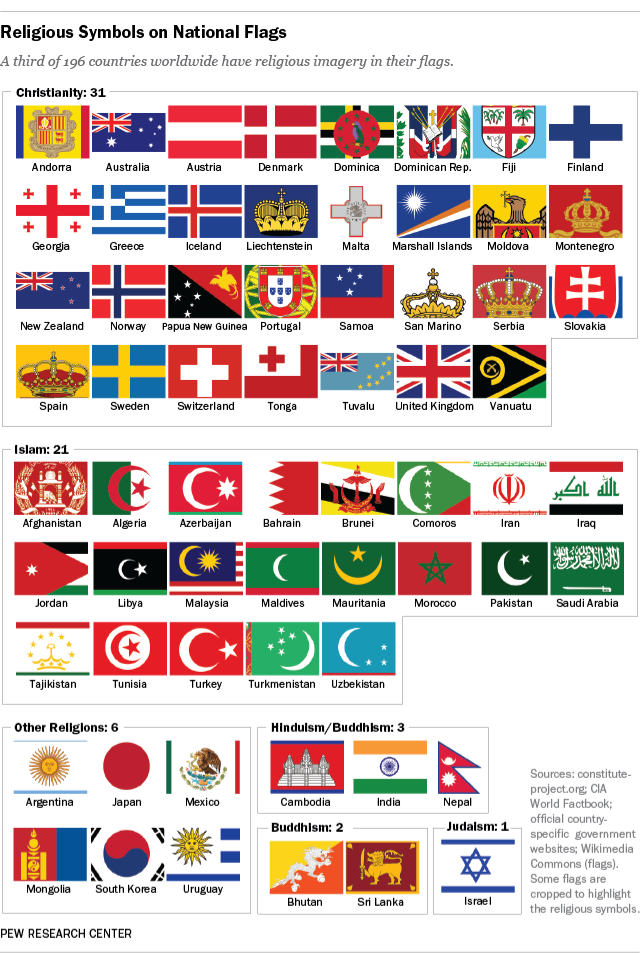
About a third of the world’s countries have flags with religious symbols. Pew Research Center counted 64 of 196 national flags with religious imagery in its study. 31 carry Christian symbols, mostly crosses, and 21 carry Islamic symbols such as the crescent and star or Arabic script. Five have Buddhist or Hindu symbols, Israel’s has the Star of David, and six use symbols from other traditions, such as Japan’s sun.
Pew’s researcher Angelina E. Theodorou built the count from national constitutions on constituteproject.org, the CIA World Factbook and official government websites, coding a flag as religious when those sources link a symbol on it to a faith [1][2]. The Pew Research Center infographic that goes with this article groups every flag by religion, with some flags cropped to the emblem that counts.
| Religion | Flags | Countries |
|---|---|---|
| Christianity | 31 | Andorra, Australia, Austria, Denmark, Dominica, Dominican Republic, Fiji, Finland, Georgia, Greece, Iceland, Liechtenstein, Malta, Marshall Islands, Moldova, Montenegro, New Zealand, Norway, Papua New Guinea, Portugal, Samoa, San Marino, Serbia, Slovakia, Spain, Sweden, Switzerland, Tonga, Tuvalu, United Kingdom, Vanuatu |
| Islam | 21 | Afghanistan, Algeria, Azerbaijan, Bahrain, Brunei, Comoros, Iran, Iraq, Jordan, Libya, Malaysia, Maldives, Mauritania, Morocco, Pakistan, Saudi Arabia, Tajikistan, Tunisia, Turkey, Turkmenistan, Uzbekistan |
| Hinduism and Buddhism | 3 | Cambodia, India, Nepal |
| Buddhism | 2 | Bhutan, Sri Lanka |
| Judaism | 1 | Israel |
| Other religions | 6 | Argentina, Japan, Mexico, Mongolia, South Korea, Uruguay |
The list dates from November 2014 [1]. Two of the flags have changed since then, but both still carry Islamic symbols, so the count of 64 holds. Mauritania added red bands to the top and bottom of its green crescent and star flag in 2017 [5]. Afghanistan’s Taliban government replaced the black, red and green flag with a mosque emblem by a white flag bearing the black Shahada in August 2021 [6].
Christian symbols on national flags
The cross is the most common religious symbol on any national flag. Pew found Christian symbols on 31 flags across Europe, Asia and the Pacific and the Americas [1], and nearly all of them use a cross in some form.
- The Nordic cross, set off-centre towards the hoist, is shared by Denmark, Finland, Iceland, Norway and Sweden. Switzerland, Greece, Georgia, Tonga and Malta also show crosses.
- The Union Jack combines the crosses of St George, St Patrick and St Andrew, and Commonwealth countries including Australia, New Zealand, Fiji and Tuvalu still carry it in a corner of their flags [1].
- Several flags carry a coat of arms or crown topped with a cross, such as Spain, Portugal, Andorra, Liechtenstein, Montenegro, Serbia, San Marino, Moldova and the Dominican Republic, whose arms sit on a white cross. Slovakia’s shield has a double cross.
- Dominica’s flag has a cross in three colours, which its government says represents the Holy Trinity [2].
Some entries rely on the meaning a government gives a design rather than an obvious religious emblem. The Marshall Islands says the star on its flag represents the cross of Christianity, with one point for each municipality [2]. Vanuatu’s yellow Y shape stands for the light of the Gospel spreading through the islands [2]. Austria’s plain red, white and red flag is counted because of the tradition that it comes from Duke Leopold V’s blood-stained tunic after a battle in the Third Crusade [2].
Islamic symbols on national flags
21 national flags carry Islamic symbols, spread across the Middle East and North Africa, sub-Saharan Africa and Asia [1]. The crescent and star is the best known of them, and Pew names Algeria, Turkey, Brunei and Uzbekistan as examples [1]. Others include Azerbaijan, Libya, Malaysia, Mauritania, Pakistan, Tunisia, Turkmenistan, the Maldives and the Comoros.
The second common type of Islamic symbol is writing. Saudi Arabia’s flag carries the Shahada, the declaration of faith, above a sword [2]. Iraq’s flag has the takbir, “God is great”, in green Arabic script, and Iran’s flag repeats it 22 times along the edges of its green and red stripes [2]. Afghanistan’s current flag is the Shahada in black on white [6]. Bahrain’s flag is the most indirect. Its five white points stand for the Five Pillars of Islam [1].
Green is often linked to Islam too, but colour alone isn’t how Pew counted a flag. A crescent can also be secular. Singapore’s flag has a crescent and five stars, but its government says the crescent stands for a young nation on the rise and the stars for democracy, peace, progress, justice and equality, so Pew left it out [1].
Buddhist, Hindu and Jewish symbols on flags
Five flags carry Buddhist or Hindu symbols, and in three of them the symbol belongs to both religions [1]. Cambodia’s flag shows Angkor Wat, a temple linked to both Hinduism and Buddhism. Nepal’s crimson double pennant carries a moon and a sun, which the CIA World Factbook says are now understood to stand for Hinduism and Buddhism, the country’s two main religions [2]. India’s blue chakra in the centre of its flag has meaning for Hindus and Buddhists alike, and Pew corrected an earlier version of its article that called it a Hindu symbol only [1].
Bhutan’s flag is Buddhist. Its constitution says the orange half represents the spiritual tradition and the flourishing of Buddhist teaching, and the white thunder dragon gives the country its name [2]. Sri Lanka’s lion flag counts because its tail represents the Noble Eightfold Path of Buddhism, and the bo leaves in the corners are Buddhist symbols too [2].
Israel is the only country with Jewish symbols on its flag. The Star of David sits between two blue stripes on white, a design Pew says represents a traditional Jewish prayer shawl [1].
Flags with symbols from other religions
Six national flags carry symbols linked to other religious traditions, most of them older than the modern state that uses them [1].
- Japan’s red disc, the hinomaru or rising sun, is linked to Shinto spiritual roots in the former Japanese empire [1].
- Argentina and Uruguay both show the Sun of May, which Pew links to the Inca sun god Inti [1].
- Mexico’s eagle on a cactus with a snake in its beak shows the sign the Aztec god Huitzilopochtli was said to have given the Aztecs, telling them where to build Tenochtitlan [1].
- Mongolia’s flag carries the Soyombo, a column of symbols for fire, sun, moon, earth and water with a yin-yang symbol [2].
- South Korea’s Taegeukgi has the taegeuk circle and four trigrams for heaven, earth, water and fire, drawn from East Asian philosophy [2].
US flags with religious symbols
The US national flag has no religious symbols, but several state flags do [1]. Pew points to New Mexico’s red Zia sun, which represents the spiritual history of the Zia Pueblo, and to the St Andrew’s cross adapted on the flags of Alabama and Florida [1]. Since Pew’s analysis, Mississippi has adopted a new flag. Its 2021 design has a magnolia blossom with the words “In God We Trust” underneath, and the law that set up the redesign required the motto to be included [7].
Flags of religions themselves
Separate from national flags, several religions have their own flags. These are flown at places of worship, festivals and processions rather than by governments.
- The Buddhist flag, with bands of blue, yellow, red, white and orange, was designed in Sri Lanka in the late 19th century as a universal symbol of Buddhism and was adopted by the World Fellowship of Buddhists [8].
- The Christian Flag, a white field with a red Latin cross on a blue canton, was first shown in the United States in 1897 and is used mainly by Protestant churches [9].
- The Nishan Sahib is the Sikh flag, a triangular saffron or navy blue flag with the Khanda emblem, flown above gurdwaras [10].
Islam and Judaism have no single religious flag in the same sense. The Star of David is the best-known Jewish symbol, and plain green or black banners with the Shahada are used in many Muslim countries, but none is a recognised flag of the religion as a whole.
Questions about flags with religious symbols
How many countries have religious symbols on their flags?
Pew Research Center counted 64 of the world’s 196 countries, about a third, with religious symbols on their national flags. 31 are Christian, 21 Islamic, three Hindu and Buddhist, two Buddhist, one Jewish and six from other traditions [1].
Which country flags have a cross?
Flags with a cross include Denmark, Finland, Iceland, Norway, Sweden, Switzerland, Greece, Georgia, Tonga, Malta, Dominica and the Dominican Republic, plus the United Kingdom and the Commonwealth flags that include the Union Jack, such as Australia, New Zealand, Fiji and Tuvalu [1].
Which flags have Islamic symbols?
Pew counted 21, including Algeria, Turkey, Pakistan, Malaysia and Tunisia with a crescent and star, and Saudi Arabia, Iraq, Iran and Afghanistan with religious script [1][2].
Is the crescent moon on a flag always religious?
No. Singapore’s crescent and stars have no religious meaning according to its government, which is why Pew left Singapore out [1].
Which country has the Star of David on its flag?
Israel is the only country with Jewish symbols on its national flag, the Star of David between two blue stripes [1].
Does the American flag have religious symbols?
No, but some state flags do, including New Mexico’s Zia sun, the St Andrew’s cross on Alabama’s and Florida’s flags, and the “In God We Trust” motto on Mississippi’s flag [1][7].
Sources
- Angelina E. Theodorou, Pew Research Center, 64 countries have religious symbols on their national flags (25 November 2014), the creator’s original article for this graphic.
- Pew Research Center, National symbol coded text, the data file with the source text for each flag.
- Constitute Project, the world’s constitutions, one of Pew’s sources.
- CIA, The World Factbook, one of Pew’s sources.
- Wikipedia, Flag of Mauritania.
- Wikipedia, Flag of Afghanistan.
- Wikipedia, Flag of Mississippi.
- Wikipedia, Buddhist flag.
- Wikipedia, Christian flag.
- Wikipedia, Nishan Sahib.
Last reviewed 13 November 2026