Animals kill about 1.5 million people a year, according to Our World in Data, but almost all of those deaths come from disease rather than attacks. Mosquitoes are the deadliest animal by far, killing around 760,000 people a year through malaria and other diseases. Humans come second at about 600,000, then snakes at about 100,000 and dogs, mostly through rabies, at about 40,000.
Which animals kill the most humans?
The mosquito kills more people than any other animal, followed by humans themselves, snakes and dogs. Our World in Data (OWID) brought together the best current estimates in 2026, and says that while the figures carry a lot of uncertainty, it is confident about the relative order of magnitude across the animals [1][2].
Bill Gates made the same point in 2014 with the infographic shown here, published on his GatesNotes blog for Mosquito Week [3]. Its figures are older and in several places quite different, so the table compares the two.
| Animal | Humans killed per year (OWID, 2026) | GatesNotes figure (2014) | How it kills |
|---|---|---|---|
| Mosquito | 760,000 | 725,000 | Malaria, dengue and other diseases |
| Human | 600,000 | 475,000 | Homicide, war and conflict |
| Snake | 100,000 | 50,000 | Venom |
| Dog | 40,000 | 25,000 | Mostly rabies |
| Freshwater snail | 14,000 | 10,000 | Schistosomiasis |
| Kissing (assassin) bug | 8,000 | 10,000 | Chagas disease |
| Sandfly | 5,000 | Not listed | Leishmaniasis |
| Roundworm | 4,000 | 2,500 | Ascariasis |
| Scorpion | 3,000 | Not listed | Venom |
| Tapeworm | 2,000 | 2,000 | Cysticercosis |
| Tsetse fly | 1,500 | 10,000 | Sleeping sickness |
| Elephant | 1,000 | 100 | Attacks |
| Bees, wasps and hornets | 500 | Not listed | Stings |
| Big cats (lions, tigers, leopards) | 300 | 100 (lions) | Attacks |
| Crocodile | More than 150 | 1,000 | Attacks |
| Jellyfish | 100 | Not listed | Stings |
| Hippopotamus | Around 50 | 500 | Attacks |
| Bear | 20 | Not listed | Attacks |
| Shark | 6 | 10 | Attacks |
| Grey wolf | 5 | 10 | Attacks and rabies |
Sources: Our World in Data deadliest animals methodology [2] and GatesNotes [3]. The GatesNotes graphic itself warns that all its calculations have wide error margins.
Why mosquitoes are the deadliest animal
Mosquitoes kill by spreading disease. OWID puts their toll at about 760,000 deaths a year, and more than 80% of those are from malaria, carried by the Anopheles mosquito [1]. Its methodology adds up 669,960 malaria deaths, 52,677 from dengue, about 25,000 from Japanese encephalitis and smaller numbers from yellow fever, chikungunya, West Nile virus and Zika for 2023 [2].
The World Health Organization’s own malaria estimate is a little lower, at 610,000 deaths in 2024 from 282 million cases [4]. The WHO African Region had 95% of those deaths, and children under 5 made up about 75% of malaria deaths in that region [4]. Gates wrote in 2014 that malaria killed more than 600,000 people a year, and that mosquitoes kill 50,000 times as many people as sharks [3].
The good news is that mosquito deaths are preventable. Bednets, insecticide sprays and malaria medicines all work, and OWID notes that if mosquito deaths fell to zero, the total killed by other animals would be almost six times smaller [1].
Humans killing humans
About 600,000 people a year are killed by other people, which makes humans the second deadliest animal. OWID’s figure counts only direct deaths from violence and conflict, built on the Global Burden of Disease estimates of about 436,000 deaths from interpersonal violence, 159,000 from conflict and terrorism and 9,000 from police conflict and executions [2].
This number moves a lot from year to year with wars. OWID notes that the Uppsala Conflict Data Program counted around 160,000 conflict deaths in 2023 but around 310,000 in 2022 [2]. The GatesNotes figure of 475,000 was close to the homicide count alone, and the UN Office on Drugs and Crime puts homicides at 420,000 to 450,000 a year over the last decade [2].
Snakes and dogs
Snakes are the deadliest animal that kills directly. The WHO estimates that 81,410 to 137,880 people die from snakebites each year, and that around three times as many suffer amputations or other permanent disability [5]. Most snakebites happen in Africa, Asia and Latin America, and agricultural workers and children are the most affected [5]. OWID uses about 100,000, double the 50,000 on the 2014 graphic, and points out that snakes kill more people than all the animals below them on the list combined [1].
Dogs kill mainly through rabies rather than bites. The WHO says dog bites and scratches cause 99% of human rabies cases, that rabies kills tens of thousands of people a year, mainly in Asia and Africa, and that 40% of victims are children under 15 [6]. One model it cites puts the toll at 44,203 deaths a year, though the true number is uncertain because cases are underreported [6]. Once symptoms appear rabies is fatal, but prompt treatment after a bite or scratch prevents it [6].
Parasites and insects that spread disease
Several of the deadliest animals are small creatures that carry parasites. The WHO estimates 14,353 deaths a year from schistosomiasis, spread by freshwater snails [7], and more than 10,000 a year from Chagas disease, spread by triatomine (kissing) bugs [8].
Sleeping sickness is a success story, and this is where the 2014 graphic is most out of date. It gave tsetse flies 10,000 deaths a year, but the WHO says new cases have fallen by 97% in the last 20 years and have stayed under 1,000 a year since 2018 [9]. OWID now puts the death toll at about 1,500 a year [2].
Large animals that people fear
Sharks, wolves, lions and bears kill very few people. OWID estimates 6 shark deaths a year, based on 54 fatal attacks logged by the International Shark Attack File from 2010 to 2019, and 5 a year from grey wolves [2]. Big cats kill around 300 people a year, about 100 each from lions, tigers and other large cats such as leopards [2].
Elephants are more dangerous than they look, at around 1,000 deaths a year on OWID’s estimate [2]. Hippos are the opposite. The figure of 500 a year, which the 2014 graphic uses, is widely repeated but poorly sourced, and OWID estimates around 50, citing a 2025 Zimbabwe study that recorded about 3 hippo deaths a year in that country [2]. Crocodiles kill more than 150 people a year, far fewer than the graphic’s 1,000 [2].
OWID’s explanation is exposure. Large predators are not less dangerous in an encounter, but it is much easier to avoid them than to avoid insects and parasites [1].
Questions about human deaths by animals
What single animal has killed the most humans?
The mosquito. It kills about 760,000 people a year through malaria and other diseases [1], more than any other animal including humans.
How many humans are killed by wild animals each year?
About 920,000 people a year are killed by animals other than humans, according to OWID. Mosquitoes account for 760,000 of those, so other animals kill around 160,000, and about 100,000 of that is from snakes [1].
Which animal kills almost 1,000 humans a year?
The elephant, at around 1,000 deaths a year on OWID’s estimate [2]. The 2014 GatesNotes graphic gives 1,000 a year for crocodiles, but OWID’s figure for crocodiles is now more than 150 [2][3].
How many people do sharks kill a year?
About 6 on average, based on 54 fatal attacks between 2010 and 2019 [2].
How many people do dogs kill a year worldwide?
About 40,000 on OWID’s estimate, mostly from rabies [2]. The WHO cites a model figure of 44,203 rabies deaths a year [6].
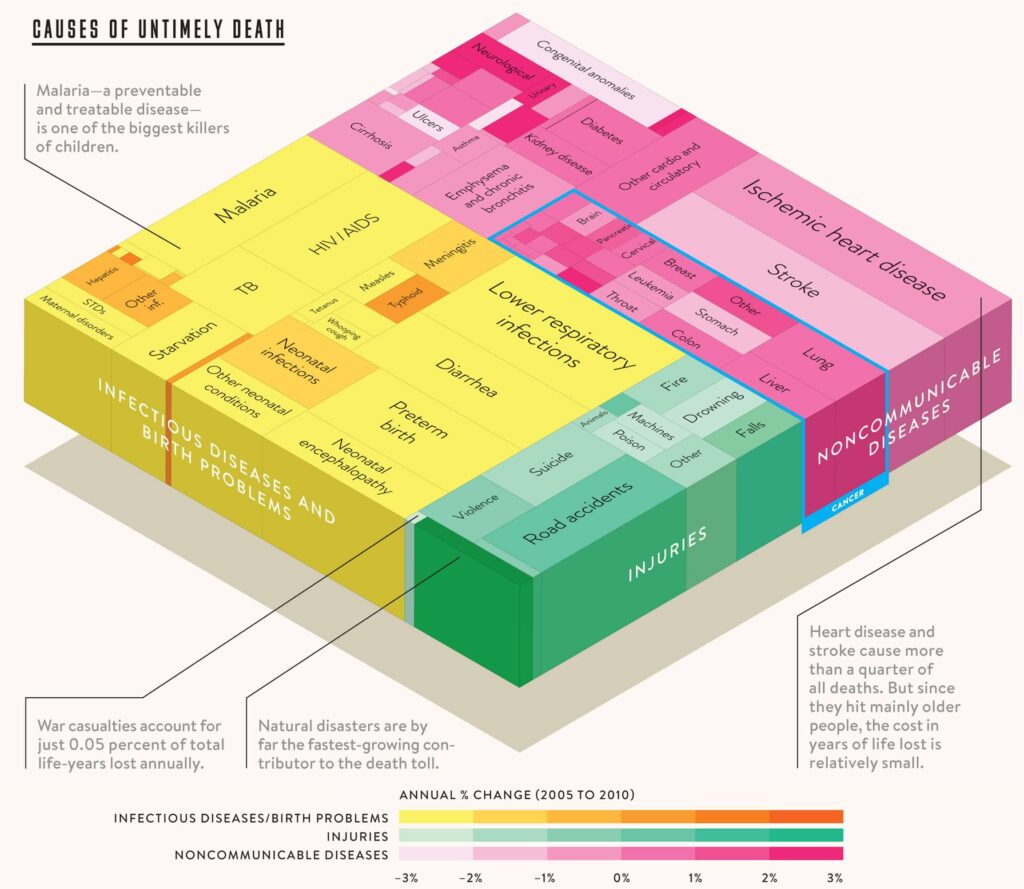
For a wider look at what people die from, see the infographic on causes of untimely death.
Sources
- Hannah Ritchie and Fiona Spooner, What are the world’s deadliest animals, and can we protect ourselves against them?, Our World in Data, 2026.
- Our World in Data, Deadliest animals methodology.
- Bill Gates, The Deadliest Animal in the World, GatesNotes, 25 April 2014 (archived copy). The original page for the infographic.
- World Health Organization, Malaria fact sheet.
- World Health Organization, Snakebite envenoming fact sheet.
- World Health Organization, Rabies fact sheet.
- World Health Organization, Schistosomiasis fact sheet.
- World Health Organization, Chagas disease fact sheet.
- World Health Organization, Human African trypanosomiasis (sleeping sickness) fact sheet.
Last reviewed 14 November 2026