

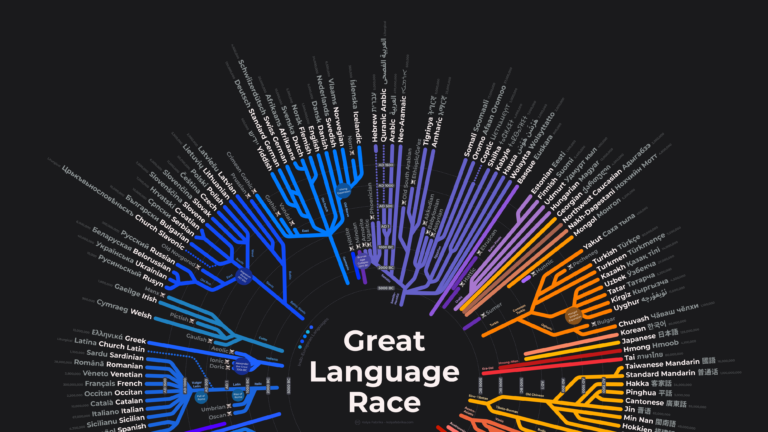
The 16 infographics here fall into three groups. The largest traces where words come from, with the origins of colour names, flower names, car brands, currencies, Nintendo characters and colour surnames. A second group counts and maps languages, covering native speaker totals, language family trees, how fast languages are spoken and which languages websites use. A third ranks countries by English proficiency. Smaller pieces cover Hindi kinship terms, Christmas greetings in 58 languages and the phrase "top banana".
For word origins, begin with two charts by Adam Aleksic, the Etymology Nerd. How Colors Got Their Names, the Origins of 33 Color Words shows that most colours are named after something that had the colour, and six trace back to places, including turquoise (Turkey) and sienna (Siena). How Flowers Got Their Names, the Origins of 24 Flower Names finds that three flowers honour real people: begonia, dahlia and poinsettia.
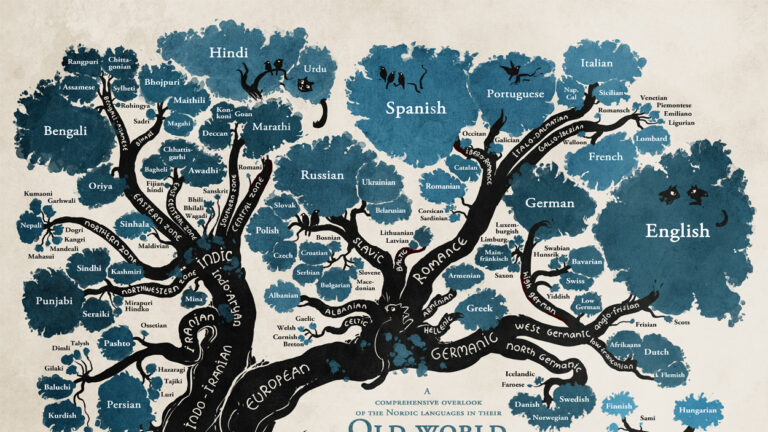
For speaker numbers, the World Languages Map of the 23 Most Spoken Native Tongues by Alberto Lucas López for the South China Morning Post shows 23 languages that are together the mother tongue of 4.1 billion people, led by Chinese with 1,197 million native speakers. The Old World Language Families Tree by Minna Sundberg, drawn for her webcomic Stand Still. Stay Silent, places Finnish and Estonian on the Uralic tree, separate from Swedish and Danish in the Indo-European family.
For English around the world, EF Education First's English Proficiency in Europe, EF EPI Rankings Map puts the Netherlands first with a score of 636 on the 2024 index, while Turkey and Azerbaijan are the only two countries rated low. Visual Capitalist's Most Used Languages on the Internet Compared With Speakers shows English on 60.4% of the top 10 million websites, although 16.2% of the world's population speaks it. Chinese has the widest gap the other way, with 14.3% of speakers but 1.4% of websites.
Chinese, with 1,197 million native speakers, according to the World Languages Map by Alberto Lucas López for the South China Morning Post. Spanish follows with 399 million and English with 335 million.
The Netherlands, with a score of 647 in the 2023 EF English Proficiency Index, as shown on the Voronoi by Visual Capitalist map of the top 25 countries. Singapore (631) and Austria (616) come next.
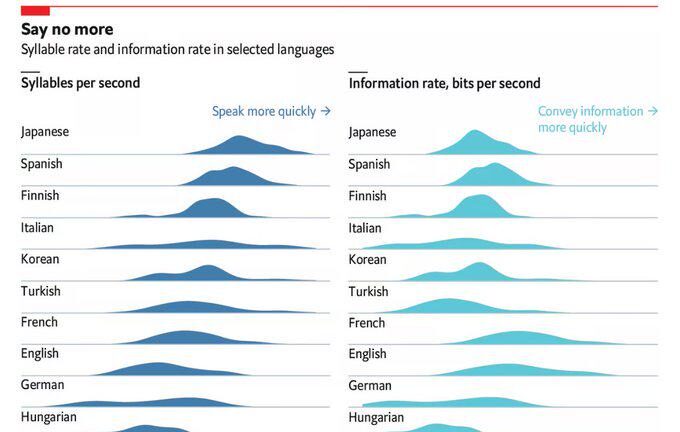
Not really, according to The Economist's chart of syllable rate and information rate. Japanese and Spanish are spoken fastest and Thai slowest, but once information per syllable is counted, all 14 languages convey roughly 39 bits per second.