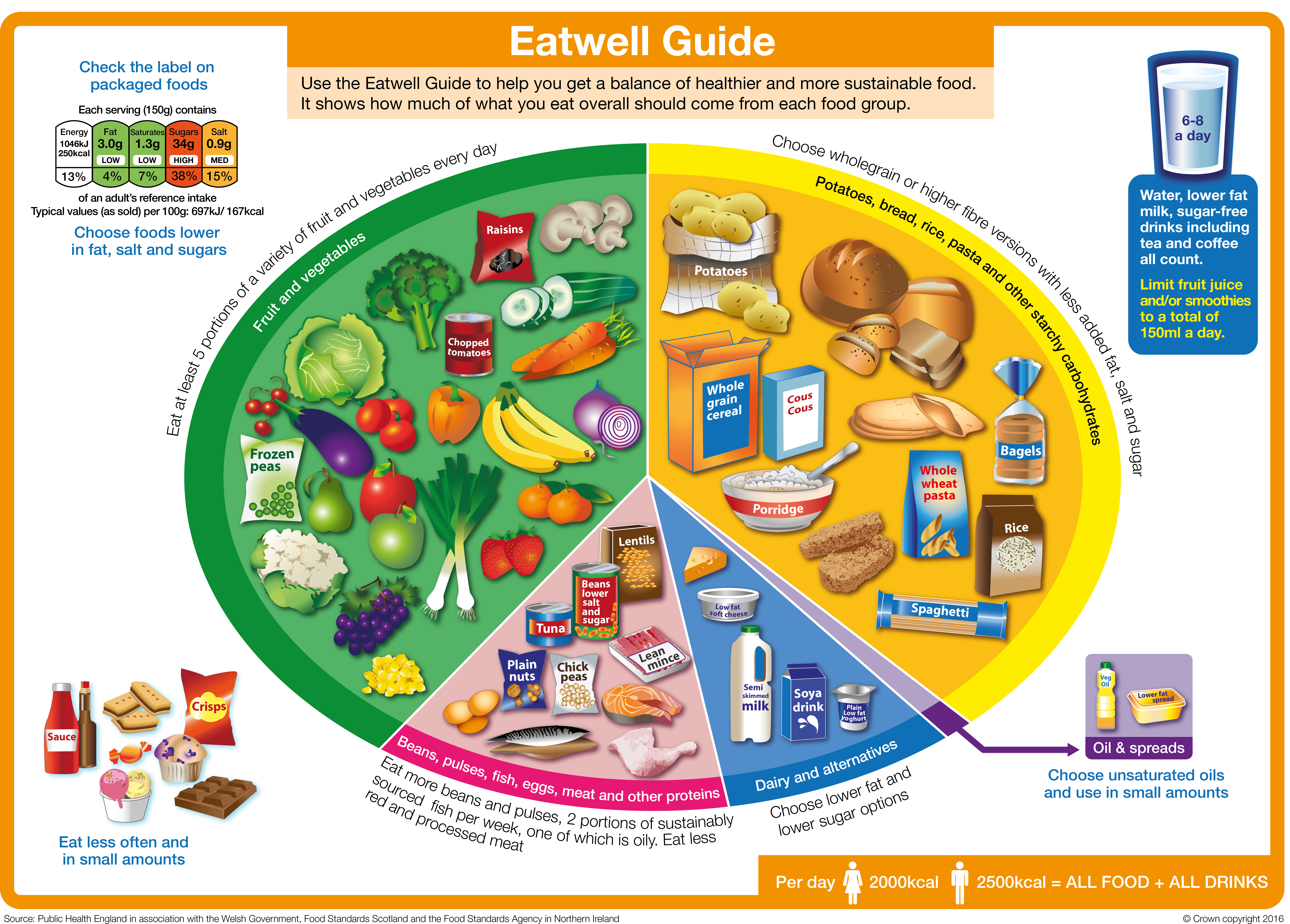
The Eatwell Guide is the UK government’s picture of a healthy, balanced diet. It splits what you eat into 5 food groups and shows how much of your overall diet should come from each. Fruit and vegetables make up about 40%, starchy foods 38%, proteins 12%, dairy and alternatives 8% and oils and spreads 1%, with 6 to 8 drinks a day and foods high in fat, salt and sugar kept to small amounts.
What is the Eatwell Guide?
It is the government’s official model of healthy eating, used across England, Scotland, Wales and Northern Ireland. The Office for Health Improvement and Disparities (OHID) describes it as “a visual representation of how different foods contribute towards a healthy balanced diet”. The guide was first published by Public Health England in March 2016, together with the Welsh Government, Food Standards Scotland and the Food Standards Agency in Northern Ireland, and it replaced the older eatwell plate. OHID took over the guide when Public Health England closed.
The guide is about your diet as a whole, not a single plate of food. The NHS says you do not need to get the balance right at every meal, but you should try to get it right over a day or even a week. That is why the infographic on this page shows everything you eat and drink, including snacks and drinks, rather than one meal.
What are the 5 food groups in the Eatwell Guide?
The 5 food groups are fruit and vegetables, starchy carbohydrates, proteins, dairy and alternatives, and oils and spreads. OHID’s guidance sets the size of each group, and says the proportions should stay as they are because they are consistent with the government’s recommendations for a diet that gives a healthy adult, or a child over 5, all the nutrients they need.
| Food group | Share of your diet | Examples | Main advice |
|---|---|---|---|
| Fruit and vegetables | 40% | Apples, bananas, carrots, broccoli, peas, tinned tomatoes | At least 5 portions of a variety every day |
| Potatoes, bread, rice, pasta and other starchy carbohydrates | 38% | Potatoes, wholemeal bread, brown rice, wholewheat pasta, porridge | Choose wholegrain or higher fibre versions |
| Beans, pulses, fish, eggs, meat and other proteins | 12% | Lentils, chickpeas, beans, eggs, salmon, chicken, lean mince | More beans and pulses, 2 portions of fish a week, less red and processed meat |
| Dairy and alternatives | 8% | Milk, cheese, yoghurt, soya drinks | Choose lower fat and lower sugar options |
| Oils and spreads | 1% | Vegetable, rapeseed or olive oil, lower fat spreads | Choose unsaturated types and use small amounts |
The shares come from OHID’s guidance and add up to 99% because of rounding. Foods high in fat, salt and sugar are not a food group at all. They sit outside the main oval because they are not needed as part of a healthy diet.
Fruit and vegetables, at least 5 A Day
Fruit and vegetables should make up just over a third of what you eat, and you should aim for at least 5 portions a day. The NHS 5 A Day guidance says 80g of fresh, tinned or frozen fruit and vegetables counts as 1 portion, and so does 30g of dried fruit. Fresh, frozen, tinned and dried all count, as do vegetables cooked into soups, stews and sauces.
A few things only count once a day, however much you have. Fruit juice, vegetable juice and smoothies count as 1 portion and should be kept to a combined 150ml a day, because juicing releases sugars that can damage teeth. Beans and pulses also count only once. Potatoes do not count at all, because they are a starchy food and belong in the yellow group, while sweet potatoes, parsnips, swedes and turnips do count.
Starchy foods and wholegrains
Starchy foods such as potatoes, bread, rice and pasta should make up just over a third of your diet, and the guide asks you to choose wholegrain or higher fibre versions with less added fat, salt and sugar. The NHS suggests including at least 1 starchy food with each main meal, and points out that gram for gram the carbohydrate in these foods has fewer than half the calories of fat. It is usually the oil, butter and creamy sauces added to them that push the calories up.
Wholegrains matter because of fibre. The government’s dietary recommendations set a fibre target of 30g a day for adults, with lower amounts for children (15g at 2 to 4 years, 20g at 5 to 10, 25g at 11 to 14 and 30g from 15). Wholemeal bread, brown rice, wholewheat pasta and potatoes eaten with their skins on all help you get there.
Beans, pulses, fish, eggs, meat and other proteins
This pink group makes up about 12% of the diet. The guide puts beans and pulses first in the name on purpose. Public Health England’s note on what changed in 2016 says the segment was renamed to highlight how much protein comes from non-meat sources, which can also be more environmentally sustainable.
- Fish. Aim for at least 2 portions a week, one of them oily, such as salmon, sardines, trout or mackerel. The NHS gives a portion as around 140g, and says fresh and canned tuna do not count as oily fish.
- Red and processed meat. The government’s advice is that if you eat more than 90g a day, you should cut down to 70g, as the National Diet and Nutrition Survey report sets out.
- Beans, lentils and chickpeas. The NHS says pulses are good alternatives to meat because they are low in fat and give you fibre as well as protein.
- Meat. Choose lean cuts and lean mince, and eat less bacon, ham and sausages.
Dairy and alternatives
Dairy and alternatives make up about 8% of the guide. Milk, cheese, yoghurt and fromage frais give you protein, some vitamins and calcium, which helps keep bones healthy. The NHS suggests lower fat and lower sugar versions where you can, such as semi-skimmed, 1% or skimmed milk, reduced fat cheese and plain low fat yoghurt. Soya drinks and yoghurts count too, and the same lower fat and lower sugar advice applies to them.
Oils and spreads
Oils and spreads are the smallest group at about 1%, and the advice is to choose unsaturated types and use them in small amounts. Vegetable, rapeseed, olive and sunflower oils are unsaturated, and so are lower fat spreads based on them. The group is tiny because all fats are high in calories, even the healthier ones. Butter and ghee are not in this group. The NHS lists them with the foods outside the main guide, because they are high in saturated fat.
Foods high in fat, salt and sugar
Foods such as chocolate, cakes, biscuits, crisps, sugary soft drinks, ice cream, butter and sauces sit outside the main guide, and the advice is to have them less often and in small amounts. Before 2016 some of these foods shared the purple segment with oils, which suggested they were part of a balanced diet. Public Health England moved them out of the main image after consumer research showed people understood their role better that way.
The limits behind this advice are specific. The NHS says adults and children aged 11 and over should have no more than 6g of salt a day, about a teaspoonful, and that about three quarters of the salt people eat is already in food when they buy it. The government’s dietary recommendations say free sugars should be under 5% of daily energy, which works out at less than 33g a day for men and 27g for women aged 19 to 64. Free sugars are sugars added to food and drink plus those in honey, syrups and fruit juices, not the sugars inside whole fruit or milk.
How much should you drink a day?
The Eatwell Guide recommends 6 to 8 cups or glasses of fluid a day. The NHS says water, lower fat milk and lower sugar or sugar-free drinks, including tea and coffee, all count, and that most people should drink enough for their pee to be a clear pale yellow. You may need more if you are pregnant or breastfeeding, in hot weather, active for long periods or unwell. Fruit juice and smoothies count as fluid too, but keep them to 150ml a day in total.
How many calories should you eat a day?
As a guide, women need around 2,000 calories a day and men around 2,500, which is the figure printed along the bottom of the Eatwell Guide. These match the government’s dietary recommendations for adults aged 19 to 64 (8,400 and 10,500 kilojoules). The guide counts all food and all drinks towards that total, including milky coffees and fruit juice.
Your own needs depend on your age, size and how active you are. The same recommendations give slightly lower figures for older adults, for example around 1,912 calories for women and 2,342 for men aged 65 to 74. The NHS says most adults in the UK eat more calories than they need.
How to use food labels with the Eatwell Guide
Food labels tell you whether a packaged food is high, medium or low in fat, saturated fat, sugars and salt, which helps you choose within each food group. Many front of pack labels use red, amber and green colour coding, and the Eatwell Guide shows an example of one. The NHS food labels guide gives the thresholds per 100g.
| Per 100g | High (red) | Low (green) |
|---|---|---|
| Total fat | More than 17.5g | 3g or less |
| Saturated fat | More than 5g | 1.5g or less |
| Total sugars | More than 22.5g | 5g or less |
| Salt | More than 1.5g | 0.3g or less |
Anything between the two is medium, or amber. Drinks use different thresholds. A good rule when choosing between 2 similar products is to go for more greens and ambers and fewer reds.
How the Eatwell Guide differs from the eatwell plate
The Eatwell Guide replaced the eatwell plate in March 2016 after a review of the evidence on carbohydrates and health by the Scientific Advisory Committee on Nutrition. Public Health England listed the main changes.
- The name changed and the knife and fork were removed, because people read the plate as advice for every meal.
- Drawn images replaced photographs of food, because people with poorer diets in testing preferred drawings.
- The segments were resized using modelling based on what people in the UK actually eat, to find the fewest changes needed to meet the recommendations.
- The purple segment now holds only oils and spreads, and foods high in fat, salt and sugar moved outside the main image.
- A hydration message was added, recommending 6 to 8 drinks a day.
- Segment names were changed to point people to more sustainable choices, such as beans and pulses in the protein group.
So if you remember a plate with cakes and sweets in the purple slice, that is the old version. The current Eatwell Guide is still the version in use today.
Who the Eatwell Guide is for
The guide applies to most people over the age of 2, whether you are a healthy weight or overweight, eat meat or are vegetarian, and whatever your ethnic background, according to the NHS. It does not apply to children under 2, who have different nutritional needs. After 2, the NHS says children should move towards eating the same foods as the rest of the family in the proportions shown, and OHID says the segment sizes are designed for adults and children over 5.
If you have a medical condition or special dietary needs, the NHS suggests checking with a registered dietitian on how to adapt it. The guide also works for mixed dishes such as pizza, lasagne or a sandwich. Work out which food groups the main ingredients come from and think about how they fit the overall balance.
How close is the UK to eating this way?
Not very close. The latest National Diet and Nutrition Survey, covering 2019 to 2023, found most people in the UK fall short of the main recommendations behind the Eatwell Guide.
| Recommendation | What adults actually do |
|---|---|
| At least 5 portions of fruit and vegetables a day | 3.3 to 3.7 portions on average, and 17% meet 5 A Day |
| At least 30g of fibre a day | 16.4g a day on average at 19 to 64, and 4% meet the target |
| Free sugars under 5% of energy | 10% of energy on average, and 19% meet the target |
| Saturated fat no more than 10% of energy | 12.6% of energy on average, and 82% go over |
Teenagers fare worse on fruit and vegetables. The survey found 11 to 18 year olds ate 2.8 portions a day on average and only 9% met 5 A Day. On meat, average intake of red and processed meat was below 70g a day in every age group, but 27% of men aged 19 to 64 ate more than 90g a day. The report notes that the fall in fruit and vegetable figures for adults is likely to be partly down to a change in the survey’s method, and may also reflect the pandemic and the cost of living.
Questions about the Eatwell Guide
What are the 5 parts of the Eatwell Guide?
The 5 parts are the 5 food groups. They are fruit and vegetables (about 40%), potatoes, bread, rice, pasta and other starchy carbohydrates (38%), beans, pulses, fish, eggs, meat and other proteins (12%), dairy and alternatives (8%) and oils and spreads (1%).
What are the 8 Eatwell guidelines for eating well?
The NHS 8 tips for healthy eating are to base meals on higher fibre starchy carbohydrates, eat lots of fruit and veg, eat more fish including a portion of oily fish, cut down on saturated fat and sugar, eat less salt (no more than 6g a day for adults), get active and be a healthy weight, do not get thirsty, and do not skip breakfast. They sit alongside the Eatwell Guide rather than being part of the graphic.
What defines a balanced diet?
In the UK, a balanced diet means eating a variety of foods from the 5 food groups in roughly the proportions the Eatwell Guide shows, over a day or a week. It also means the right amount of energy for how active you are, plenty of fluids, and only small amounts of foods high in fat, salt and sugar.
What are the 5 food groups and an example of each?
Fruit and vegetables, such as an apple or a portion of peas. Starchy carbohydrates, such as wholemeal bread or brown rice. Proteins, such as lentils, eggs or salmon. Dairy and alternatives, such as semi-skimmed milk or plain yoghurt. Oils and spreads, such as rapeseed oil.
Do potatoes count towards your 5 A Day?
No. The NHS counts potatoes as a starchy food, so they sit in the yellow group with bread, rice and pasta. Yams, cassava and plantain do not count either, but sweet potatoes, parsnips, swedes and turnips do.
Is the Eatwell Guide the same in Scotland, Wales and Northern Ireland?
Yes. The guide was produced by Public Health England in association with the Welsh Government, Food Standards Scotland and the Food Standards Agency in Northern Ireland, and the same graphic is used across the whole UK.
Is the Eatwell Guide suitable for vegetarians?
The NHS says it applies whether you eat meat or are vegetarian. Beans, pulses, eggs and other non-meat proteins are part of the protein group, and soya drinks and yoghurts count in the dairy and alternatives group. Anyone with special dietary needs can ask a registered dietitian how to adapt it.
Sources
- Office for Health Improvement and Disparities, The Eatwell Guide (the infographic on this page, colour JPG edition) and The Eatwell Guide, how to use in promotional material
- Public Health England, The Eatwell Guide, how does it differ to the eatwell plate and why?, March 2016
- Public Health England, Government Dietary Recommendations, August 2016
- OHID and Food Standards Agency, National Diet and Nutrition Survey 2019 to 2023 report
- NHS, The Eatwell Guide, 5 A Day, what counts?, 8 tips for healthy eating, Water, drinks and hydration, Food labels and Fish and shellfish
The Eatwell Guide is © Crown copyright 2016, and its source is OHID in association with the Welsh Government, Food Standards Scotland and the Food Standards Agency in Northern Ireland. Contains public sector information licensed under the Open Government Licence v3.0. The infographic is reproduced unchanged and carries no departmental logo. Its use here does not imply any endorsement by OHID. This page is general information, not medical or dietary advice.