The basic do’s and don’ts in Germany
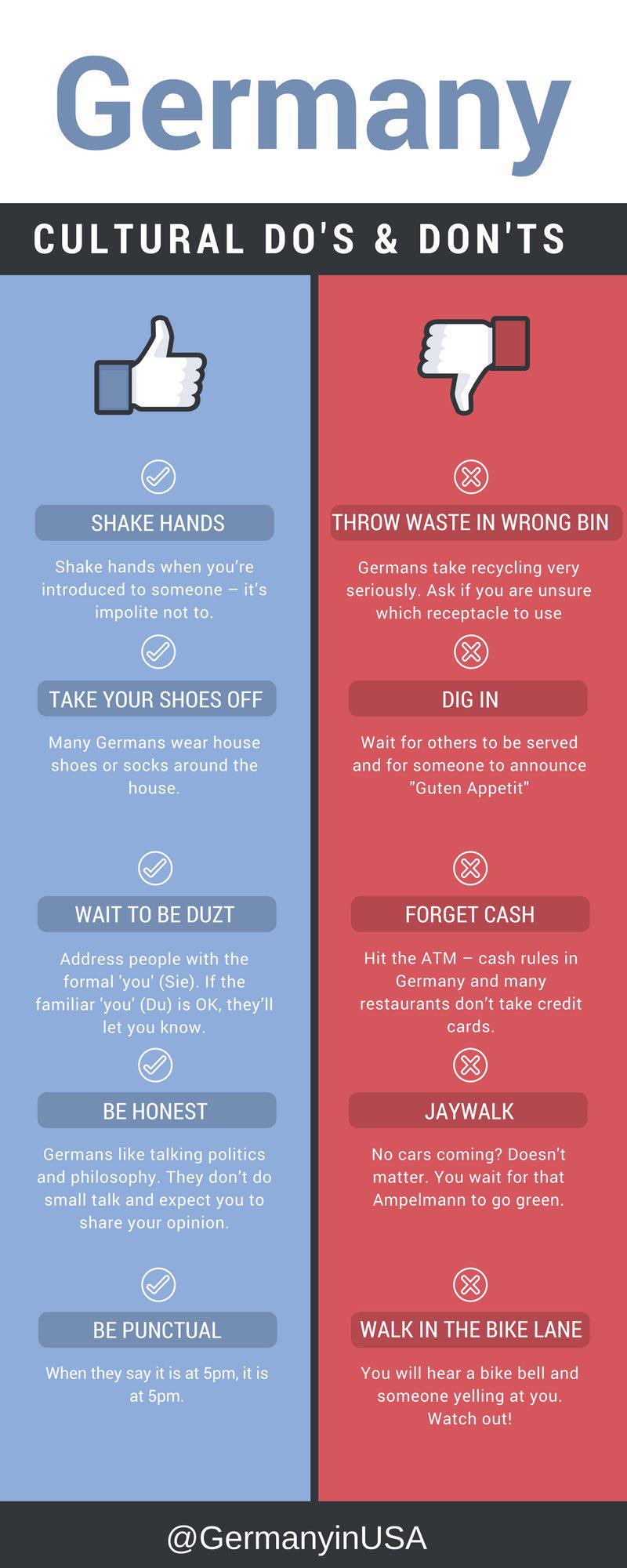
Most German etiquette comes down to a few habits: be on time, be direct, respect other people’s quiet and privacy, and follow the shared rules even when nobody is watching. The German Embassy in Washington put its own short list together for American visitors in 2017, the infographic on this page, and the tips on it still match what German and cultural guides tell visitors today [1][3][4].
The do’s on the embassy’s list are to shake hands, take your shoes off in people’s homes, use the formal Sie until you are invited to use du, be honest and be punctual. The don’ts are to put rubbish in the wrong bin, start eating before everyone is served, rely on paying by card, cross on a red light and walk in the bike lane [1]. Each one is explained below, along with a few more customs that catch visitors out.
How Germans greet each other
A handshake is the normal greeting, with direct eye contact [5]. Germans shake hands both when they arrive and when they leave, and someone joining a group will often shake hands with every person in it [4]. Not offering your hand when you are introduced can come across as rude, which is why it tops the embassy’s list [1]. Close friends may hug or kiss on both cheeks, but that is not done in a business setting [4][5].
When you walk into a small shop or a doctor’s waiting room, it is polite to say “Guten Tag” to the room, and “Auf Wiedersehen” when you leave [4]. In the south you may also hear “Grüß Gott” [5].
Du or Sie, and how to address people
German has two words for “you”. Du is informal and used with family and friends, and commonly between peers, especially young people. Sie is the formal version used with strangers and acquaintances [6]. “Wait to be duzt”, the embassy’s phrase, means wait to be invited to use du [1].
The invitation normally comes from the older person in private life, or from the more senior person at work, whatever their age or sex [4]. Until then, use Sie with Herr or Frau and the person’s surname, and keep the full surname if it is double-barrelled [4][5]. Don’t use “Fräulein” for a young woman. It is outdated and can cause offence; “Frau” is correct for every adult woman [4].
Punctuality and planning
Being late is one of the quickest ways to make a bad impression. An old German saying puts it as “five minutes ahead of schedule is a German’s punctuality” [3]. For important appointments, aim to arrive five to ten minutes early, and phone ahead if you really can’t make it on time [4]. A short delay when visiting friends at home is more easily forgiven, usually up to 10 or 15 minutes [7].
Plans matter in other ways too. Don’t turn up at someone’s home unannounced, and avoid phoning people at home after about 8pm unless you know them well [3]. If you are invited round, flowers, wine or sweets make a good gift [7]. Unwrap flowers before you hand them over, give an odd number, and avoid red roses (romantic) and carnations, lilies or chrysanthemums (used at funerals) [4][7].
Being direct and honest
Germans tend to skip small talk and get to the point, and they expect you to say what you think, which is what the embassy means by “be honest” [1][8]. A question like “How are you?” may get a full and frank answer rather than “fine, thanks” [3]. Give straight answers: if you say no to food or a drink to be polite, your host may well take you at your word and not offer again [7].
The flip side is that Germans will usually tell you directly if they disagree or if you have made a mistake. It is not meant as an insult [8]. Approach the Second World War and the Nazi era carefully, never compare a German to Hitler or the Nazis even as a joke, and don’t talk about the war as if the person you are speaking to was responsible [8].
Table manners in Germany
Wait until everyone has been served and someone, usually the host, says “Guten Appetit” before you start eating [1][7]. When people say “Prost” or “Zum Wohl” and clink glasses, look each person in the eye; it is considered bad luck not to [3][7]. Keep your hands above the table, though not your elbows on it [7].
In a busy restaurant you may be seated at a table with strangers. Ask “Ist dieser Platz noch frei?” (is this seat free?) before you sit down, wish the others “Guten Appetit”, and say goodbye when you leave [4]. To show you have finished, place your knife and fork side by side on the right of your plate; crossing them means you are still eating [4]. Eating everything on your plate shows you enjoyed the meal [7].
Recycling and the bottle deposit
Germans take waste separation seriously, and putting something in the wrong bin is a classic visitor mistake [1][3]. Households sort their rubbish into several bins: packaging marked with the Green Dot (plastic, metal and cartons) goes in the yellow bin or yellow sack, paper and cardboard in the blue or green paper bin, food and garden waste in the organic bin, and anything that can’t be recycled in the grey or black bin. Glass bottles go to public containers sorted by colour [9]. If you are not sure, ask, as the embassy suggests [1].
Many drinks bottles and cans carry a deposit, called Pfand. Since 2003 there has been a 25 cent deposit on single-use plastic bottles and cans, and reusable glass and PET bottles carry 8 to 15 cents; you get the money back by returning them to a supermarket [9]. According to deutschland.de, about 70% of all waste in Germany is now recycled [9].
Do you still need cash in Germany?
The embassy’s 2017 advice was to hit the ATM because “cash rules in Germany and many restaurants don’t take credit cards” [1]. That is less true than it was, but it is still worth carrying some cash. As of the Bundesbank’s study of 2025, published in June 2026, cash was still the single most used way to pay, at 45% of purchases, although for the first time cashless methods together made up more than half (55%) [2].
The same study found that card or other cashless payment was possible for 86% of purchases at physical locations, and around a quarter of people said they had been unable to pay cashless at least once in the previous month [2]. Debit cards, especially the German girocard, are used far more than credit cards [2], so smaller cafés, bakeries and market stalls are the places most likely to want cash.
Crossings, bike lanes and quiet hours
Don’t cross on a red pedestrian light, even when the road is empty. It is a minor offence, it is frowned upon, and other pedestrians, especially parents with children, may tell you off for setting a bad example [3][7]. The little green and red man on many crossings is the Ampelmann, designed for East Berlin in 1961 by the traffic psychologist Karl Peglau and now a well loved symbol, especially in the east [10].
Keep out of cycle lanes, including the ones that run along the pavement. Cyclists will ring their bell and may shout at pedestrians who wander into them [1][3].
Noise has set hours. Mowing the lawn, drilling or loud music are frowned on between 10pm and 7am, around lunchtime, and on Sundays and public holidays [3]. The legal night-time rest period (Nachtruhe) generally runs from 10pm to 6am [11]. Sunday is a day of rest and most shops are closed, so do your shopping on Saturday [7].
Questions about etiquette in Germany
What are some things to avoid in Germany?
Avoid being late, crossing on a red light, walking in bike lanes, putting rubbish in the wrong bin, making noise late at night or on Sundays, turning up at someone’s home unannounced, and any joke about Hitler or the Nazis [1][3][8].
What is the 10pm rule in Germany?
It is the start of the night-time quiet period. From 10pm, generally until 6am, you should avoid noise that would disturb neighbours, such as loud music, parties or DIY [3][11]. Sundays and public holidays are quiet days as well [3].
What are some basic etiquette rules in Germany?
Shake hands when you meet people, use Sie until invited to use du, be on time, wait for “Guten Appetit” before eating, look people in the eye when you toast, and sort your rubbish properly [1][4][7].
Is it rude to be late in Germany?
Yes. Punctuality is expected for work and social plans alike. Aim to be five to ten minutes early for important appointments, and call ahead if you are running late [3][4].
Do you need cash in Germany?
It is wise to carry some. Cash was still used for 45% of purchases in 2025, and cashless payment was not possible for about one in seven purchases at physical locations [2].
Sources
- German Embassy Washington (@GermanyinUSA), Germany cultural do’s and don’ts, post on X, 21 July 2017 (the original infographic).
- Deutsche Bundesbank, Payment behaviour in Germany in 2025, press release, 17 June 2026.
- deutschland.de, Dos and don’ts in Germany: just make sure you avoid these mistakes.
- deutschland.de, A Guide to German Etiquette.
- Cultural Atlas, German Culture, Greetings.
- Wikipedia, T and V distinction (German section).
- Cultural Atlas, German Culture, Etiquette, and Other Considerations.
- Cultural Atlas, German Culture, Do’s and Don’ts.
- deutschland.de, Waste separation, deposits and recycling in Germany.
- Wikipedia, Ampelmännchen.
- Wikipedia (German), Nachtruhe.
Last reviewed 4 November 2026