The notable humanoid robots of 2024
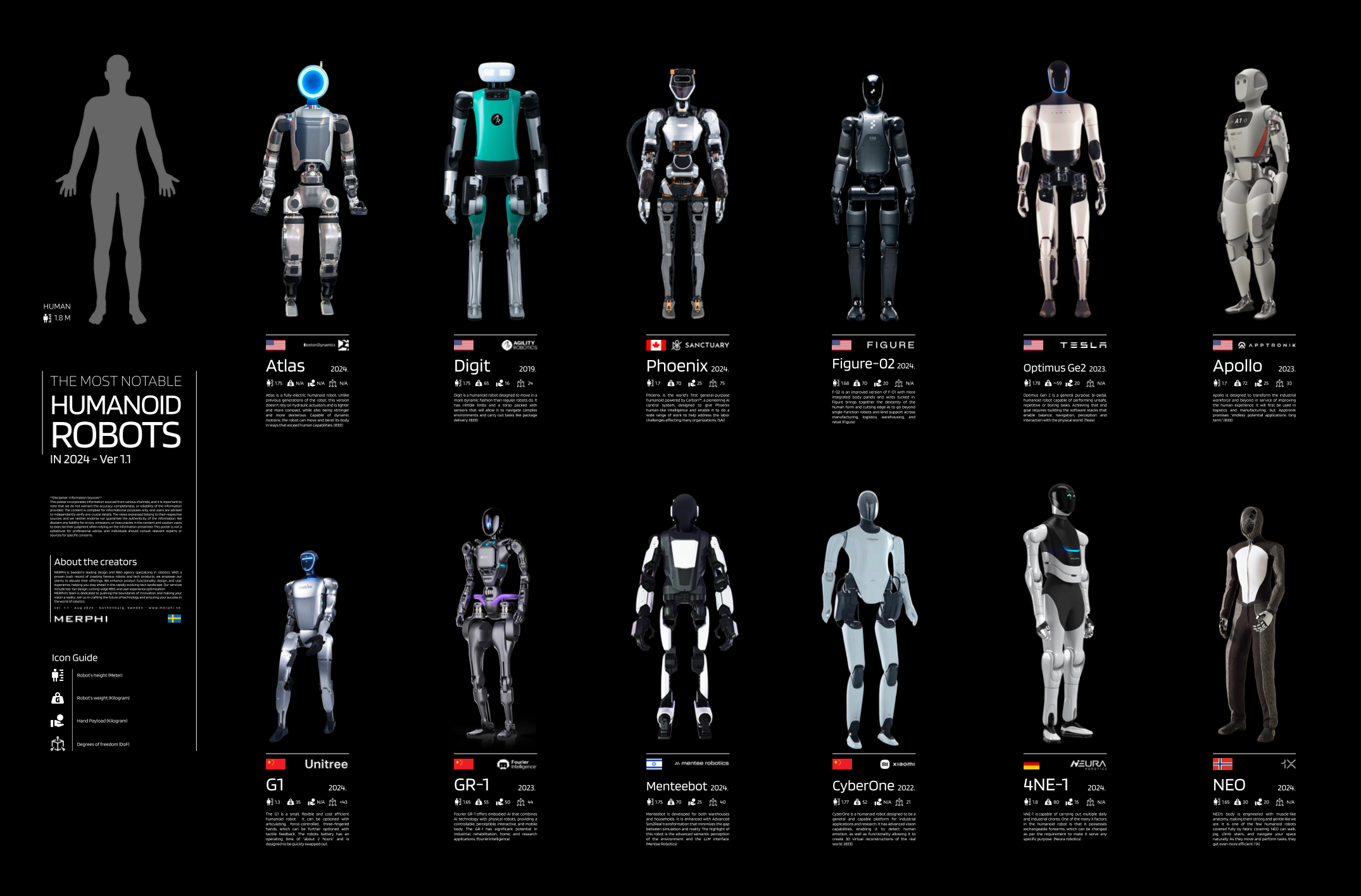
2024 was the year humanoid robots moved from research labs towards factories and warehouses. Boston Dynamics replaced its hydraulic Atlas with an all electric one, Figure signed a deal with BMW and launched Figure 02, Unitree put its G1 on sale for about $16,000, and Agility’s Digit started paid work in a logistics warehouse [2][3][4][5]. MERPHI, a Swedish robotics design agency, picked out 12 of the year’s most notable humanoids for the poster on this page, compared against a 1.8 m person [1].
| Robot | Maker and country | Height | Weight | Hand payload | Built for |
|---|---|---|---|---|---|
| Atlas (electric, 2024) | Boston Dynamics, USA | 1.75 m | not published | not published | Industrial work, first in car plants |
| Digit (2019) | Agility Robotics, USA | 1.75 m | 65 kg | 16 kg | Warehouse work and package delivery |
| Phoenix (2024) | Sanctuary AI, Canada | 1.7 m | 70 kg | 25 kg | General purpose work |
| Figure 02 (2024) | Figure, USA | 1.68 m | 70 kg | 20 kg (other sources give 25 kg) | Manufacturing, logistics, warehousing, retail |
| Optimus Gen 2 (2023) | Tesla, USA | 1.78 m | about 59 kg | 20 kg | Unsafe, repetitive or boring tasks |
| Apollo (2023) | Apptronik, USA | 1.7 m | 72 kg | 25 kg | Logistics and manufacturing |
| G1 (2024) | Unitree, China | 1.3 m | 35 kg | not published | Small, flexible, low cost general use |
| GR-1 (2023) | Fourier Intelligence, China | 1.65 m | 55 kg | 50 kg | Industry, rehabilitation, home and research |
| Menteebot (2024) | Mentee Robotics, Israel | 1.75 m | 70 kg | 25 kg | Warehouses and households |
| CyberOne (2022) | Xiaomi, China | 1.77 m | 52 kg | not published | Industrial applications and research |
| 4NE-1 (2024) | Neura Robotics, Germany | 1.8 m | 80 kg | 15 kg | Daily and industrial chores, with swappable forearms |
| NEO (2024) | 1X, Norway | 1.65 m | 30 kg | 20 kg | Help in the home |
The figures are the makers’ own or press figures collected by MERPHI in August 2024, and MERPHI says they should be checked independently [1]. Where we found a different figure elsewhere, it is noted [3].
Why 2024 was a turning point for humanoid robots
Several of the best known projects changed direction or found their first customers in 2024.
- Atlas went electric. Boston Dynamics retired the hydraulic Atlas, first shown to the public in 2013, in April 2024 and announced a fully electric version the next day [2]. The new Atlas is lighter and more compact, stronger and more dexterous, and can bend its joints further than a human can [1][2].
- Figure moved into car making. In January 2024 Figure announced a partnership with BMW to use humanoid robots in its car plants, and in February it raised $675 million from investors including Jeff Bezos and Microsoft. Figure 02 followed in August 2024, with five-fingered hands that each have 16 degrees of freedom [3].
- Prices started to fall. Unitree released the G1 in 2024 at about $16,000, far below what most humanoids were expected to cost. It uses 23 to 43 motorised joints depending on the version [4].
- Robots started paid work. Agility and the logistics firm GXO signed what they called the first humanoid Robot-as-a-Service contract, with Digit working at a Spanx warehouse near Atlanta [5].
- Home robots appeared. 1X introduced NEO Beta on 30 August 2024, one of the few humanoids covered in a soft fabric suit, aimed at helping in people’s homes [1][6].
- Optimus drew scepticism. Tesla showed Optimus at its “We, Robot” event in October 2024. Critics pointed out that the robots mostly relied on remote control (teleoperation) to interact with guests, and that Tesla was not open about it [7].
How big and strong are humanoid robots?
Most are built to human size so they can work in spaces designed for people. Eleven of the twelve robots on the poster are between 1.65 m and 1.8 m tall; the exception is Unitree’s G1 at 1.3 m [1]. 4NE-1 from Neura Robotics is the tallest and heaviest at 1.8 m and 80 kg, and NEO the lightest at 30 kg [1].
Hand payload, the weight a robot can carry, is modest compared with industrial robot arms. Most of the robots on the poster are rated at 15 to 25 kg, with Fourier’s GR-1 the outlier at 50 kg [1]. Degrees of freedom count how many independent joints a robot can move. The poster gives figures for seven robots, from 21 for Xiaomi’s CyberOne to 75 for Sanctuary AI’s Phoenix [1]. A lot of those joints are in the hands: Figure 02’s hands alone have 16 degrees of freedom each, and 1X said in 2026 that NEO’s hands have 25 [3][6].
Which countries make humanoid robots?
The US and China lead. Five of the twelve robots on MERPHI’s 2024 poster are American (Atlas, Digit, Figure 02, Optimus and Apollo) and three are Chinese (G1, GR-1 and CyberOne), with one each from Canada, Israel, Germany and Norway [1].
China’s makers have pushed hard on price and volume. Unitree, the maker of G1, reported revenue of 1.7 billion renminbi for 2025 and filed to list on the Shanghai Stock Exchange in March 2026 [4]. In 2025 it streamed what it billed as the first boxing tournament between humanoid robots, using four G1s [8].
What happened to these robots after 2024?
Most of the 2024 robots have since been updated or replaced. As of November 2026:
- Figure introduced Figure 03 in October 2025, 1.7 m tall with 60 degrees of freedom, and said it had delivered more than 350 of them by April 2026 [3].
- Atlas appeared as a product version at CES 2026, where it was remote controlled for the demonstration. As of January 2026 it was in production, due to be deployed at Hyundai’s Metaplant America car plant in 2028 [2].
- Optimus is on its way to a third generation. In April 2026 Tesla said production lines were being installed at its Fremont factory, and Elon Musk said production should start around late July or August 2026 [7].
- NEO went on pre-order in October 2025 for delivery in 2026, at $20,000 or $499 a month. The tech journalist Joanna Stern reported that at that stage most tasks were carried out by a remote human operator wearing a VR headset [6].
- Agility Robotics renamed itself Agility in March 2026 [5].
Not everyone is convinced. The roboticist Rodney Brooks, a co-founder of iRobot, said in 2025 that the idea of humanoids as all purpose assistants is “pure fantasy thinking”, partly because robots still struggle with coordination [7].
A short history of humanoid robots
The 2024 generation builds on more than 50 years of work. Waseda University in Tokyo completed WABOT-1, described as the first full-scale humanoid intelligent robot, in 1972 [8]. Honda’s ASIMO, its 11th walking robot and one that could run, followed in 2000. Boston Dynamics first showed Atlas in 2013, Hanson Robotics’ Sophia appeared in 2016, and Tesla unveiled the first Optimus in October 2022 [2][8].
The recent wave is different in scale. Figure alone raised $675 million in 2024 and was valued at $39 billion by late 2025, and it now controls its robots with Helix, a vision-language-action AI model that can run two robots at once [3]. Its BotQ factory aims to build 12,000 humanoids a year [3].
Questions about humanoid robots in 2024
What were the best humanoid robots of 2024?
The most talked about were Boston Dynamics’ electric Atlas, Figure 02, Tesla’s Optimus Gen 2, Agility’s Digit, Apptronik’s Apollo, Unitree’s G1, Sanctuary AI’s Phoenix and 1X’s NEO [1].
How much does a humanoid robot cost?
It varies a lot. Unitree’s G1 launched at about $16,000 in 2024 [4], 1X priced NEO at $20,000 for early buyers in 2025 [6], and Elon Musk has said Optimus should eventually cost $20,000 to $30,000 [7].
Is the Boston Dynamics Atlas robot electric?
Yes. Since April 2024 Atlas has been fully electric; the hydraulic model that ran from 2013 was retired [2].
What is the tallest humanoid robot of 2024?
Of the robots on MERPHI’s poster, Neura Robotics’ 4NE-1 is the tallest at 1.8 m, about the height of an adult man. Unitree’s G1 is the shortest at 1.3 m [1].
Are humanoid robots controlled by people?
Often, at least in demonstrations. Tesla’s Optimus at “We, Robot” and 1X’s NEO at launch both relied heavily on remote operators, and Atlas was remote controlled at CES 2026 [2][6][7]. The makers say the aim is full autonomy.
Sources
- MERPHI, The Most Notable Humanoid Robots in 2024, poster version 1.1, August 2024 (the original infographic).
- Wikipedia, Atlas (robot).
- Wikipedia, Figure AI.
- Wikipedia, Unitree Robotics.
- Wikipedia, Agility Robotics.
- Wikipedia, 1X Technologies.
- Wikipedia, Optimus (robot).
- Wikipedia, Humanoid robot.
Last reviewed 4 November 2026