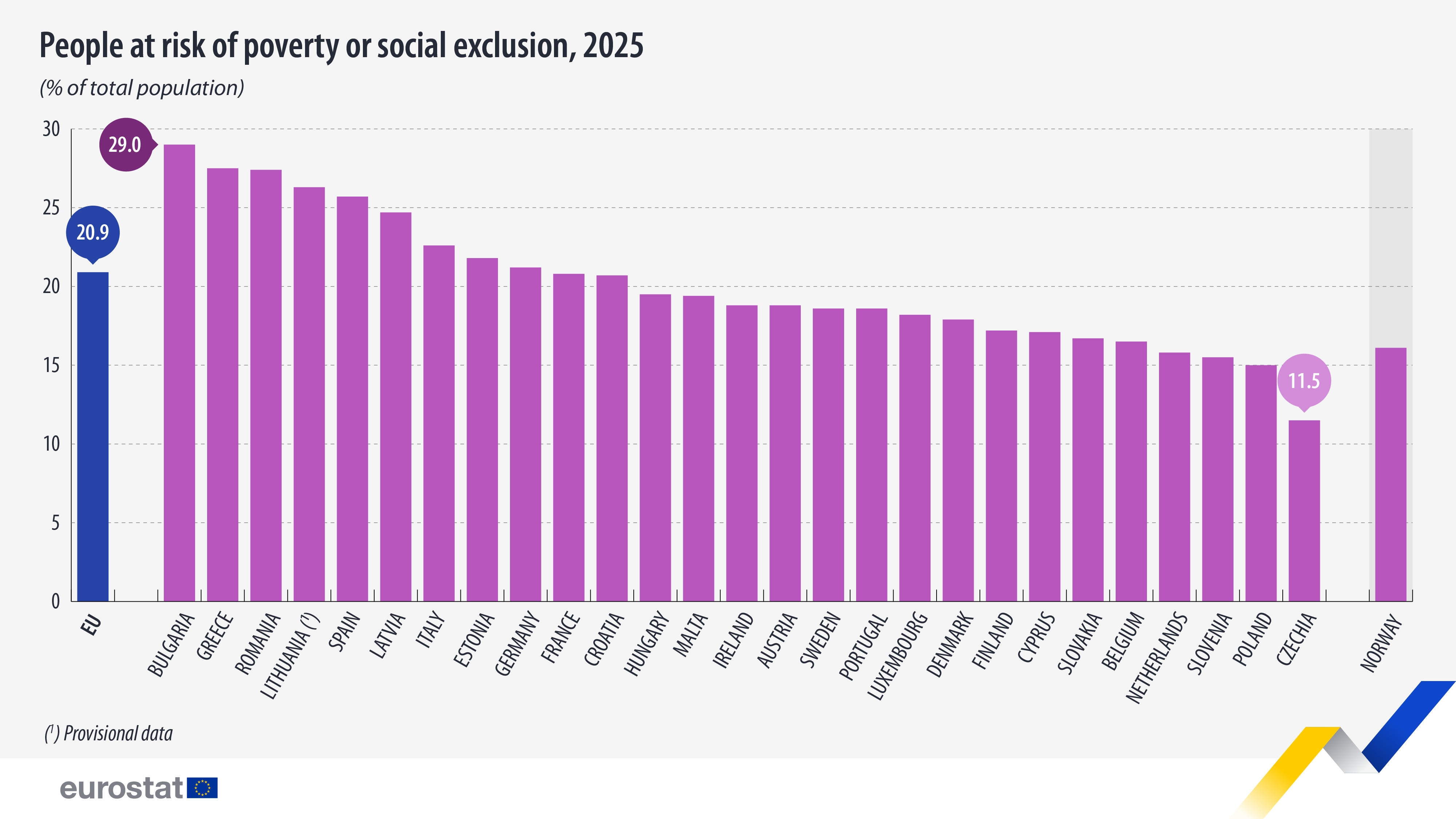
About one in five people in the EU, 92.7 million in total, were at risk of poverty or social exclusion in 2025, Eurostat reports. That is 20.9% of the population. Bulgaria has the highest rate in the EU at 29.0%, followed by Greece (27.5%) and Romania (27.4%), while Czechia has the lowest at 11.5%.
As Eurostat’s infographic shows, the rate in Bulgaria is two and a half times the rate in Czechia. Below you’ll find every EU country’s figures, what “at risk of poverty or social exclusion” actually means, which countries are the poorest in Europe as a whole, who is most likely to be poor, and whether poverty in Europe is falling.
What is the poverty rate in Europe?
In 2025, 20.9% of people in the EU were at risk of poverty or social exclusion, down slightly from 21.0% in 2024, according to Eurostat’s ilc_peps01n dataset. This is the EU’s main poverty measure, often shortened to AROPE.
It counts anyone who is in at least one of three situations. They live on a low income, they can’t afford several basic things, or they live in a household where the adults barely work. Looking at each part on its own, Eurostat’s data shows that in 2025
- 16.3% of people in the EU lived below their country’s poverty line (ilc_li02)
- 6.3% were severely materially and socially deprived (ilc_mdsd11)
- 7.9% of people under 65 lived in a household with very low work intensity (ilc_lvhl11n)
Many people fall into more than one group. Eurostat says 5.7 million people in the EU faced all three risks at the same time in 2025.
Poverty rate by country
Bulgaria (29.0%), Greece (27.5%), Romania (27.4%) and Lithuania (26.3%) have the highest shares of people at risk of poverty or social exclusion, and Czechia (11.5%), Poland (15.0%), Slovenia (15.5%) and the Netherlands (15.8%) the lowest. Of the largest economies, Spain (25.7%) and Italy (22.6%) are above the EU average, Germany (21.2%) is just above it and France (20.8%) is just below.
The table gives every EU country’s 2025 figures from Eurostat’s EU-SILC survey, plus Norway, which reports to Eurostat but isn’t in the EU. “Below the poverty line” is the at-risk-of-poverty rate, the share of people whose income is under 60% of their country’s median. The poverty line column is that 60% threshold in euros for one adult living alone (ilc_li01). Lithuania’s figures are provisional.
| Country | At risk of poverty or social exclusion | Below the poverty line | Severe material and social deprivation | Yearly poverty line, single adult |
|---|---|---|---|---|
| EU average | 20.9% | 16.3% | 6.3% | n/a |
| Bulgaria | 29.0% | 21.2% | 15.0% | €5,317 |
| Greece | 27.5% | 19.6% | 14.9% | €7,020 |
| Romania | 27.4% | 18.4% | 16.8% | €4,912 |
| Lithuania (provisional) | 26.3% | 22.6% | 5.5% | €8,389 |
| Spain | 25.7% | 19.5% | 8.1% | €12,220 |
| Latvia | 24.7% | 22.0% | 4.8% | €8,390 |
| Italy | 22.6% | 18.6% | 5.2% | €13,237 |
| Estonia | 21.8% | 19.5% | 3.5% | €10,287 |
| Germany | 21.2% | 16.1% | 5.6% | €17,334 |
| France | 20.8% | 16.3% | 7.0% | €15,875 |
| Croatia | 20.7% | 19.5% | 2.0% | €9,034 |
| Hungary | 19.5% | 14.0% | 8.5% | €5,275 |
| Malta | 19.4% | 16.9% | 4.1% | €13,220 |
| Ireland | 18.8% | 13.0% | 5.2% | €21,083 |
| Austria | 18.6% | 15.9% | 2.9% | €21,928 |
| Portugal | 18.6% | 15.4% | 4.3% | €8,679 |
| Sweden | 18.6% | 15.6% | 3.9% | €17,144 |
| Luxembourg | 18.2% | 14.8% | 3.4% | €30,027 |
| Denmark | 17.9% | 11.8% | 4.5% | €21,715 |
| Finland | 17.2% | 13.4% | 3.3% | €17,844 |
| Cyprus | 17.1% | 14.9% | 2.2% | €13,240 |
| Slovakia | 16.7% | 12.2% | 7.0% | €7,794 |
| Belgium | 16.5% | 10.9% | 4.9% | €18,780 |
| Netherlands | 15.8% | 13.4% | 2.6% | €20,680 |
| Slovenia | 15.5% | 14.3% | 1.9% | €12,249 |
| Poland | 15.0% | 13.2% | 2.0% | €8,636 |
| Czechia | 11.5% | 9.6% | 2.6% | €9,119 |
| Norway (not in the EU) | 16.1% | 11.3% | 2.6% | €25,154 |
The three measures don’t always point the same way. Latvia and Lithuania have some of the highest shares of people on low incomes (22.0% and 22.6%) but low levels of severe deprivation (4.8% and 5.5%). Croatia is similar, with 19.5% below its poverty line but only 2.0% severely deprived. In Romania, Bulgaria and Greece, both numbers are high.
What is the poorest country in the EU?
Bulgaria, on most measures. It has the EU’s highest rate of people at risk of poverty or social exclusion (29.0% in 2025) and, with Greece, the lowest GDP per head, at 68% of the EU average once prices are taken into account, Eurostat’s GDP per capita in PPS figures show (2025, provisional).
Which country comes out “poorest” depends on what you measure.
- Bulgaria has the highest share of people at risk of poverty or social exclusion (29.0%), followed by Greece (27.5%) and Romania (27.4%).
- Romania has the highest share of people who are severely deprived (16.8%), followed by Bulgaria (15.0%) and Greece (14.9%).
- Lithuania has the highest share below its national poverty line (22.6%, provisional), followed by Latvia (22.0%) and Bulgaria (21.2%).
- Bulgaria and Greece have the lowest GDP per head (both 68% of the EU average), followed by Latvia (71%).
At the other end, Luxembourg (239% of the EU average) and Ireland (238%) have the highest GDP per head in the EU.
What are the poorest countries in Europe?
Outside the EU, Ukraine, Kosovo and Moldova are the poorest countries in Europe by income per head. World Bank figures put GDP per person in 2025, adjusted for prices, at about $18,900 in Ukraine, $19,300 in Kosovo and $20,000 in Moldova, compared with about $156,500 in Luxembourg (GDP per capita, PPP, current international dollars).
Bosnia and Herzegovina (about $25,800), North Macedonia ($28,000) and Albania ($28,200) come next. All of these are lower than Bulgaria ($44,500), the lowest in the EU on the same World Bank measure.
Some EU candidate countries also report the EU poverty measure to Eurostat. In 2025, 39.4% of people in Albania and 29.8% in Türkiye were at risk of poverty or social exclusion, both higher than any EU country, while Serbia’s rate (23.2%) was between Italy’s and Latvia’s.
Which European countries have the lowest poverty rates?
Czechia has the lowest rate in the EU by a wide margin, at 11.5% in 2025. Poland (15.0%), Slovenia (15.5%), the Netherlands (15.8%) and Belgium (16.5%) come next, and Norway, outside the EU, is at 16.1%.
Czechia also has the EU’s lowest share of people below the poverty line (9.6%). Slovenia has the lowest severe deprivation rate (1.9%), with Croatia and Poland both at 2.0%. Slovenia also has the lowest share of people in households with very low work intensity (3.8%).
A low rate doesn’t mean a country is rich. Poland (81% of the EU average) and Slovenia (90%) both have lower GDP per head than the EU as a whole. The poverty rate measures how many people are far behind the typical income in their own country, not how well off the country is overall.
What does at risk of poverty or social exclusion mean?
It means a person is in at least one of three situations, as defined in Eurostat’s glossary and its article on poverty and social exclusion.
- They are at risk of poverty, meaning their household’s disposable income, adjusted for household size, is below 60% of the national median after social benefits.
- They are severely materially and socially deprived, meaning they can’t afford at least 7 of 13 everyday items.
- They are under 65 and live in a household with very low work intensity, where the working-age adults worked 20% or less of their possible working time in the previous year.
The 13 deprivation items in Eurostat’s severe material and social deprivation definition are things most people take for granted. Seven apply to the household. These are facing an unexpected expense, a week’s holiday away from home, avoiding arrears on rent, mortgage, bills or loans, a meal with meat, fish or a vegetarian equivalent every second day, keeping the home warm enough, having a car and replacing worn-out furniture. Six apply to the person. These are an internet connection, replacing worn-out clothes, two pairs of properly fitting shoes, a small amount of money to spend on yourself each week, regular leisure activities and meeting friends or family for a drink or meal at least once a month.
The EU revised the measure in 2021, replacing the older severe material deprivation rate with this 13-item version and redefining very low work intensity. Eurostat publishes the revised measure from 2015 onwards, so the figures on this page compare like with like.
Why the poverty line is so different between countries
Because each country’s line is set at 60% of its own median income, there is no single EU poverty line. In 2025 the line for one adult living alone was €30,027 a year in Luxembourg and €4,912 in Romania, about six times lower, Eurostat’s figures show.
For a couple with two children under 14, the line ranged from €63,057 in Luxembourg to €10,315 in Romania. Prices are lower in poorer countries, so the gap narrows once Eurostat adjusts for what money buys (purchasing power standards). On that basis the single-adult line runs from 22,604 PPS in Luxembourg to 7,175 PPS in Hungary, about three times lower.
This is why the at-risk-of-poverty rate is a measure of relative poverty. It shows how many people are a long way behind the typical income in their own country, not how many can’t afford to live. The deprivation rate shows more directly who can’t afford the basics, and on that measure Romania and Bulgaria stand out much more.
Who is most at risk of poverty in the EU?
Unemployed people face by far the highest risk. In 2025, 66.3% of unemployed adults in the EU were at risk of poverty or social exclusion, compared with 10.9% of people in work and 17.6% of retired people, according to Eurostat.
- Education makes a big difference. 34.2% of adults with at most lower secondary education were at risk, against 19.2% with upper secondary and 10.3% with a degree or other tertiary qualification.
- Young adults aged 18 to 24 had the highest rate of any age group (26.3%), followed by children under 18 (24.3%). People aged 65 or over had the lowest (18.8%).
- Women were more at risk than men (21.9% compared with 19.8%).
- 22.1% of people in households with dependent children were at risk, against 19.8% in households without them.
Child poverty in Europe
Almost one in four children in the EU (24.3%) were at risk of poverty or social exclusion in 2025, higher than the rate for the population as a whole. Spain had the highest child rate in the EU at 33.8%, followed by Bulgaria (33.1%) and Romania (32.4%), Eurostat’s data shows.
The lowest child rates were in Slovenia (12.5%), the Netherlands (12.7%), Cyprus (14.0%) and Denmark (14.8%). Greece (29.6%), France (27.5%) and Italy (27.1%) were all above the EU average.
Poverty in Germany, France, Italy and Spain
Spain has the highest poverty rate of the EU’s four largest economies, with 25.7% of people at risk of poverty or social exclusion in 2025. Italy is at 22.6%, Germany at 21.2% and France at 20.8%.
- In Germany, 21.2% of people were at risk, 16.1% below the poverty line and 5.6% severely deprived. The share in households with very low work intensity (10.3%) is one of the highest in the EU. Germany’s poverty line for a single adult was €17,334 a year. Eurostat marks a break in Germany’s series in 2020, so the jump from 17.3% in 2019 to 20.4% in 2020 is partly a change of method.
- In France, 20.8% were at risk, 16.3% below the poverty line and 7.0% severely deprived, with a single-adult poverty line of €15,875.
- In Italy, 22.6% were at risk, 18.6% below the poverty line and 5.2% severely deprived. Italy’s rate has fallen from 24.6% in 2019. Its single-adult line was €13,237.
- In Spain, 25.7% were at risk, 19.5% below the poverty line and 8.1% severely deprived. One in three children in Spain (33.8%) is at risk, the highest child rate in the EU. Its single-adult line was €12,220.
Is poverty in Europe going down?
Slowly over ten years, but hardly at all since 2019. The number of people at risk of poverty or social exclusion in the EU fell from 104.9 million (24.0%) in 2015 to 92.2 million (21.1%) in 2019, then rose to 95.4 million in 2021 before easing back to 92.7 million (20.9%) in 2025, Eurostat’s ilc_peps01n series shows.
The EU’s target, set in the European Pillar of Social Rights Action Plan, is to cut the number by at least 15 million by 2030. Measured against 2019, that means getting below about 77.2 million. On our calculation from Eurostat’s figures, the 2025 total is still about 0.5 million higher than in 2019, which leaves a gap of around 15.5 million with five years to go.
Some countries have made big gains. Romania’s rate fell from 36.1% in 2019 to 27.4% in 2025, and Bulgaria’s from 33.2% to 29.0%. Poland’s fell from 17.9% to 15.0%. Rates rose over the same period in Finland (14.5% to 17.2%), Slovenia (13.7% to 15.5%) and France (18.8% to 20.8%), though France and Finland both have breaks in their series.
How the UK compares
The UK left the EU, so it isn’t in Eurostat’s latest poverty figures and uses its own measure. The Department for Work and Pensions reports that 16% of people in the UK lived in relative low income before housing costs in the year to March 2025, and 20% after housing costs, in its Households Below Average Income statistics.
The UK’s relative low-income line is also 60% of median household income, so the before-housing-costs figure is close in concept to the EU’s 16.3% at-risk-of-poverty rate. The surveys and income definitions differ, though, so treat it as a rough comparison rather than a ranking. For UK children, the DWP figures are 21% before housing costs and 27% after.
Questions about poverty in Europe
What are the top 3 poorest countries in Europe?
By income per head, Ukraine, Kosovo and Moldova, on World Bank figures for 2025. In the EU, Bulgaria, Greece and Romania have the highest shares of people at risk of poverty or social exclusion.
Which EU country has the highest poverty rate?
Bulgaria, where 29.0% of people were at risk of poverty or social exclusion in 2025. Greece (27.5%) and Romania (27.4%) were next.
Which country in Europe has the lowest poverty rate?
Czechia, at 11.5% in 2025, the lowest in the EU. It also has the lowest share of people below the poverty line, at 9.6%.
How many people in the EU live in poverty?
92.7 million people, or 20.9% of the population, were at risk of poverty or social exclusion in 2025. Of these, 16.3% of the population were below their national poverty line.
What is AROPE?
AROPE stands for “at risk of poverty or social exclusion”. It is the EU’s headline poverty measure and counts people who are on a low income, severely materially and socially deprived, or living in a household with very low work intensity.
What is severe material deprivation?
Being unable to afford at least 7 of 13 everyday items, such as keeping your home warm, a week’s holiday, replacing worn-out clothes or facing an unexpected expense. In 2025, 6.3% of people in the EU were severely materially and socially deprived.
What is the poverty line in Europe?
There isn’t one. Each country’s line is 60% of its own median income. For a single adult in 2025 it ranged from €30,027 a year in Luxembourg to €4,912 in Romania.
What is the poverty level in the UK?
In the year to March 2025, 16% of people in the UK were in relative low income before housing costs and 20% after housing costs, according to the Department for Work and Pensions.
Sources
- Eurostat, Living conditions in Europe, poverty and social exclusion (Statistics Explained, last edited 28 April 2026), including the infographic “People at risk of poverty or social exclusion, 2025”
- Eurostat, Persons at risk of poverty or social exclusion by age and sex (ilc_peps01n) (doi.org/10.2908/ILC_PEPS01N, updated 20 October 2026, accessed 24 November 2026)
- Eurostat, At-risk-of-poverty rate (ilc_li02), At-risk-of-poverty thresholds (ilc_li01), Severe material and social deprivation rate (ilc_mdsd11) and Persons living in households with very low work intensity (ilc_lvhl11n) (updated 20 October 2026, accessed 24 November 2026)
- Eurostat, GDP per capita in PPS (tec00114) (updated 9 July 2026, accessed 24 November 2026)
- Eurostat glossary, At risk of poverty or social exclusion (AROPE) and Severe material and social deprivation rate (SMSD)
- World Bank, GDP per capita, PPP (current international $) (World Development Indicators, updated 11 November 2026, CC BY 4.0)
- European Commission, European Pillar of Social Rights Action Plan
- Department for Work and Pensions, Households Below Average Income, FYE 1995 to FYE 2025 (Open Government Licence v3.0)
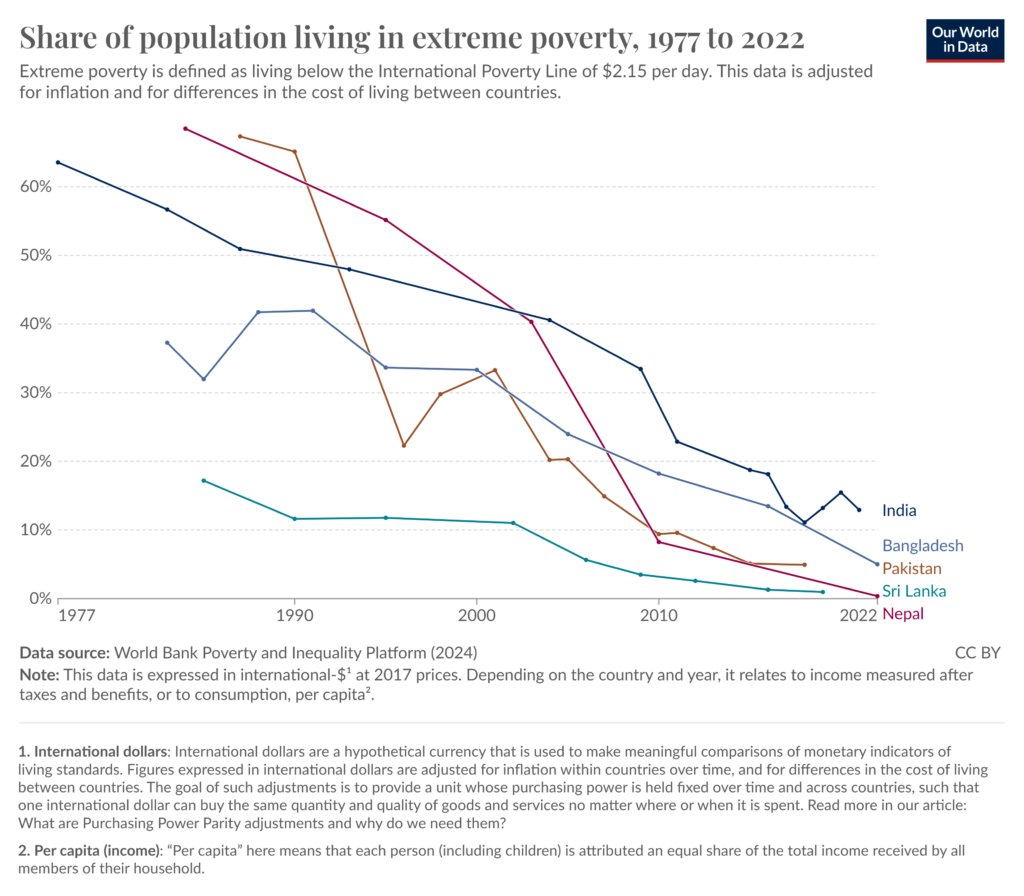
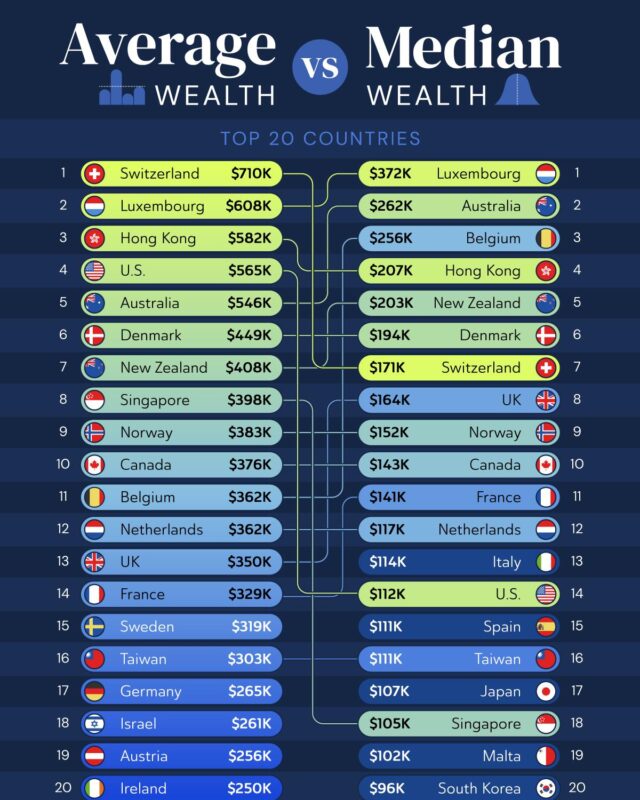
For a global view, see our listing on the share of the world’s population living in extreme poverty, and on median and average wealth by country.
The infographic “People at risk of poverty or social exclusion, 2025” is by Eurostat and is shared unchanged under the Creative Commons CC BY 4.0 licence, in line with Eurostat’s copyright notice. The data comes from Eurostat (ilc_peps01n). The changes since 2019 and the gap to the 2030 target are our own calculations from Eurostat data, and Eurostat is not responsible for them. Their use here does not imply any endorsement by Eurostat or the European Commission.