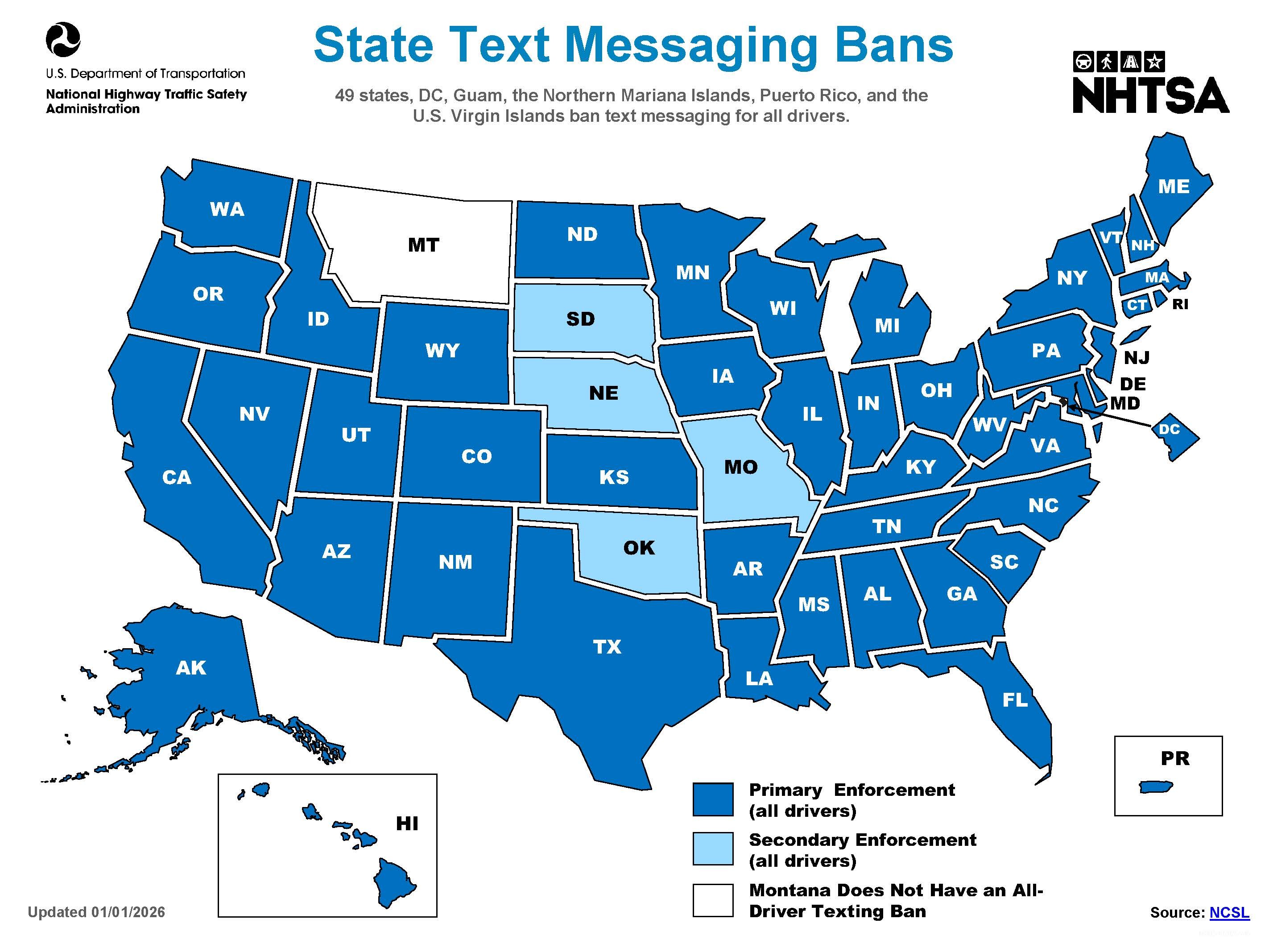
Texting while driving is illegal for all drivers in 49 US states, Washington DC, Puerto Rico, Guam, the Northern Mariana Islands and the US Virgin Islands. Montana is the only state without a texting ban for all drivers, according to the National Highway Traffic Safety Administration (NHTSA). Stricter hands-free laws, which also stop you holding a phone to make calls, now cover 32 states and DC, the Insurance Institute for Highway Safety (IIHS) says.
Is texting and driving illegal in every state?
No, but it is close. Every state except Montana bans texting for all drivers, as NHTSA’s State Text Messaging Bans map (updated 1 January 2026, using data from the National Conference of State Legislatures) shows. The same map shows DC, Puerto Rico, Guam, the Northern Mariana Islands and the US Virgin Islands with all-driver texting bans too.
Montana has no statewide law on phone use by drivers at all. The IIHS electronic device laws table (November 2026) lists Montana with no texting ban, no hand-held ban and no extra rules for new drivers. The GHSA notes that some localities have their own extra rules, so it is worth checking local rules before you assume something is allowed.
Texting bans are older and more widespread than hand-held bans. Washington was the first state to ban texting while driving, in 2007, according to the Governors Highway Safety Association (GHSA), and New York was the first to ban hand-held phone calls by all drivers, in 2001, the IIHS says.
Where police can stop you just for texting
In 45 states and DC, police can pull you over for texting alone, because the ban is a primary offence. The GHSA explains that under a primary law an officer may cite you without any other traffic offence taking place. Under a secondary law, police can only ticket you for texting after stopping you for something else, such as speeding.
NHTSA’s map shows four states where the texting ban is secondary for all drivers.
- Missouri
- Nebraska
- Oklahoma
- South Dakota
A secondary law still makes texting illegal. It only changes when an officer can act on it, and a texting offence can be added to any other ticket you get.
Which states are hands-free?
Thirty-two states and DC ban all drivers from making hand-held calls as well as texting, according to the IIHS. In these states you can only use a phone while driving in a hands-free way, such as through voice commands, a car’s built-in system or a mounted phone you barely touch.
Taken from the IIHS state table, the hands-free states are Alabama, Arizona, California, Colorado, Connecticut, Delaware, Georgia, Hawaii, Idaho, Illinois, Indiana, Iowa, Louisiana, Maine, Maryland, Massachusetts, Michigan, Minnesota, Missouri, Nevada, New Hampshire, New Jersey, New York, Oregon, Pennsylvania, Rhode Island, South Carolina, Tennessee, Vermont, Virginia, Washington and West Virginia, plus the District of Columbia.
Of these, 21 states go further and ban drivers from simply holding an electronic device, the IIHS says, whatever you are doing with it. Colorado, Iowa, Pennsylvania and South Carolina all brought in hands-free laws during 2025, the GHSA’s state-by-state list shows. The GHSA also notes that Alabama’s and Missouri’s hand-held bans are secondary laws, while the rest are primary.
Ohio sits in between. Its law bans hand-held use by all drivers but still allows you to hold a phone to your ear for a call, the IIHS table notes, so it is not part of the IIHS count of 32 hands-free states.
States that only ban texting
Seventeen states ban texting for all drivers but do not ban hand-held calls, the IIHS says. In these states you can legally hold a phone to talk in most places, but you can’t type or read messages.
Several of them do ban hand-held phones in certain places. The IIHS table shows hand-held bans in school and work zones in Arkansas, Florida, Kansas and Oklahoma, in school crossing zones and on school property in Texas, and in work zones in Wisconsin when workers are present. Arkansas also bans hand-held calls for drivers aged 18 to 20.
The table below brings the texting and hand-held rules together for every state. The texting column follows NHTSA’s 1 January 2026 map, and the hand-held column follows the IIHS table as of November 2026.
| State | Texting ban for all drivers | Hand-held phone ban for all drivers |
|---|---|---|
| Alabama | Yes, primary | Yes |
| Alaska | Yes, primary | No |
| Arizona | Yes, primary | Yes |
| Arkansas | Yes, primary | Drivers aged 18 to 20, and in school and work zones |
| California | Yes, primary | Yes |
| Colorado | Yes, primary | Yes |
| Connecticut | Yes, primary | Yes |
| Delaware | Yes, primary | Yes |
| District of Columbia | Yes, primary | Yes |
| Florida | Yes, primary | Only in school crossing zones, school zones and work zones |
| Georgia | Yes, primary | Yes |
| Hawaii | Yes, primary | Yes |
| Idaho | Yes, primary | Yes |
| Illinois | Yes, primary | Yes |
| Indiana | Yes, primary | Yes |
| Iowa | Yes, primary | Yes |
| Kansas | Yes, primary | Only in active school and work zones |
| Kentucky | Yes, primary | No |
| Louisiana | Yes, primary | Yes |
| Maine | Yes, primary | Yes |
| Maryland | Yes, primary | Yes |
| Massachusetts | Yes, primary | Yes |
| Michigan | Yes, primary | Yes |
| Minnesota | Yes, primary | Yes |
| Mississippi | Yes, primary | No |
| Missouri | Yes, secondary | Yes |
| Montana | No all-driver ban | No |
| Nebraska | Yes, secondary | No |
| Nevada | Yes, primary | Yes |
| New Hampshire | Yes, primary | Yes |
| New Jersey | Yes, primary | Yes |
| New Mexico | Yes, primary | No |
| New York | Yes, primary | Yes |
| North Carolina | Yes, primary | No |
| North Dakota | Yes, primary | No |
| Ohio | Yes, primary | Yes, but holding a phone to your ear for a call is allowed |
| Oklahoma | Yes, secondary | Learner and intermediate licence holders, and in school and work zones |
| Oregon | Yes, primary | Yes |
| Pennsylvania | Yes, primary | Yes |
| Rhode Island | Yes, primary | Yes |
| South Carolina | Yes, primary | Yes |
| South Dakota | Yes, secondary | No |
| Tennessee | Yes, primary | Yes |
| Texas | Yes, primary | Only in school crossing zones and on school property |
| Utah | Yes, primary | No |
| Vermont | Yes, primary | Yes |
| Virginia | Yes, primary | Yes |
| Washington | Yes, primary | Yes |
| West Virginia | Yes, primary | Yes |
| Wisconsin | Yes, primary | Only in work zones and roadside response areas when workers are present |
| Wyoming | Yes, primary | No |
Laws change often, so check your state’s own transport or highway safety office before relying on any summary. The IIHS itself says its table is for general information and should be independently checked.
What hands-free means in practice
Hands-free usually means you can use a phone by voice or with a single touch, but not hold it, type on it or scroll through it. Many states spell this out. Alabama, California, Maine and Tennessee, for example, allow a single swipe or tap to turn a feature on or off while the phone is mounted to the vehicle, the IIHS table shows.
What counts as driving also varies, which matters when you are stopped at lights or in traffic.
- Arizona’s ban doesn’t apply when you are stopped at a red light or for a train at a level crossing.
- Florida’s law doesn’t apply when the vehicle is stationary.
- Illinois only allows use when you are stopped in blocked traffic with the car in neutral or park, or parked on the shoulder.
- Most other states with a rule on this only exempt you once you are lawfully parked or pulled off the road somewhere safe.
The safe habit in any state is to set up your route and music before you move off and leave the phone alone until you have parked.
Rules for teen drivers and truck drivers
New drivers face tighter rules in most of the country. Thirty-three states and DC ban teen or novice drivers from using any electronic device at all, even hands-free, the IIHS says. These bans usually cover learner’s permit and intermediate licence holders, or all drivers under 18.
Commercial drivers fall under federal rules as well as state law. The Federal Motor Carrier Safety Administration (FMCSA) bans interstate truck and bus drivers, and drivers carrying placardable amounts of hazardous materials, from texting or holding a mobile phone while driving. They can only use a hands-free phone within easy reach. The FMCSA lists civil penalties of up to $2,750 for drivers and up to $11,000 for employers that require or allow it, and repeat offences can lead to disqualification.
How dangerous is texting and driving?
Distracted driving killed 3,208 people on US roads in 2024 and injured an estimated 315,167 more, NHTSA’s research note Distracted Driving in 2024 reports. That was 8% of the 39,254 people who died in traffic crashes that year. In 437 of those deaths, at least one driver was talking on, listening to or otherwise using a phone.
Phone use behind the wheel is rising. NHTSA’s survey Driver Electronic Device Use in 2024 found that 4.5% of drivers were visibly handling a phone or other device at a typical daylight moment, up from 3.0% in 2023. That is an estimated 537,946 drivers at any moment. Among 16 to 24 year olds the share was 8.7%, the highest since NHTSA began collecting the figure in 2005.
The reason texting is singled out is how long it takes your eyes off the road. NHTSA says sending or reading a text takes your eyes away for about five seconds, which at 55 mph is like driving the length of a football field with your eyes closed.
The real toll is likely higher. The IIHS says figures based on police crash reports almost certainly underestimate distraction, because drivers often don’t volunteer that they were on the phone. NHTSA’s research note says a separate study of real driving found distraction involved in 29% of all crashes in 2019, far more than police reports show.
Questions about texting and driving laws
What states have laws against texting and driving?
Forty-nine states have laws against texting and driving for all drivers. Montana is the only exception, according to NHTSA’s January 2026 map. DC, Puerto Rico, Guam, the Northern Mariana Islands and the US Virgin Islands also ban it.
Can I hold my phone in my hand while driving?
Not in the 32 hands-free states or DC, where hand-held calls are banned for all drivers. In the 17 states that only ban texting, holding a phone to talk is legal for most adult drivers, except in the school and work zones some of them set out. Typing or reading messages is banned everywhere except Montana.
Can I sit in my car and use my phone?
Yes, if you are lawfully parked. Most state laws in the IIHS table don’t apply once the vehicle is parked or pulled off the road somewhere it can safely stay. Being stopped in traffic or at a red light usually still counts as driving.
Can you use your phone at a red light?
In most states, no. Only a few laws, such as Arizona’s and Florida’s, exempt a stopped vehicle. In hands-free states that ban holding a device, picking up the phone at a light can still break the law.
Can I use my phone for GPS while driving?
Yes in most states, as long as you use it hands-free. Many hands-free laws allow a single tap or swipe on a mounted phone, so you can start navigation, but you shouldn’t type an address or hold the phone while the car is moving.
The map shown here was produced by NHTSA and is available free of charge on TrafficSafetyMarketing.gov. Its use here does not imply endorsement by NHTSA, the U.S. Department of Transportation or the U.S. Government. This page is general information, not legal advice.
Sources
- National Highway Traffic Safety Administration, State Text Messaging Bans and State Handheld Cell Phone Bans (maps, updated 1 January 2026, data from NCSL)
- Insurance Institute for Highway Safety, Electronic device laws (November 2026) and Distracted driving
- Governors Highway Safety Association, Distracted Driving state laws
- NHTSA, Distracted Driving in 2024 (DOT HS 813 790, April 2026)
- NHTSA, Driver Electronic Device Use in 2024 (DOT HS 813 788, April 2026)
- NHTSA, Distracted Driving
- Federal Motor Carrier Safety Administration, Distracted Driving