How did colours get their names?
Most colour names come from something that had the colour. People named shades after plants (mauve, orchid, maroon), minerals (turquoise, azure), animals (teal, taupe, sepia), dyes made from insects (crimson, vermilion), fruit (orange, tangerine) and places (sienna, burgundy, indigo). The words were then borrowed into English over centuries from Latin, French, Greek, Persian and other languages. Only a handful, such as magenta and fuchsia, can be traced to a particular person or event.
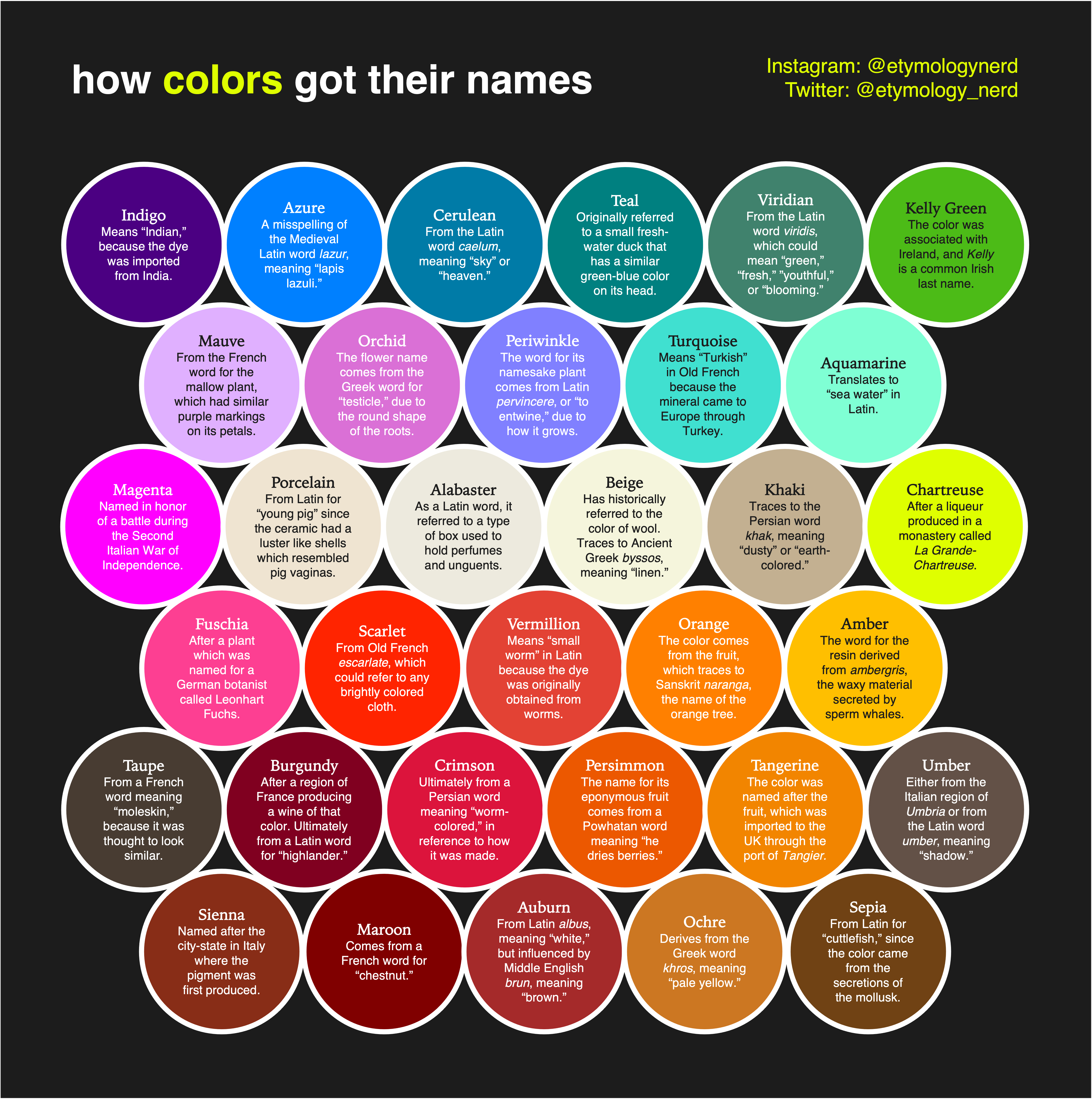
The Etymology Nerd’s chart above gives the origins of 33 colour names [1][2]. Here they are grouped by where the names come from, with a few corrections where the chart simplifies.
Colours named after places
- Indigo means “Indian”, because the dye was imported from India.
- Turquoise means “Turkish” in Old French, because the stone reached Europe through Turkey.
- Sienna is named after the Italian city where the pigment was first produced.
- Umber comes either from the Italian region of Umbria or from the Latin umbra, “shadow”.
- Burgundy is the French wine region whose wine has that colour.
- Tangerine is the fruit, which reached Britain through the port of Tangier.
- Magenta is named after the Battle of Magenta, fought on 4 June 1859; the dye was renamed in its honour in 1860 [4].
Colours named after plants and fruit
- Mauve is the French word for the mallow plant, which has purple flowers.
- Orchid comes from the flower, whose name comes from the Greek for “testicle”, after the shape of its roots.
- Periwinkle is a plant whose name comes from the Latin pervincere, linked to the way it winds as it grows.
- Fuchsia is a plant named after the German botanist Leonhart Fuchs. The French botanist Charles Plumier named the genus in his honour shortly before 1703 [5]. The chart spells it “Fuschia”, a common mistake.
- Maroon comes from the French marron, “chestnut”.
- Orange is named after the fruit, a word that goes back to the Sanskrit naranga, “orange tree”.
- Persimmon is the fruit, whose name comes from a Powhatan word the chart translates as “he dries berries”.
Colours named after animals
- Teal is a small freshwater duck with a green-blue stripe on its head.
- Taupe is French for “mole”, after the colour of moleskin.
- Sepia is Latin for “cuttlefish”, whose ink was used to make the brown pigment.
- Amber is named after the fossil resin, whose name came from ambergris, a waxy substance from sperm whales.
- Crimson comes, via Arabic, from a Persian word meaning “worm-coloured”, after the red dye made from kermes insects.
- Vermilion means “little worm” in Latin. The “worms” were kermes insects, the source of a red dye; vermilion pigment itself is made from the mineral cinnabar [3]. The chart spells it “Vermillion”.
- Porcelain, used as a colour for pale glossy white, comes from the Italian porcellana, a cowrie shell, from porcello, “piglet”. It is unclear why the shell got that name [8].
Colours named after minerals, materials and drinks
- Azure comes through Old French azur from the Arabic lazaward, “lapis lazuli”. The first l was dropped as if it were the French article l’ [7]; the chart calls it a misspelling of Medieval Latin lazur.
- Alabaster was a soft white stone used in the ancient world to make boxes and jars for perfume.
- Beige was the colour of undyed wool, from Old French bege, which goes back to Ancient Greek byssos, a fine linen [10].
- Khaki comes from the Persian khak, “dust” or “earth”.
- Scarlet comes from Old French escarlate, which could mean any brightly coloured cloth.
- Chartreuse is named after a green liqueur made by monks at La Grande Chartreuse monastery in France.
- Kelly green takes its name from Kelly, a common Irish surname, because of the colour’s link with Ireland.
Colours named after old words for colour
A few names were colour words from the start. Cerulean comes from the Latin caelum, “sky”. Viridian comes from the Latin viridis, “green”, which also meant fresh or youthful. Aquamarine is Latin for “sea water”. Ochre comes from the Greek okhra, “pale yellow”, from okhros, “pale” [9]. Auburn is the odd one: it comes from the Latin albus, “white”, and originally meant a yellowish white, but drifted towards brown under the influence of the Middle English brun.
Which colour words came first?
The names above are specific shades. The basic colour words, such as red, green and blue, are far older. In their 1969 book Basic Color Terms, Brent Berlin and Paul Kay proposed that languages gain basic colour terms in a fixed order: first words for dark and light, then red, then green and yellow, then blue, then brown, and finally purple, pink, orange and grey [6]. English has 11 basic colour terms [6]. Words such as teal, taupe and sepia are later, more precise names layered on top.
Questions about colour names
Who invented colour names?
No one invented them as a set. Most were taken from objects that had the colour and borrowed into English over centuries. A few have a known origin, such as magenta, named after an 1859 battle [4].
What was the first colour to be named?
Berlin and Kay’s research suggests the first colour words in a language are for dark and light, with red usually the first colour added after them [6].
Was orange named after the fruit or the colour?
The fruit. The colour took its name from the orange, a word that traces back to the Sanskrit naranga.
Why is it called magenta?
The dye was renamed magenta in 1860 after the Battle of Magenta in northern Italy, fought on 4 June 1859 [4].
Where does the word turquoise come from?
It means “Turkish” in Old French, because the stone reached Europe through Turkey.
Sources
- Adam Aleksic, the Etymology Nerd, Infographics, the original chart.
- u/etymologynerd, I made a guide showing how different colors got their names, r/coolguides.
- Wikipedia, Vermilion.
- Wikipedia, Magenta.
- Wikipedia, Fuchsia.
- Wikipedia, Basic Color Terms.
- Wiktionary, azure.
- Wiktionary, porcelain.
- Wiktionary, ochre.
- Wiktionary, beige.
Last reviewed 2 November 2026