About one in three adults in the EU didn’t drink any alcohol in 2025, and only 4.8% drank every day, Eurostat reports. Habits vary a lot by country. Portugal has by far the most daily drinkers, Denmark and France the most weekly drinkers, and Romania drinks the most alcohol per adult in Europe, according to the World Health Organization.
How often do people in Europe drink alcohol?
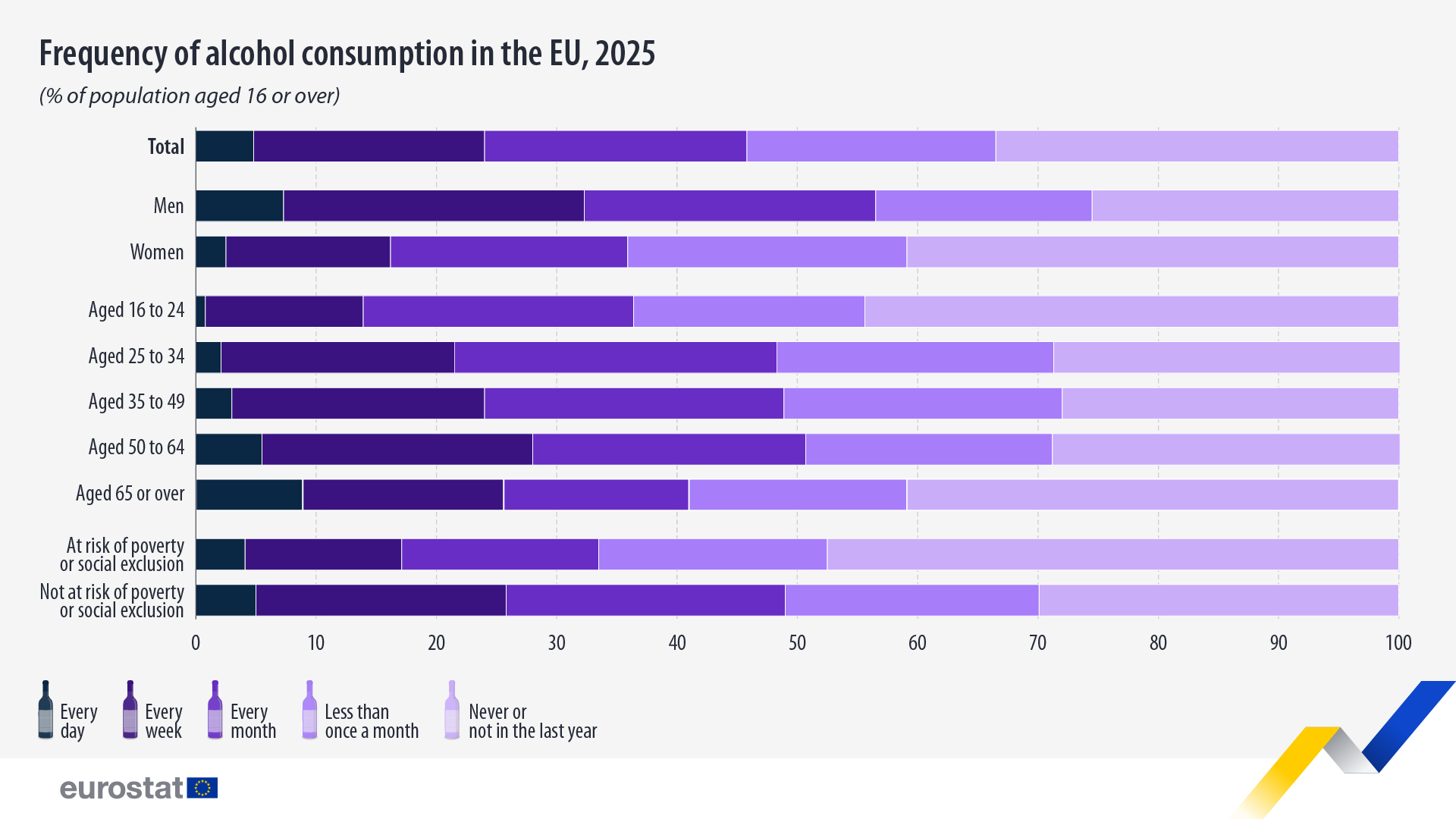
Most adults in the EU drink, but not often. In 2025, 4.8% of people aged 16 or over drank alcohol every day, 19.2% every week and 21.8% every month, according to Eurostat. Another 20.7% drank less than once a month, and 33.5% had never drunk alcohol or hadn’t done so in the past year.
That means 24.0% of EU adults drink at least once a week and 45.8% drink at least once a month (our calculation from Eurostat’s figures). So fewer than half of Europeans are regular monthly drinkers, which surprises a lot of people given Europe’s reputation for heavy drinking.
The figures come from the EU’s survey on income and living conditions, and the infographic by Eurostat above breaks them down by sex, age and poverty risk. The country figures below come from the same Eurostat dataset (ilc_hch23), updated on 20 October 2026.
Alcohol consumption by country
Daily drinking ranges from 16.0% of adults in Portugal to under 1% in Lithuania, Poland and Latvia. There are two ways to measure alcohol consumption by country, and they give quite different rankings. Eurostat’s survey asks people how often they drink, while the World Health Organization estimates how much pure alcohol is drunk per adult each year from sales, tax and production data.
The table shows both for every country Eurostat has 2025 data for, ranked by the share of people who drink every day. The UK is not in Eurostat’s survey, so only its WHO figure is shown.
| Country | Drink every day | Drink at least weekly | No alcohol in the past year | Litres of pure alcohol per adult (WHO) |
|---|---|---|---|---|
| EU | 4.8% | 24.0% | 33.5% | no WHO figure |
| Portugal | 16.0% | 32.5% | 37.0% | 13.7 |
| Italy | 7.9% | 32.3% | 45.1% | 8.4 |
| Belgium | 7.5% | 32.7% | 29.6% | 9.5 |
| Denmark | 7.5% | 35.5% | 10.7% | 9.5 |
| Netherlands | 6.3% | 32.5% | 24.5% | 8.6 |
| France | 5.9% | 35.5% | 28.3% | 11.2 |
| Spain | 5.6% | 29.7% | 33.9% | 12.1 |
| Albania (not in the EU) | 5.3% | 15.5% | 60.2% | 4.3 |
| Luxembourg | 4.7% | 24.8% | 29.0% | 11.4 |
| Malta | 4.7% | 22.4% | 44.9% | 7.6 |
| Bulgaria | 4.6% | 19.5% | 36.9% | 13.2 |
| Austria | 3.8% | 21.9% | 25.5% | 11.6 |
| Greece | 3.8% | 21.6% | 34.3% | 8.6 |
| Czechia | 3.4% | 16.9% | 22.7% | 13.5 |
| Croatia | 3.3% | 11.0% | 37.2% | 10.9 |
| Germany | 3.3% | 17.4% | 32.7% | 10.9 |
| Slovenia | 2.9% | 13.3% | 29.7% | 10.7 |
| Hungary | 2.1% | 7.8% | 45.6% | 11.4 |
| Cyprus | 1.9% | 18.0% | 42.9% | 4.9 |
| Serbia (not in the EU) | 1.9% | 7.5% | 56.9% | 11.2 |
| Slovakia | 1.8% | 8.0% | 35.9% | 9.1 |
| Romania | 1.6% | 12.1% | 38.7% | 17.1 |
| Ireland | 1.4% | 24.2% | 27.0% | 10.3 |
| Sweden | 1.2% | 21.3% | 22.2% | 8.7 |
| Estonia | 1.1% | 15.1% | 28.4% | 10.4 |
| Finland | 1.1% | 14.6% | 25.2% | 9.4 |
| Norway (not in the EU) | 1.1% | 20.8% | 18.6% | 7.0 |
| Latvia | 0.7% | 7.5% | 34.6% | 14.2 |
| Poland | 0.5% | 3.4% | 35.0% | 11.5 |
| Türkiye (not in the EU) | 0.5% | 2.5% | 89.0% | 2.2 |
| Lithuania | 0.4% | 5.2% | 37.3% | 11.2 |
| United Kingdom | no data | no data | no data | 10.4 |
Survey shares are for people aged 16 or over in 2025, from Eurostat ilc_hch23. Eurostat marks Czechia and Poland as low reliability and Lithuania as provisional. “At least weekly” adds the daily and weekly shares together (our calculation). Litres per adult are WHO’s total alcohol per capita estimates for people aged 15 or over (a three-year average to 2024, recorded plus unrecorded alcohol), from the WHO Global Health Observatory.
Which country drinks the most alcohol?
Romania drinks the most alcohol in Europe, with 17.1 litres of pure alcohol per adult a year in WHO’s latest estimate. Latvia (14.2 litres), Portugal (13.7), Czechia (13.5) and Bulgaria (13.2) come next, according to the WHO Global Health Observatory. Worldwide, only the US Virgin Islands (20.1 litres) had a higher figure than Romania.
The average across WHO’s European Region was 8.9 litres per adult, against 4.9 litres for the world as a whole, so Europe is still the heaviest drinking part of the world. The UK sits at 10.4 litres and the United States at 9.6.
A litre of pure alcohol is 100 UK units, because the NHS defines one unit as 10ml of pure alcohol. So the UK figure works out at about 20 units per adult a week and Romania’s at about 33 (our calculation). Those are averages across everyone aged 15 or over, including people who don’t drink at all, so drinkers themselves get through more.
How much a country drinks and how often its people drink are not the same thing. Romania tops the volume ranking, yet only 1.6% of Romanians drink every day and 38.7% didn’t drink at all in the past year. That points to fewer drinkers who drink more when they do. Italy is the opposite, with lots of daily drinkers (7.9%) but one of the lower volumes in the EU at 8.4 litres.
Where do people drink most often?
Portugal has the most daily drinkers in Europe by a wide margin, at 16.0% of adults in 2025, twice the share in Italy (7.9%), the next highest, Eurostat data shows. Belgium and Denmark (both 7.5%), the Netherlands (6.3%), France (5.9%) and Spain (5.6%) also come in above the EU average of 4.8%.
For weekly drinking, Denmark and France lead. In both, 35.5% of adults drink at least once a week, followed by Belgium (32.7%), the Netherlands and Portugal (both 32.5%) and Italy (32.3%) (our calculation). Denmark also has the fewest non-drinkers in the EU by far. Only 10.7% of Danes hadn’t drunk in the past year, against 33.5% across the EU.
Daily drinking is a southern and western European habit that often goes with wine at meals. Northern and eastern countries drink less often. In Finland, Estonia, Sweden and Norway only around 1% of adults drink every day.
Which countries drink the least alcohol?
Türkiye has the most non-drinkers of any country in Eurostat’s data, with 89.0% of adults not drinking alcohol in the past year. Albania (60.2%) and Serbia (56.9%) come next, Eurostat reports. Türkiye also has one of the lowest volumes in the WHO data, at 2.2 litres of pure alcohol per adult.
Inside the EU, Hungary (45.6%), Italy (45.1%), Malta (44.9%) and Cyprus (42.9%) have the highest shares of people who didn’t drink in the past year. Cyprus also has the lowest volume of any EU country in WHO’s figures, at 4.9 litres per adult, followed by Malta (7.6 litres).
The lowest daily drinking rates in the EU are in Lithuania (0.4%), Poland (0.5%) and Latvia (0.7%). Latvia shows again why frequency and volume tell different stories, as it has the second highest volume in Europe at 14.2 litres per adult.
Beer, wine or spirits by country
Beer is the main drink in most of central Europe, wine in the south and spirits play a bigger part in the east. The WHO’s recorded consumption figures by drink type for 2024 show the split clearly.
- Czechia recorded 12.5 litres of pure alcohol per adult, and 6.5 litres of it came from beer, the highest beer figure in the EU.
- In Germany, beer made up 4.7 of 10.4 litres.
- Portugal recorded 6.8 litres from wine out of 12.7, Italy 5.3 out of 7.8 and France 5.1 out of 9.9.
- Poland drank 5.0 litres from beer and 4.0 from spirits, but only 0.8 litres from wine.
- In Romania, spirits made up 3.9 of 12.2 litres, with beer at 4.9 and wine at 3.4.
- The UK was more evenly split, with 3.3 litres from beer, 2.8 from wine and 2.2 from spirits out of 8.8.
These are recorded figures only, from tax, production and sales data, so they are a little lower than the WHO totals in the table, which also estimate untaxed home-made alcohol and cross-border buying.
Do men drink more than women?
Yes. In 2025, 56.5% of men in the EU drank alcohol at least once a month, compared with 35.9% of women, Eurostat says. Men were almost three times as likely to drink every day (7.3% against 2.5%).
The gap shows at the other end too. 40.9% of women hadn’t drunk alcohol in the past year, against 25.5% of men, according to Eurostat’s data.
How drinking changes with age
Daily drinking rises steadily with age. Only 0.8% of 16 to 24 year olds in the EU drank every day in 2025, compared with 8.9% of people aged 65 or over, Eurostat reports. The share was 2.1% for 25 to 34 year olds, 3.0% for 35 to 49 year olds and 5.5% for 50 to 64 year olds.
Young people are also the most likely not to drink at all. 44.4% of 16 to 24 year olds hadn’t drunk in the past year, compared with 28.0% of 35 to 49 year olds, the age group with the fewest non-drinkers. Older people swing back the other way, and 47.2% of people aged 75 or over didn’t drink in the past year, Eurostat’s data shows.
So the typical pattern is that younger adults drink less often and older adults who do drink are more likely to have one every day.
Does income affect whether people drink?
People with less money are more likely not to drink. 47.5% of people at risk of poverty or social exclusion in the EU hadn’t drunk alcohol in the past year, compared with 29.9% of people not at risk, Eurostat says. Weekly drinking was also lower among people at risk (13.0% against 20.8%), while daily drinking was close for both groups (4.1% against 5.0%).
Is drinking falling in Europe?
Yes, slowly. Daily drinking in the EU fell from 6.7% of adults in 2022 to 4.8% in 2025, and the share who hadn’t drunk in the past year rose from 31.2% to 33.5%, according to Eurostat. The 2022 EU figures are Eurostat estimates, as there is no 2022 figure for Germany.
Daily drinking fell in 23 of the 30 countries with data for both years (our calculation). The biggest drops were in Italy (12.0% to 7.9%) and Portugal (19.3% to 16.0%). It rose slightly in Bulgaria, Latvia, Malta and Serbia.
The longer-term trend in volume points the same way. WHO’s estimate for its European Region fell from 11.1 litres of pure alcohol per adult in 2000 to 8.9 litres in 2024, and the UK’s from 12.3 to 10.4 litres, according to the WHO Global Health Observatory. Not every country has followed. Portugal was back at 13.7 litres in 2024, the same as in 2000.
It’s a similar story in the United States. 54% of American adults said they drink alcohol in 2026, matching 2025’s record low in a trend going back to 1939, and 17% said they had swapped some alcohol for non-alcoholic drinks, Gallup found.
How much alcohol is too much?
In the UK, men and women are advised not to drink more than 14 units a week on a regular basis, the NHS says. That is about 6 pints of average-strength beer or 10 small glasses of lower-strength wine. If you regularly drink as much as 14 units a week, the NHS advises spreading it over 3 or more days, and having several drink-free days each week if you want to cut down.
The UK’s average of about 20 units per adult a week (our calculation from WHO’s figure) is well above that guideline, even with non-drinkers counted in the average.
Questions about alcohol consumption in Europe
Which country drinks the most alcohol in Europe?
Romania, with 17.1 litres of pure alcohol per adult a year in WHO’s latest estimate. Latvia, Portugal, Czechia and Bulgaria come next. If you measure how often people drink instead, Portugal leads, with 16.0% of adults drinking every day.
What percentage of Europeans drink alcohol every day?
4.8% of people aged 16 or over in the EU drank alcohol every day in 2025, according to Eurostat. It was 7.3% for men and 2.5% for women.
What percentage of people in the EU don’t drink alcohol?
33.5% of EU adults had never drunk alcohol or hadn’t done so in the past year in 2025. The share ranged from 10.7% in Denmark to 45.6% in Hungary.
Which European country drinks the least alcohol?
Türkiye, where 89.0% of adults didn’t drink in the past year and WHO estimates 2.2 litres of pure alcohol per adult. Inside the EU, Cyprus has the lowest volume (4.9 litres) and Hungary the most non-drinkers (45.6%).
Does the UK drink more than the rest of Europe?
The UK drinks a little more than the European average by volume. WHO estimates 10.4 litres of pure alcohol per adult in the UK, against 8.9 litres across its European Region. Several EU countries drink more, including Romania, Latvia, Portugal, Czechia, Bulgaria, Spain, France and Germany.
Are young people drinking less?
Young Europeans drink less than older ones. In 2025, 44.4% of 16 to 24 year olds in the EU hadn’t drunk alcohol in the past year and only 0.8% drank every day, according to Eurostat.
How many units of alcohol a week is safe?
The NHS advises men and women not to drink more than 14 units a week on a regular basis, spread over 3 or more days. That is about 6 pints of average-strength beer or 10 small glasses of lower-strength wine.
Sources
- Eurostat, 5% of Europeans consumed alcohol daily in 2025, news article, 28 September 2026, which carries the infographic
- Eurostat, Person distribution by frequency of alcohol consumption, sex, age and risk of poverty or social exclusion situation (ilc_hch23), updated 20 October 2026
- Eurostat, Key figures on European living conditions, 2026 edition
- World Health Organization, Global Health Observatory, Alcohol, total per capita (15+) consumption (SDG indicator 3.5.2) and Alcohol, recorded per capita (15+) consumption by beverage type
- NHS, Alcohol units
- Gallup, Americans’ Drinking Remains at Record Low, 20 August 2026
Eurostat material is reused under the Creative Commons Attribution 4.0 licence set out in Eurostat’s copyright notice. The infographic is shown unchanged. Figures marked as our calculation were worked out by us from Eurostat or WHO data, and neither Eurostat nor the WHO is responsible for them.